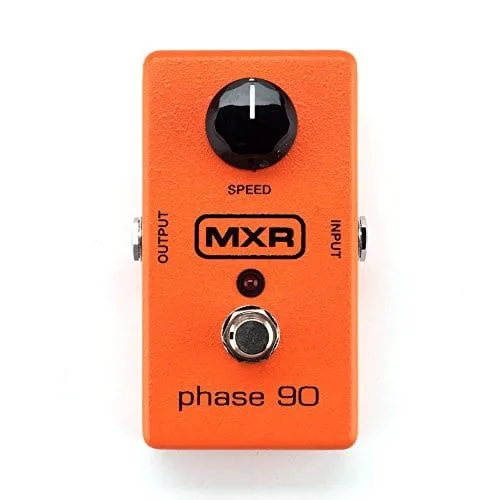
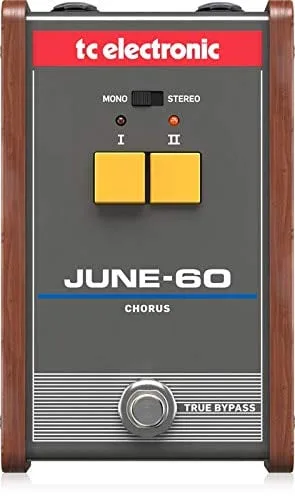
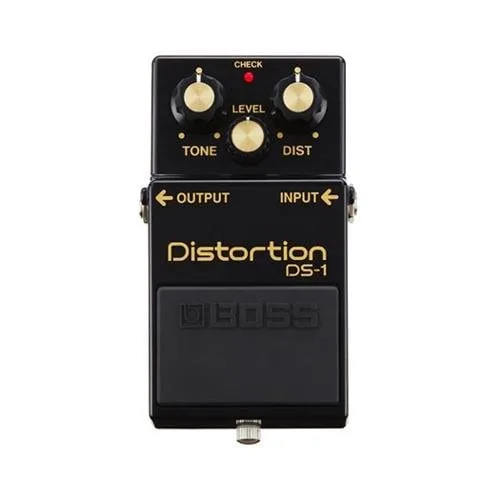
Budget pedals earn their place on a pedalboard by doing one job well for years without costing much. This page compares five of the long-running affordable options players keep reaching for: the MXR Phase 90, the BOSS DS-1 Distortion 40th Anniversary Edition, the TC Electronic June-60, the MXR Dyna Comp and the Pro Co RAT. Each has stayed in production or in circulation long enough that the press has weighed in on it, and each represents a different way of reaching a low price: a simple classic circuit, a modern redesign, a clone of a vintage unit, or a mass-produced platform players modify themselves.
The pedals side by side
| Pedal | Maker | Effect type |
|---|---|---|
| MXR Phase 90 | MXR | Phaser |
| BOSS DS-1X 40th Anniversary Edition | Boss | Distortion |
| TC Electronic June-60 | TC Electronic | Chorus |
| MXR Dyna Comp | MXR | Compressor |
| Pro Co RAT2 | Pro Co | Distortion |
The set spans the main effect families a first pedalboard needs: phaser, distortion, chorus and compressor. Two of the five are drive pedals, which reflects where budget buyers usually start.
What actually differs between them
The biggest difference between these pedals is not price but circuit origin. Three approaches show up in this group.
The modern redesign. The BOSS DS-1X looks back at the original BOSS overdrive and distortion classics but does not reuse them. In his demo video, Pete Thorn was explicit about this point1:
"these obviously uh resemble some boss Classics from the past uh the original od1 and DS1 uh but make no mistake these"1
The quote cuts off, but the direction is clear: the anniversary pedal is its own design, not a reissue of the DS-1 circuit players have known for decades. For a buyer comparing distortions, that matters, because the DS-1X is not simply a more expensive DS-1 with a coat of paint. Thorn's demo walks through what the new circuit does, and it is worth watching in full for anyone deciding between the anniversary model and the standard one1.
The clone. The TC Electronic June-60 takes the opposite approach. Writing about the Klark Teknik 3rd Dimension, a clone of the Roland Dimension D, Gearnews' Lasse Eilers pointed readers toward the June-60 as2:
"there's always the June-60 pedal from sister company TC Electronic, another Roland chorus clone from the same period"2
So where the DS-1X is a new circuit wearing a vintage face, the June-60 is a Roland chorus clone from the same period. That is the classic budget-pedal proposition: the sound of a sought-after older box without the vintage market's prices. Players who want the full picture on this family of effects can read more on the chorus pedals type page21.
The value workhorse. The Pro Co RAT2 sits in a third position: a circuit that has simply stayed cheap while doing its job. Pedal of the Day's Scott S reviewed it in September 2014 and was blunt about the money question3:
"how good value for money these pedals are. Considering all of the above, and their cost, they can't be matched."3
That is a reviewer's verdict on the RAT line as a budget distortion, and it is the argument that keeps long-running budget pedals on shelves: the circuit is settled, the production is efficient, and the price stays low without the reviewer finding the quality drops with it.
The even cheaper tier: pedals as a modding platform
Below the established budget brands sits an even lower price tier, and the Behringer UV300 Ultra Vibrato is a good example of how players treat it. Coda Effects, whose author writes technical breakdowns of pedal circuits, put the price plainly4:
"this pedal is very cheap an costs around 25 euros"4
That is a European price as stated, not a US conversion. What makes the UV300 interesting for this comparison is not just the price but what Coda Effects did with it: a full tutorial on modding the pedal, treating a very cheap vibrato unit as a platform a player can open up and change. That is one honest answer to how long inexpensive pedals last: even if a cheap pedal is a starting point rather than a keeper, it can be a working platform for learning what is inside a distortion or modulation circuit, and the modding route is well documented in the press4.
Controls, power and what to check next
Controls and power details for each of these pedals live on their individual pages, since each maker specifies its own switching, bypass and power arrangement. For players building outward from this set, the natural next comparisons are the distortion pedals roundup, the Tube Screamer-style overdrives for the drive side, and the first guitar pedals cheat sheet for how these effect types fit together on a starter board.
Questions
Are cheap guitar pedals worth buying?
Published reviewers have said yes for the long-running budget options. Reviewing the Pro Co RAT2, Pedal of the Day concluded that considering everything the pedal does and its cost, the value for money can't be matched. Cheap pedals can also be a starting point for modification, as Coda Effects showed with a tutorial on modding the Behringer UV300 vibrato.
Are budget pedals clones of more expensive circuits?
Some are and some are not. Gearnews describes the TC Electronic June-60 as a Roland chorus clone from the same period as the Klark Teknik 3rd Dimension. On the other side, Pete Thorn noted that while the BOSS DS-1X resembles the original DS-1, it is a brand new design rather than the original circuit.
Sources (4)
- Boss OD1x and DS1x, demo by Pete Thorn, YouTube (Pete Thorn channel), 2014-04-07
- Klark Teknik 3rd Dimension BBD-320: a clone of the Roland Dimension D, gearnews.com, 2020-01-04
- Pro Co RAT2 Distortion, Pedal of the Day (pedal-of-the-day.com), 2014-09-10
- Coda Effects, Coda Effects (www.coda-effects.com), 2018-01