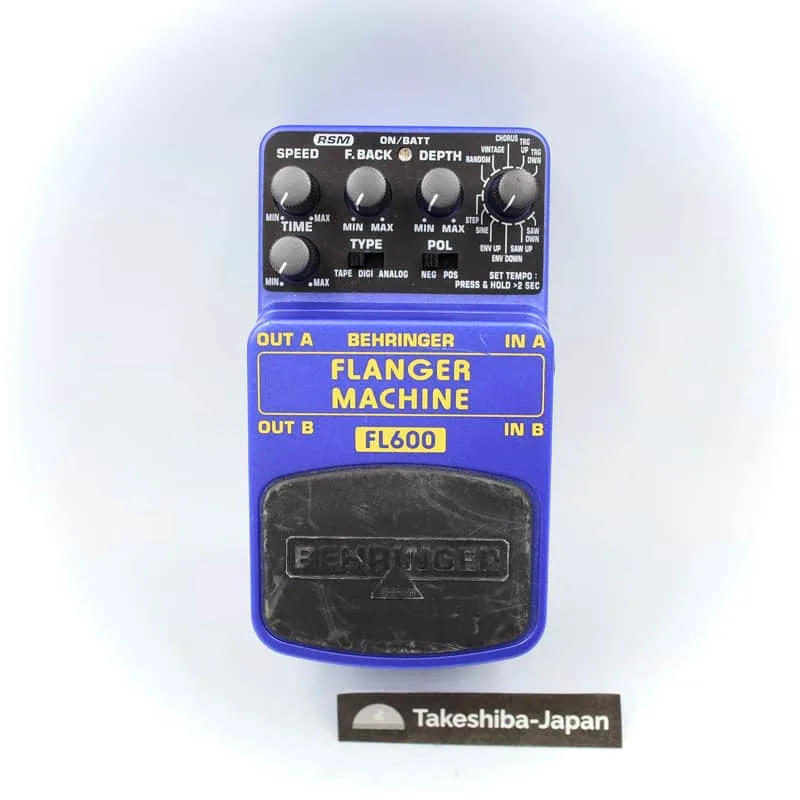
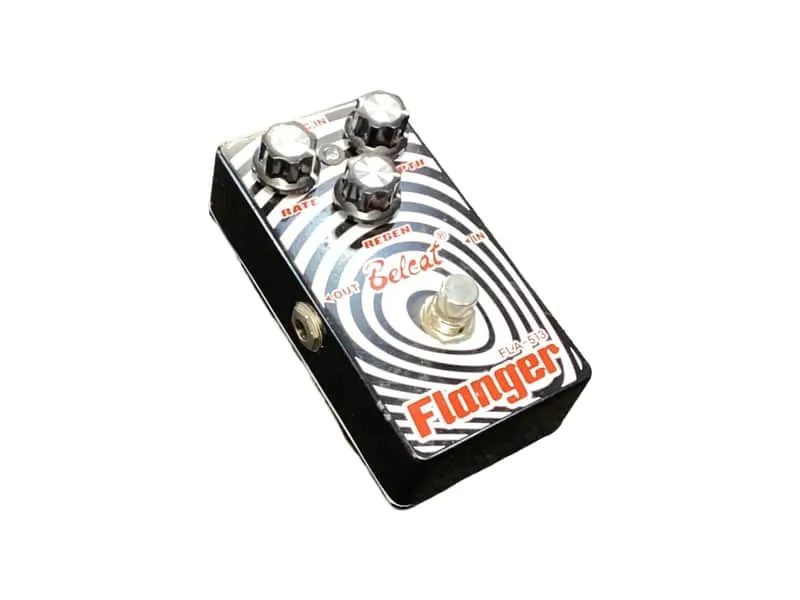
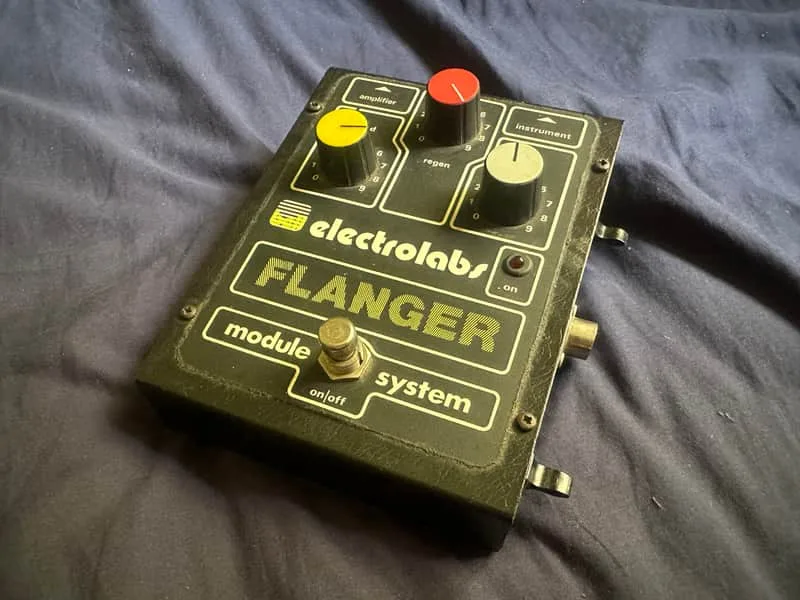
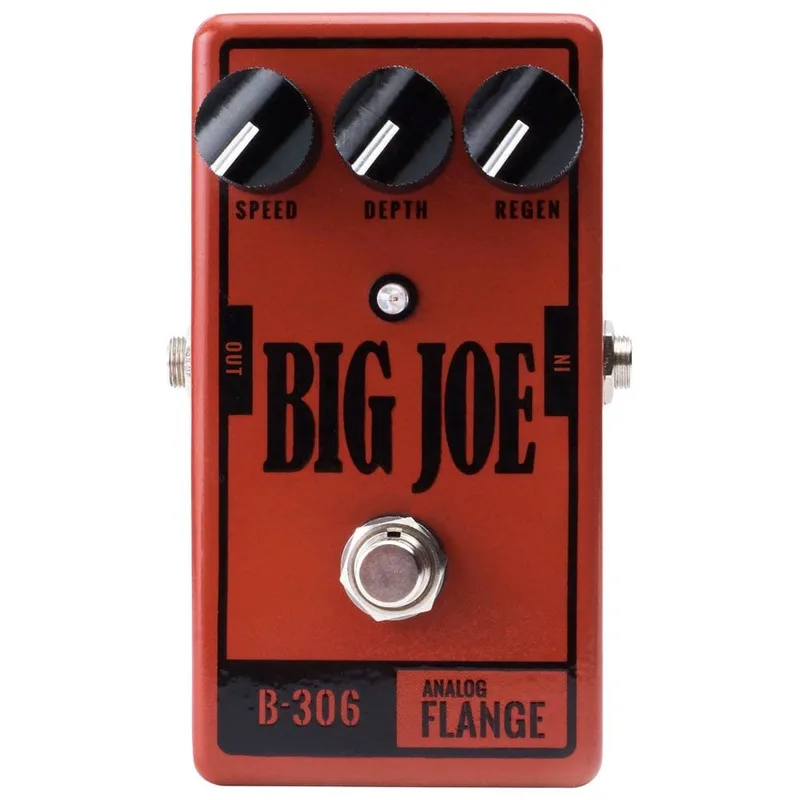
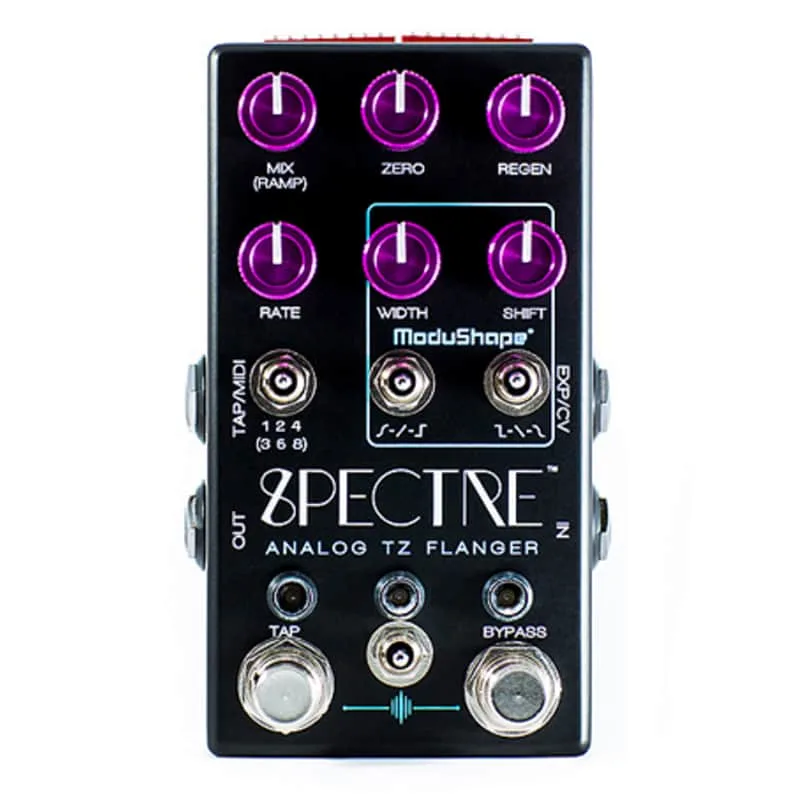
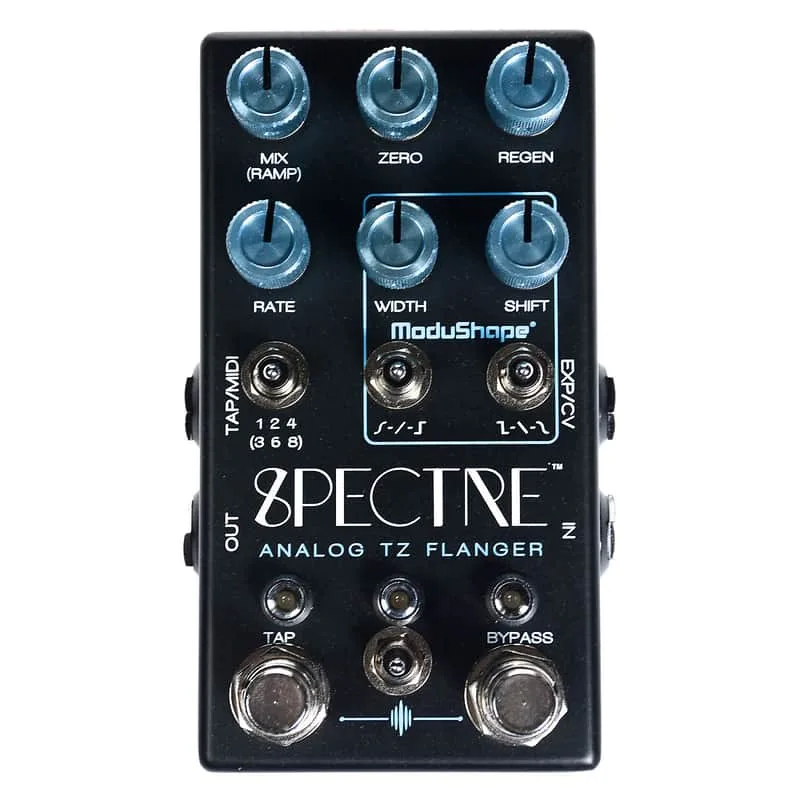
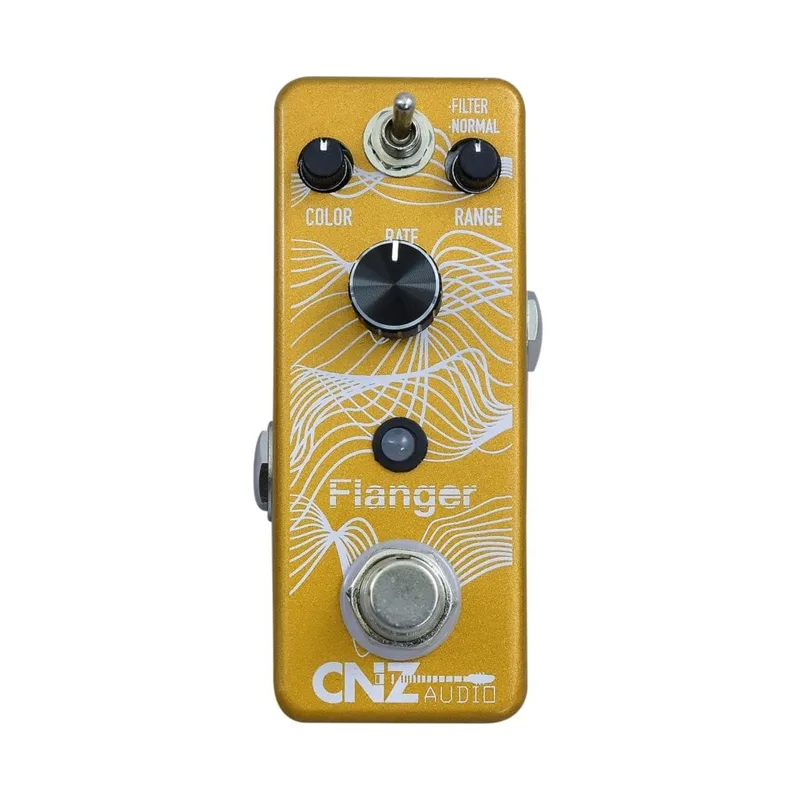
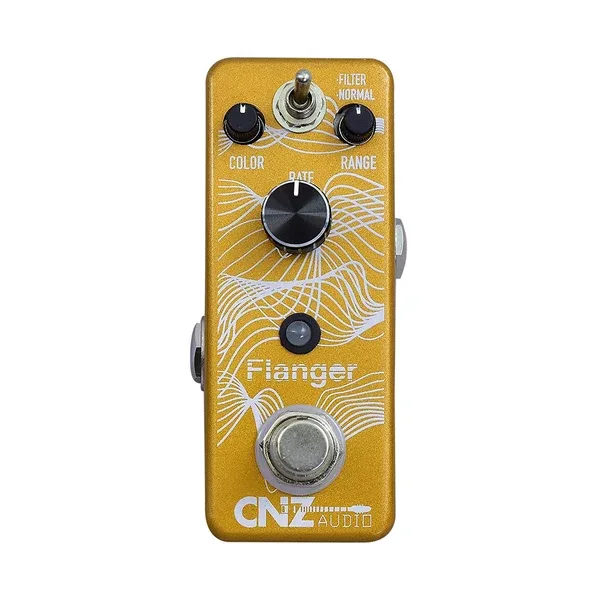
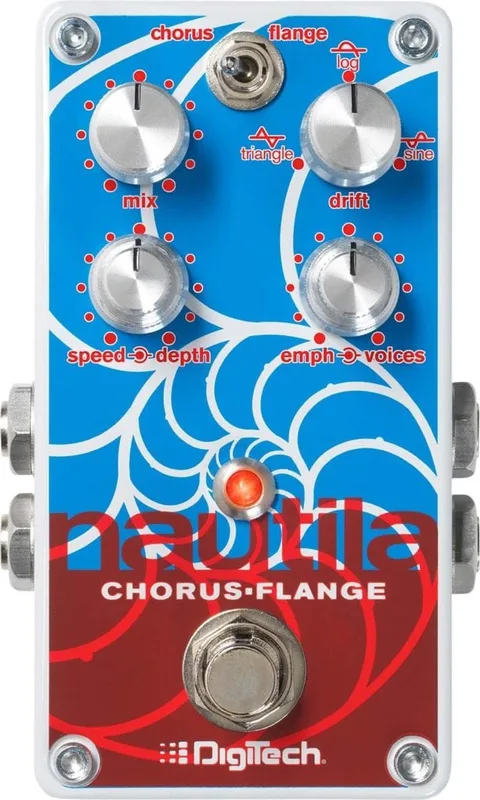
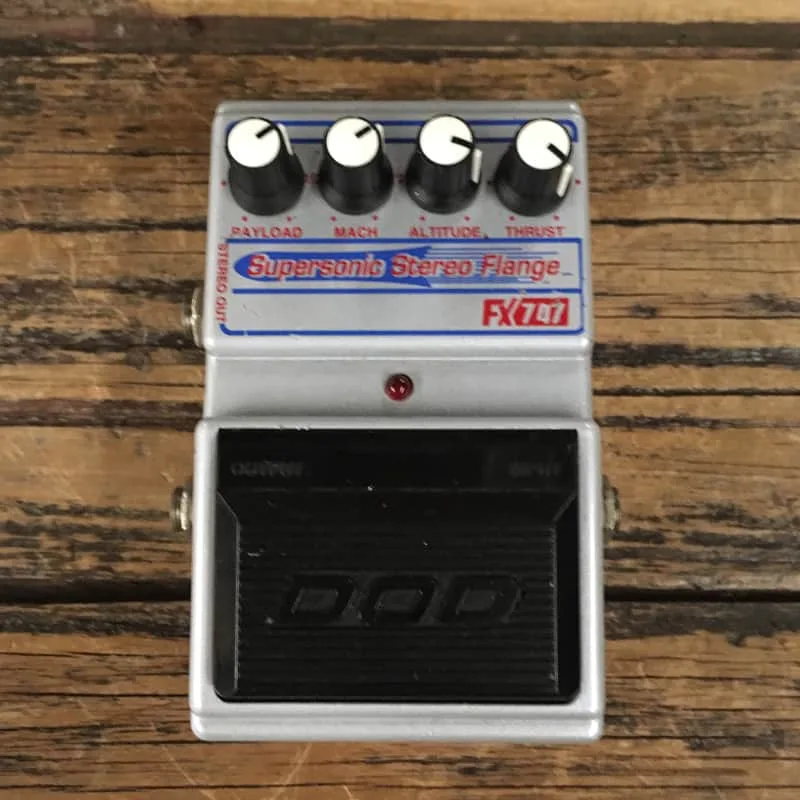
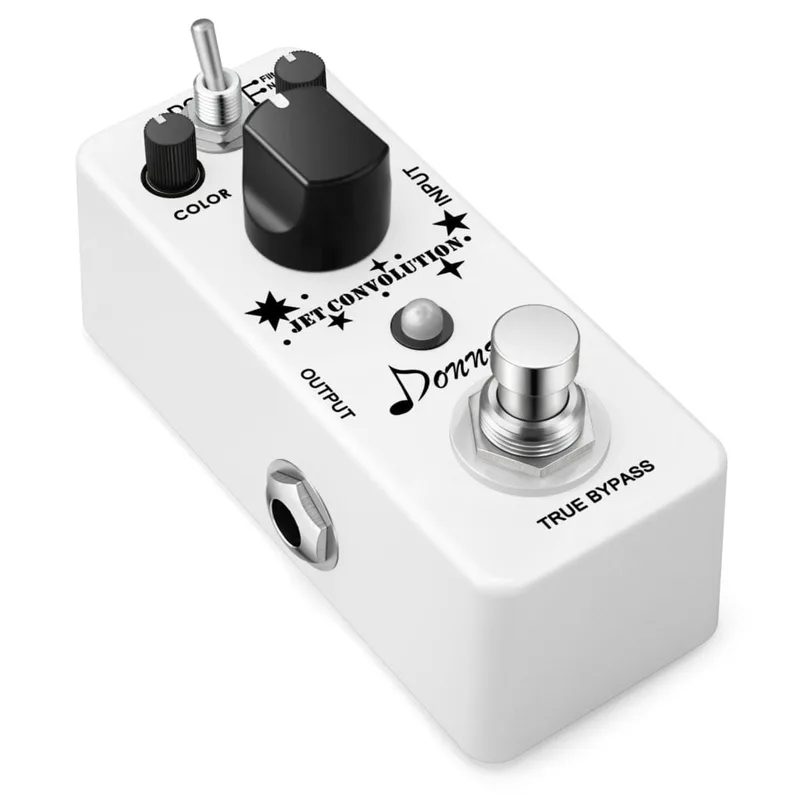
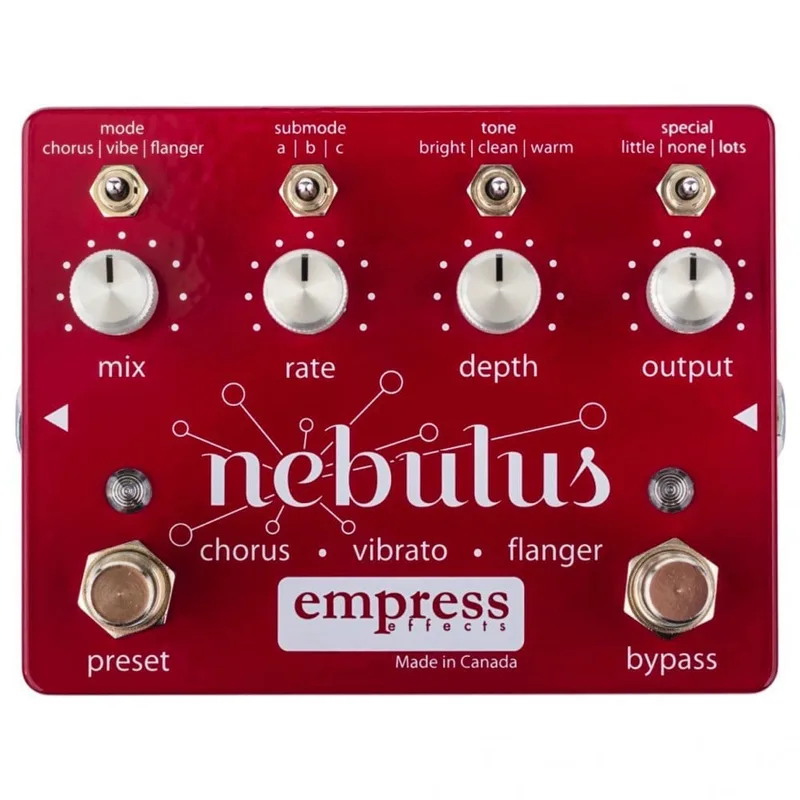
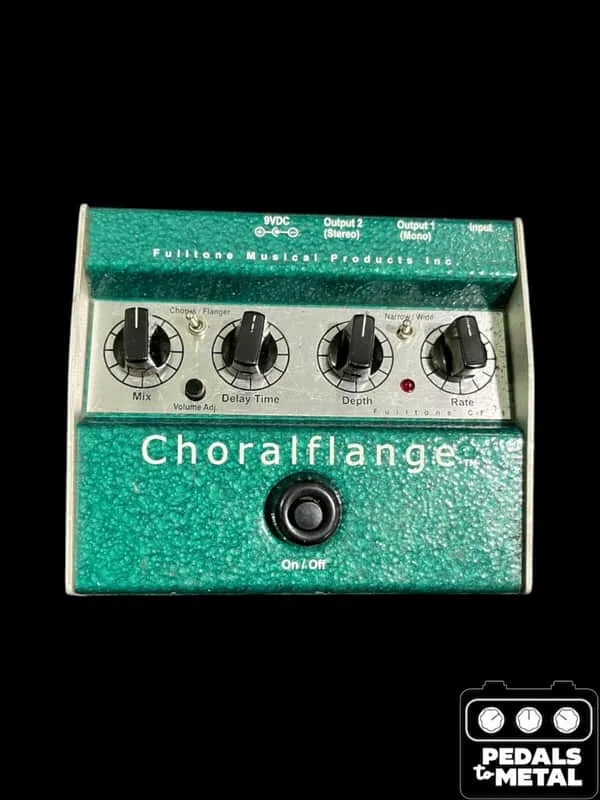
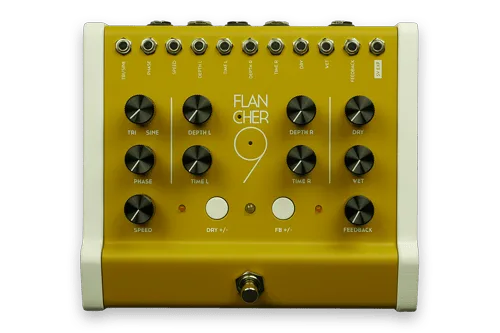
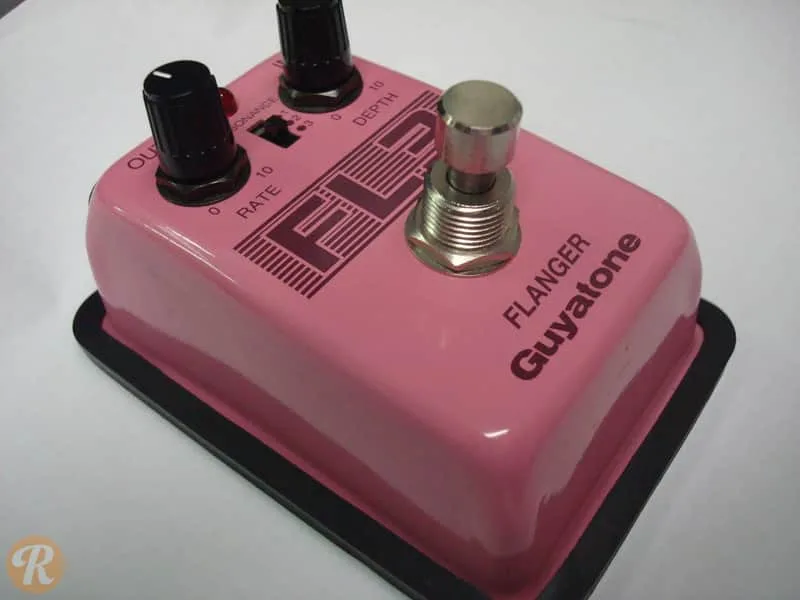
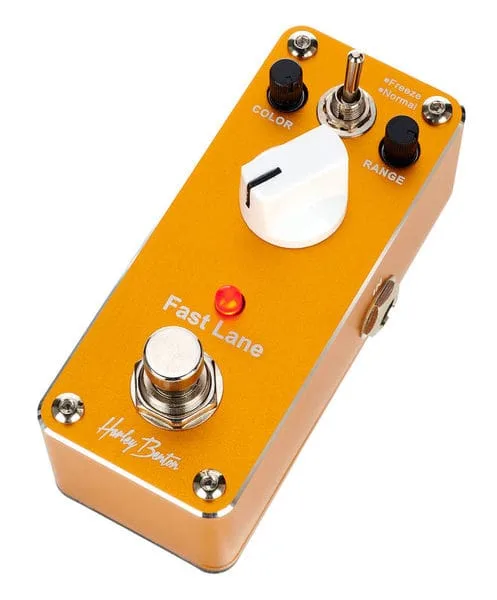
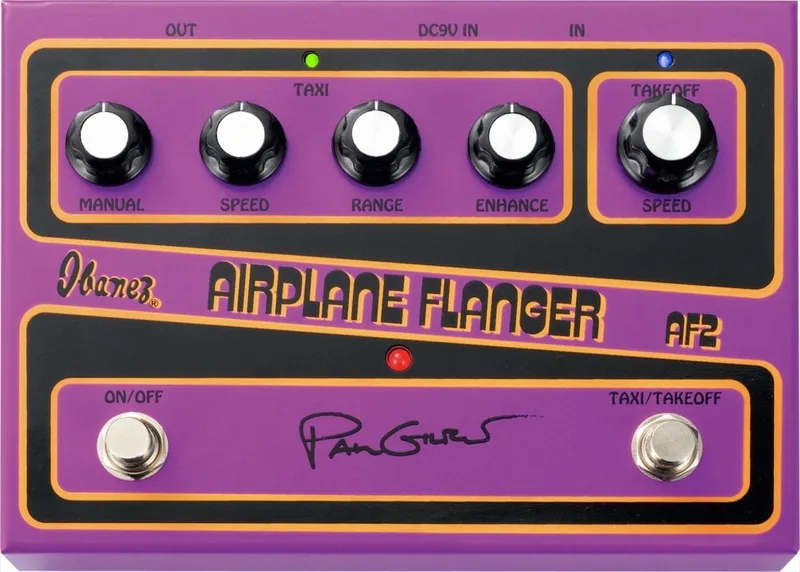
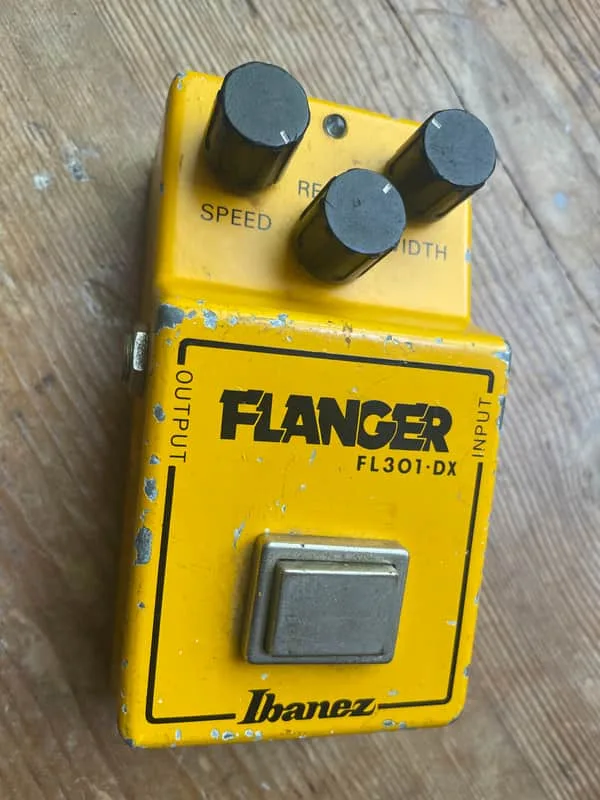
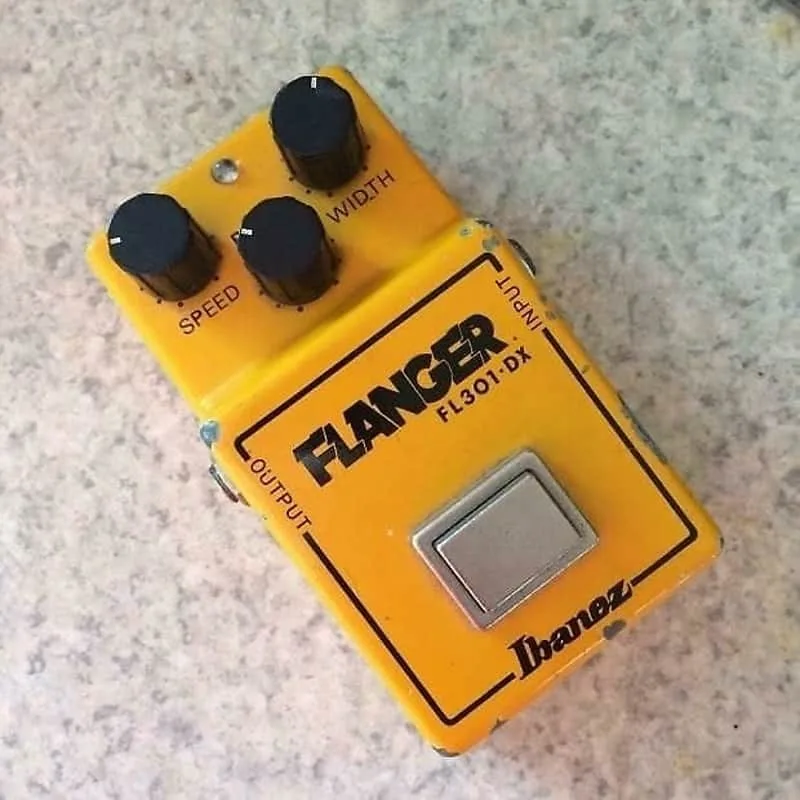
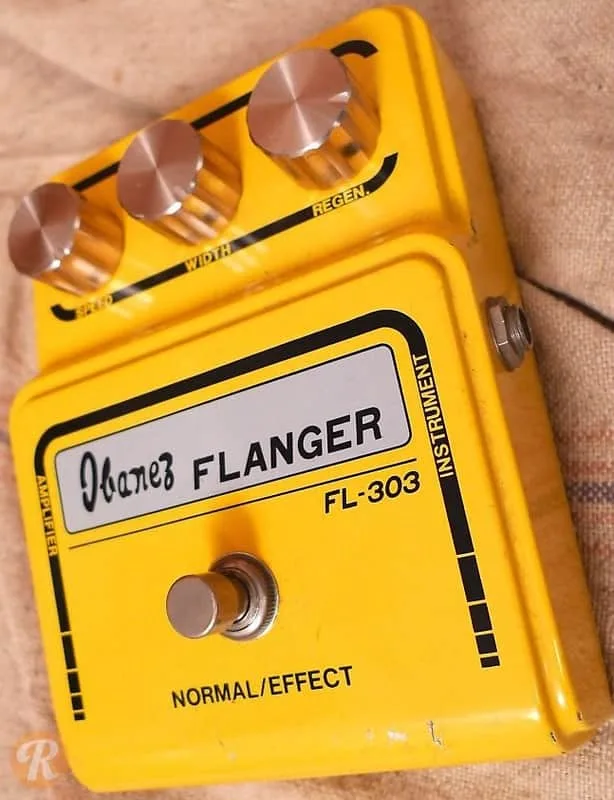
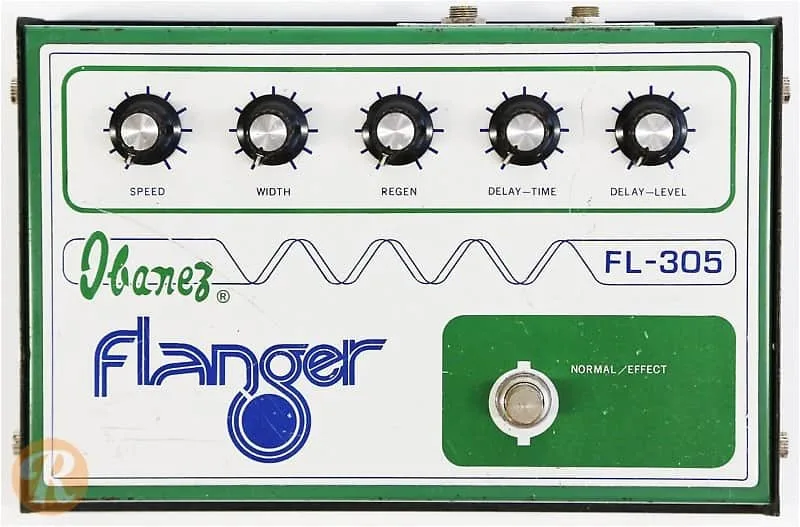
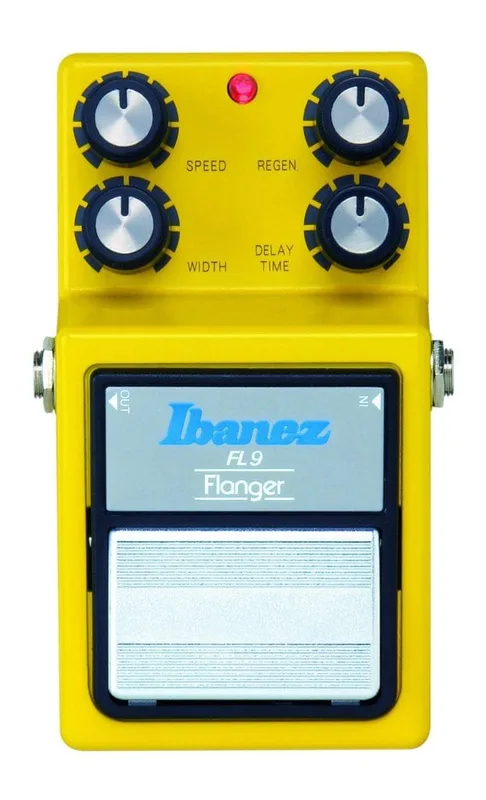
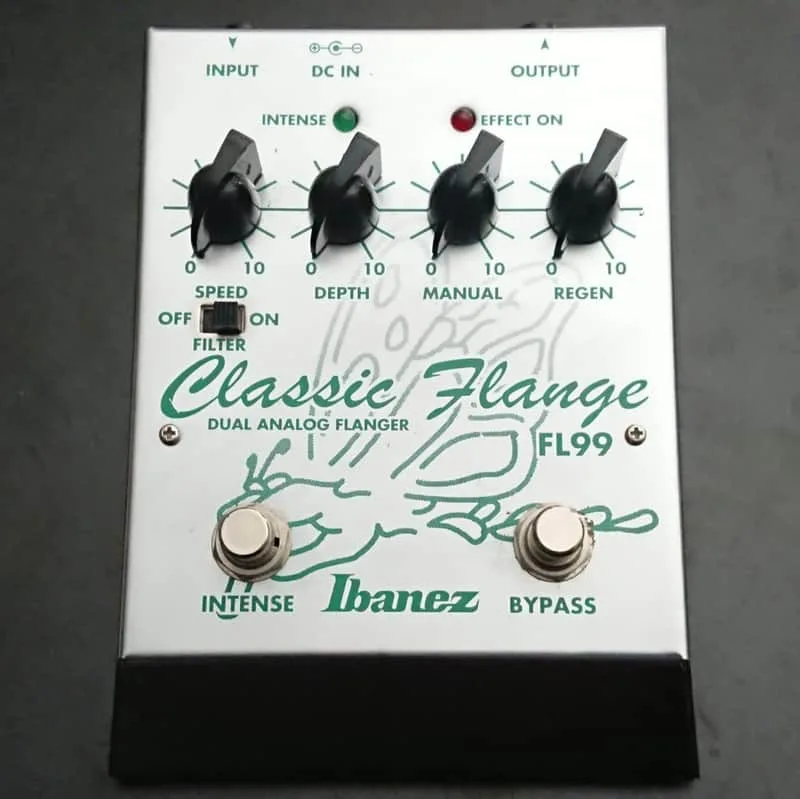
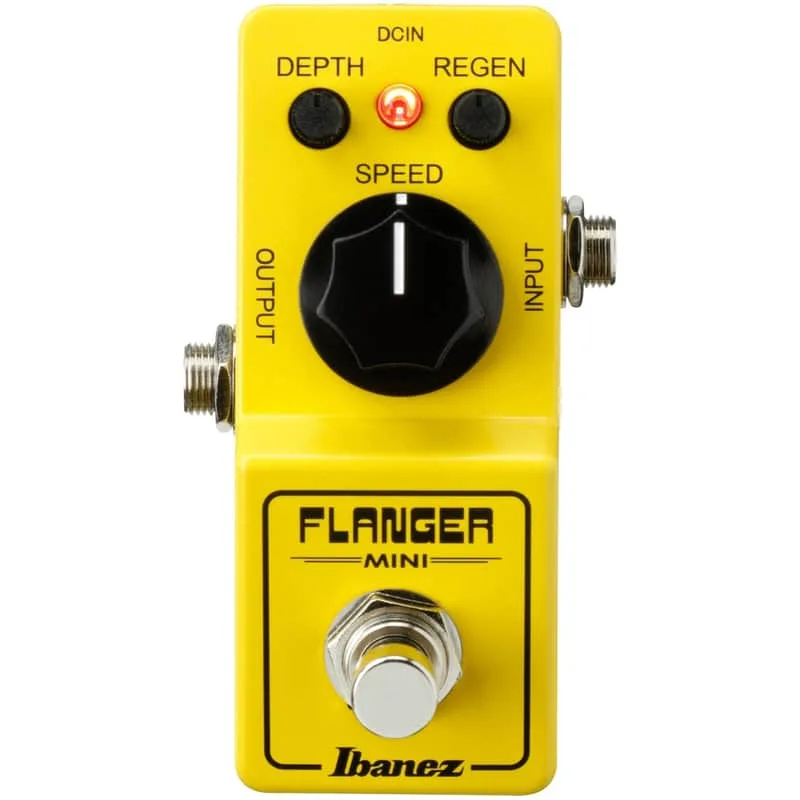
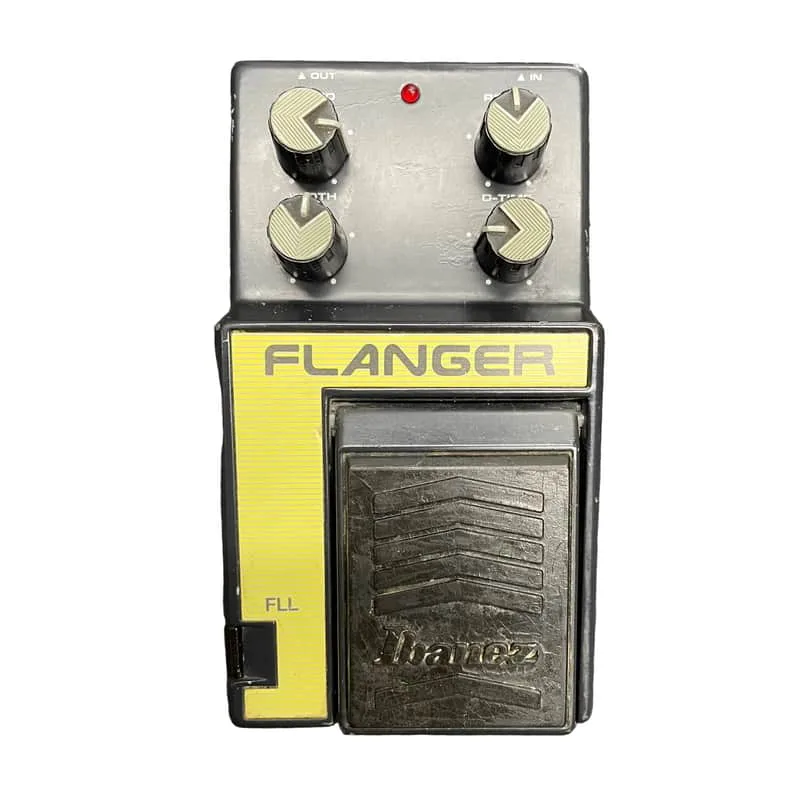
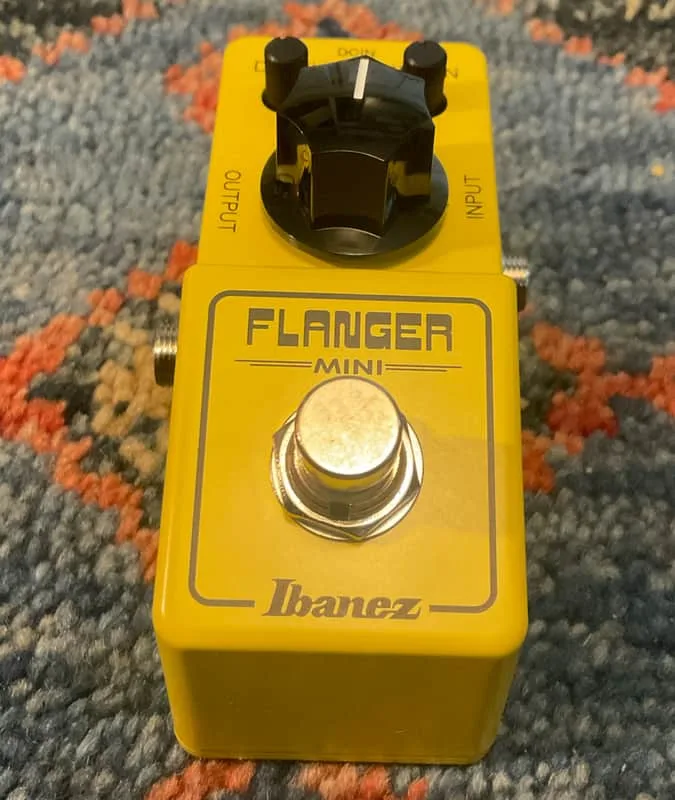
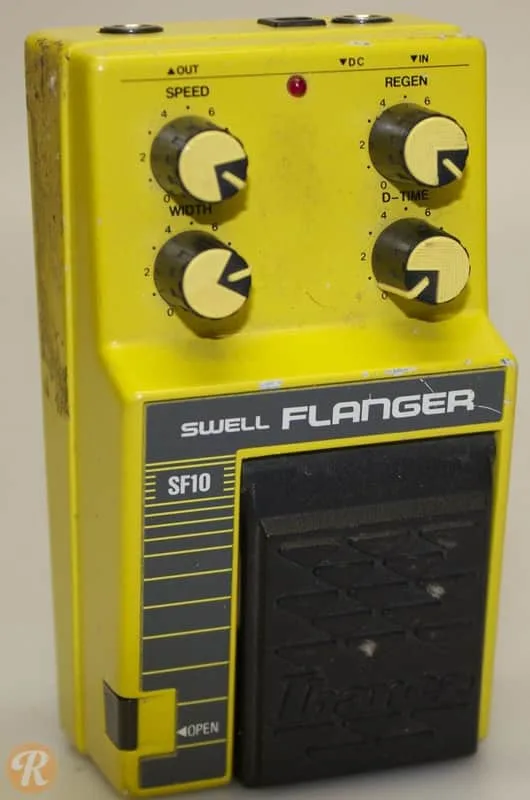
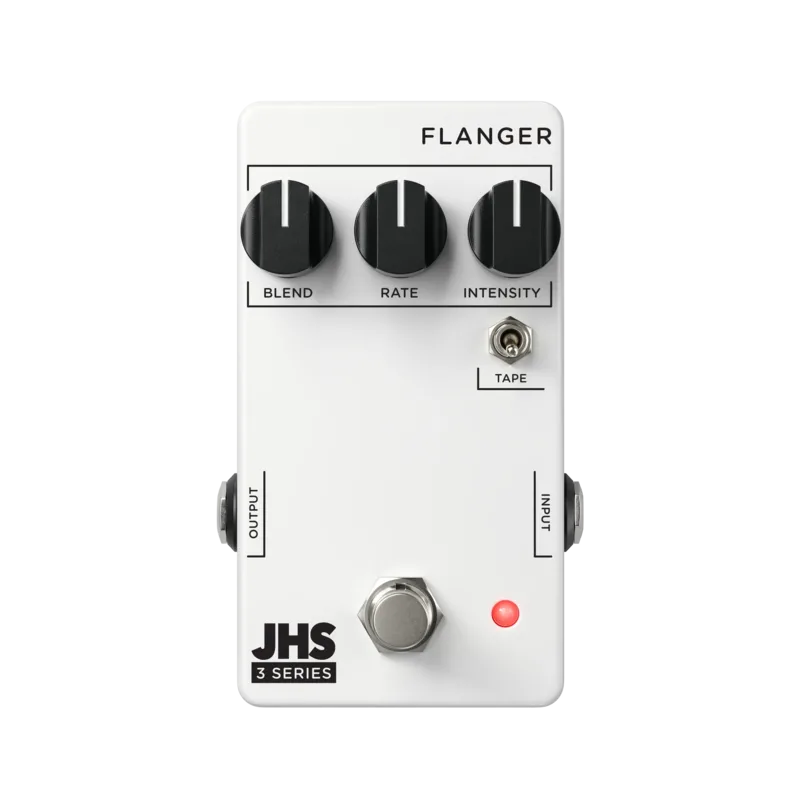
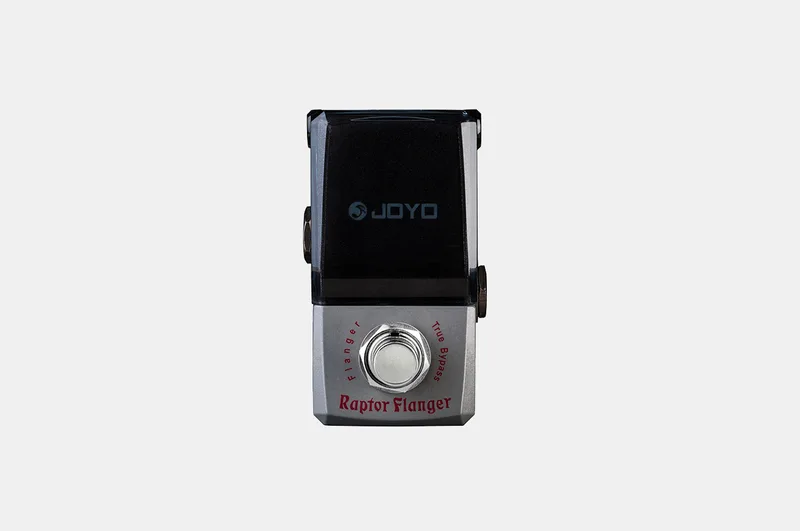
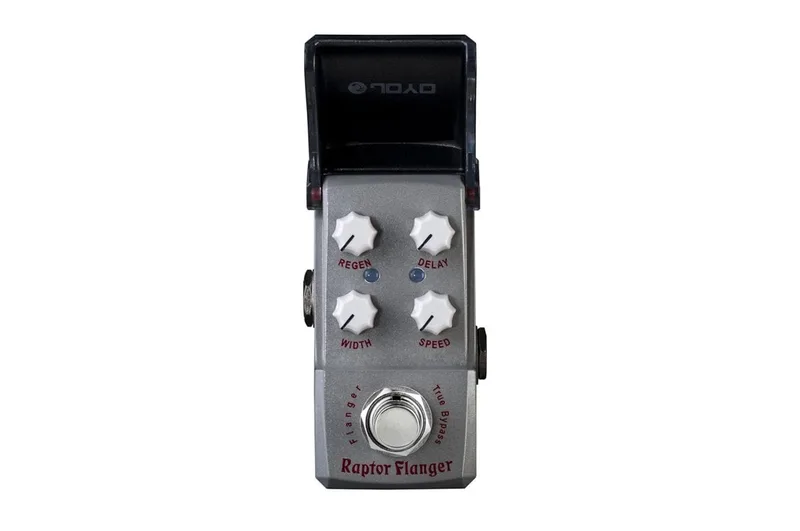
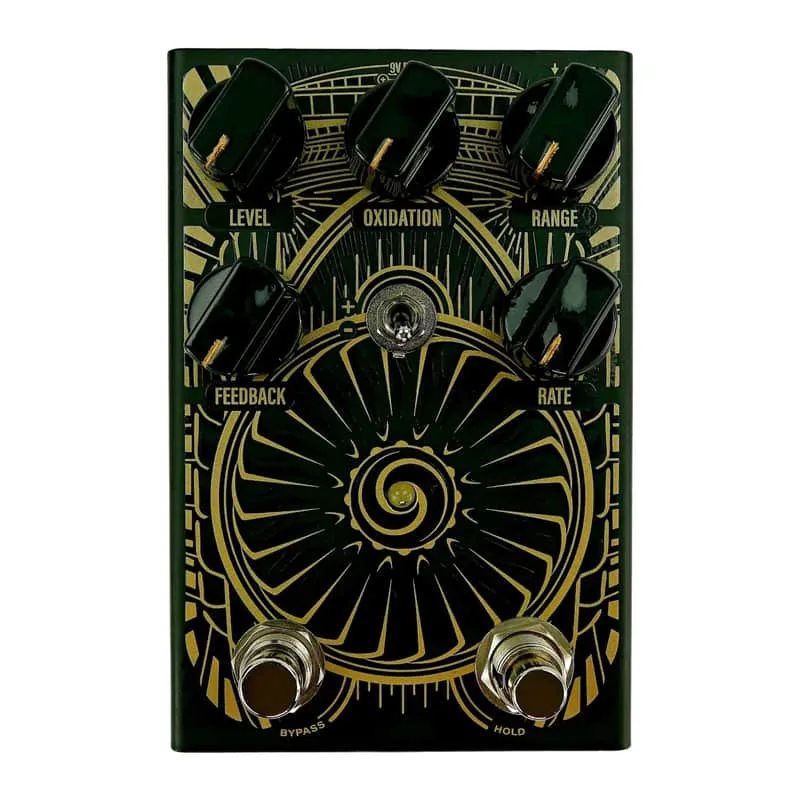
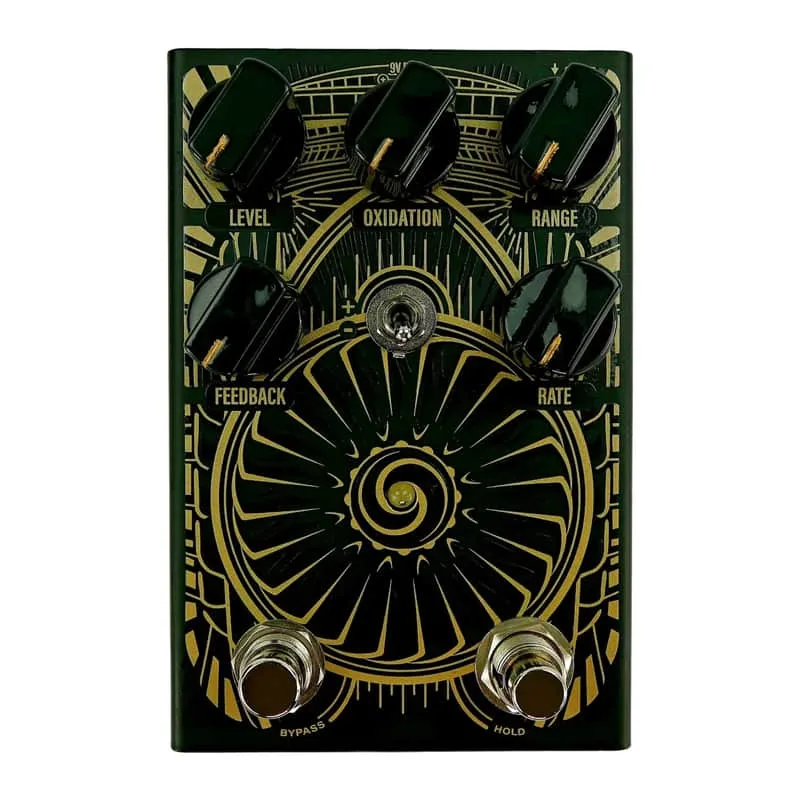
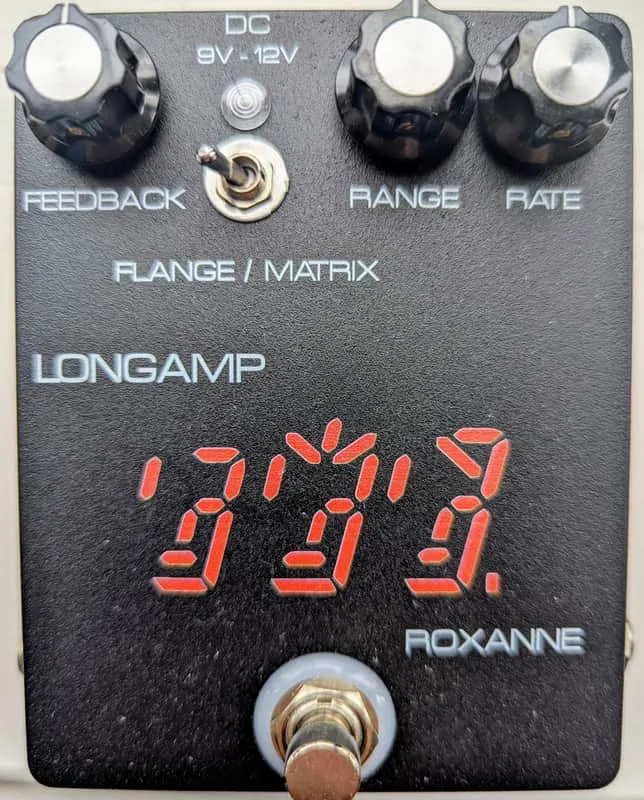
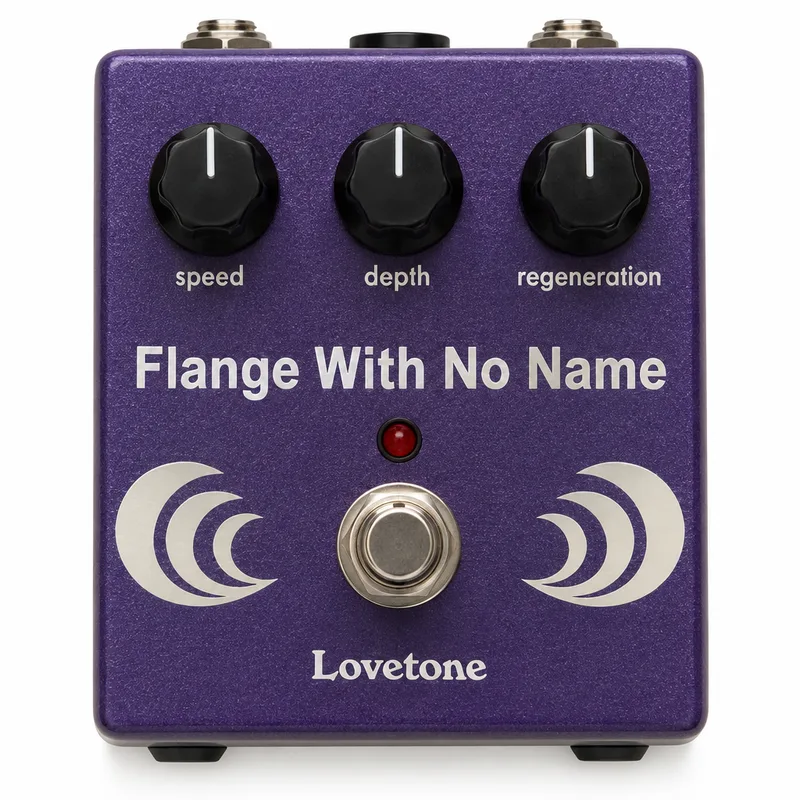
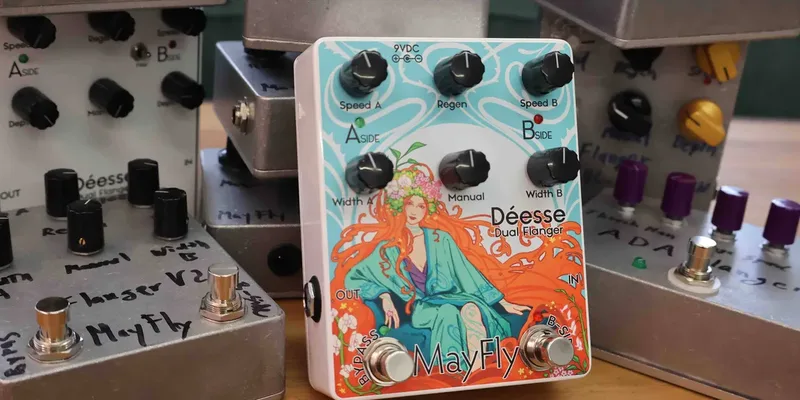
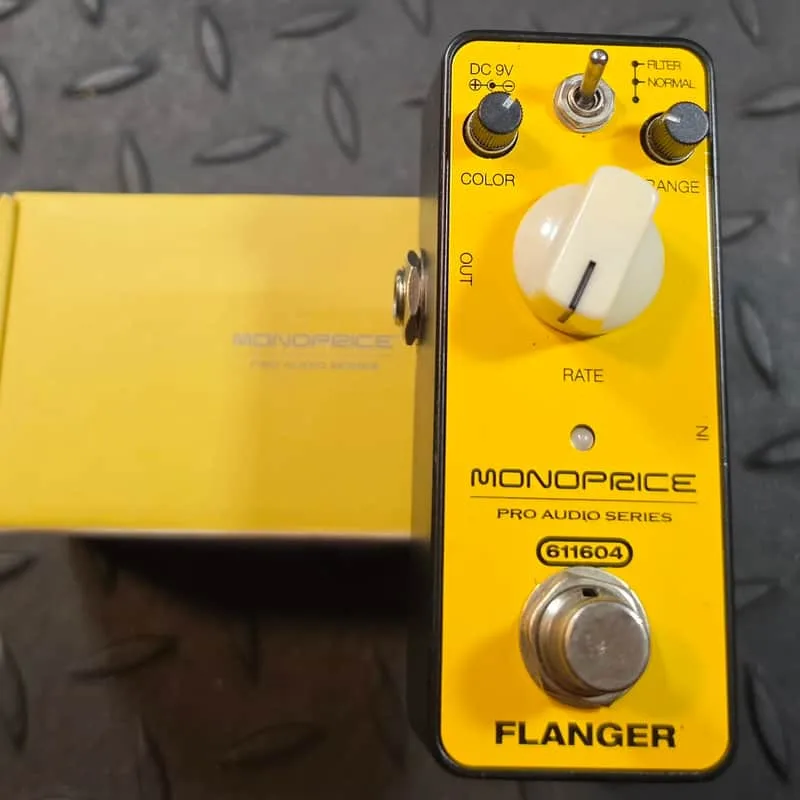
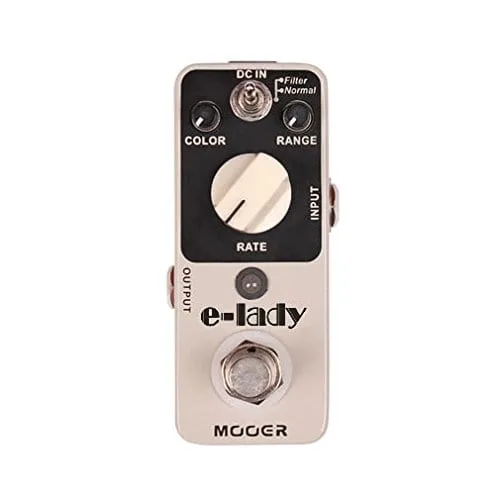
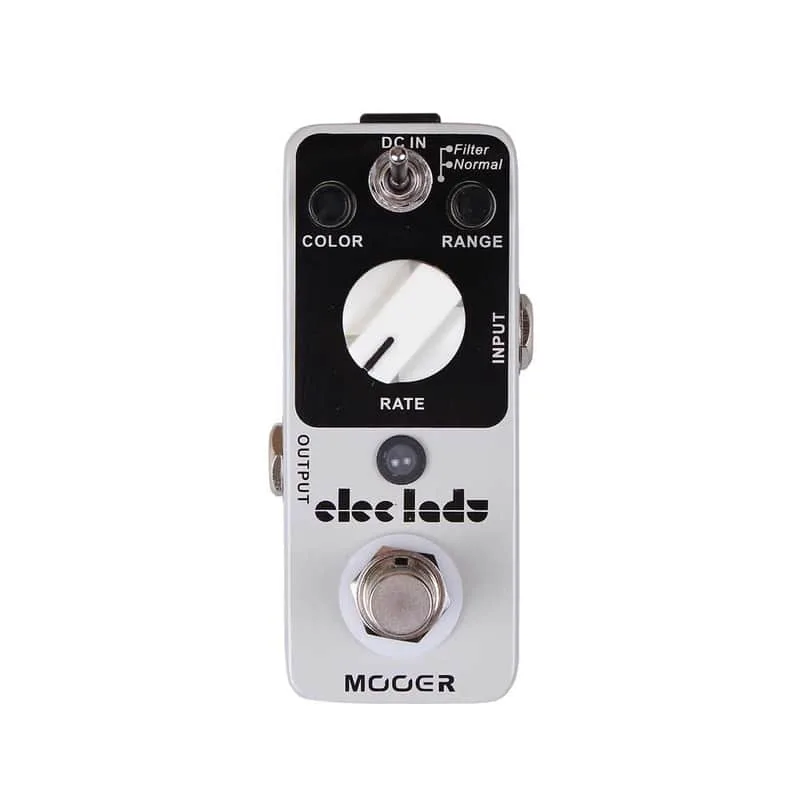
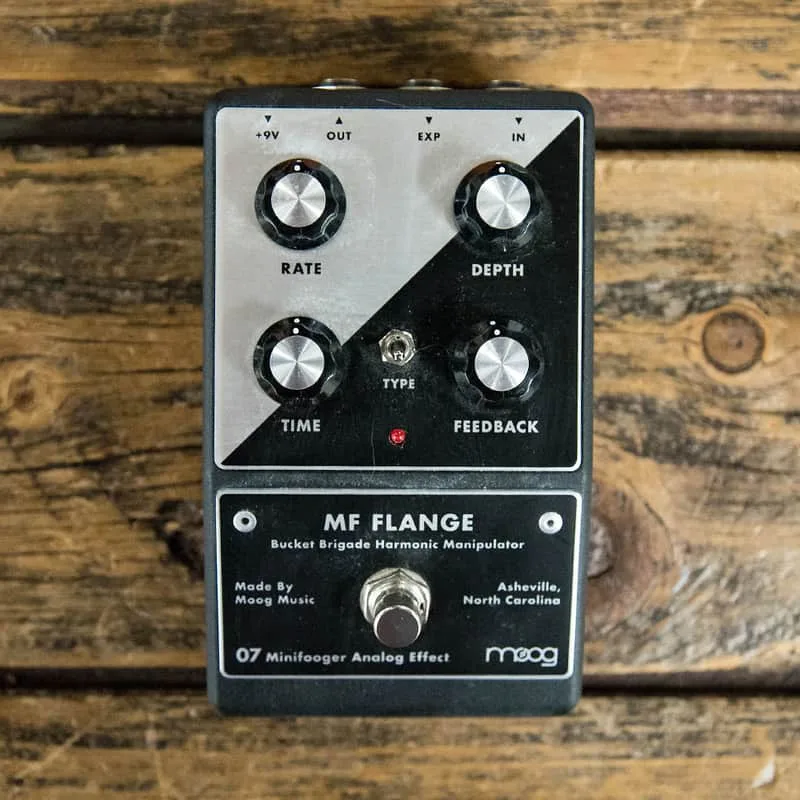
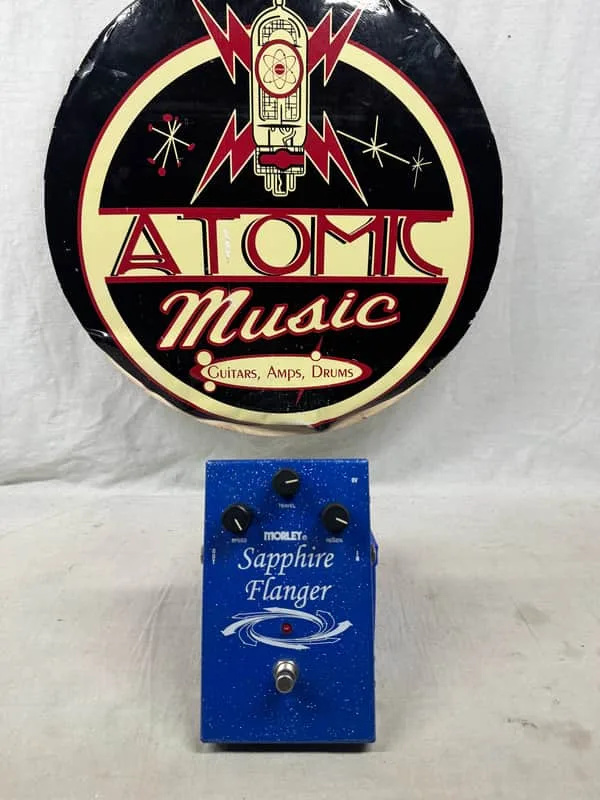
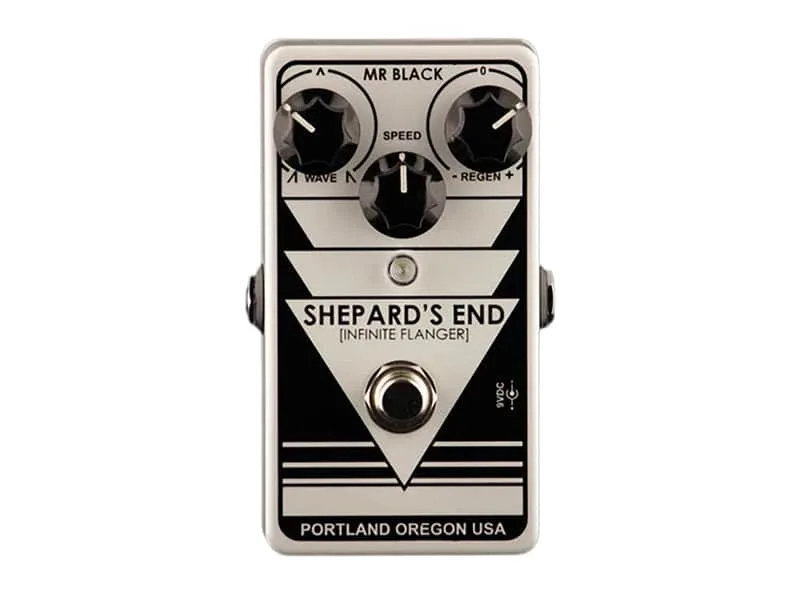
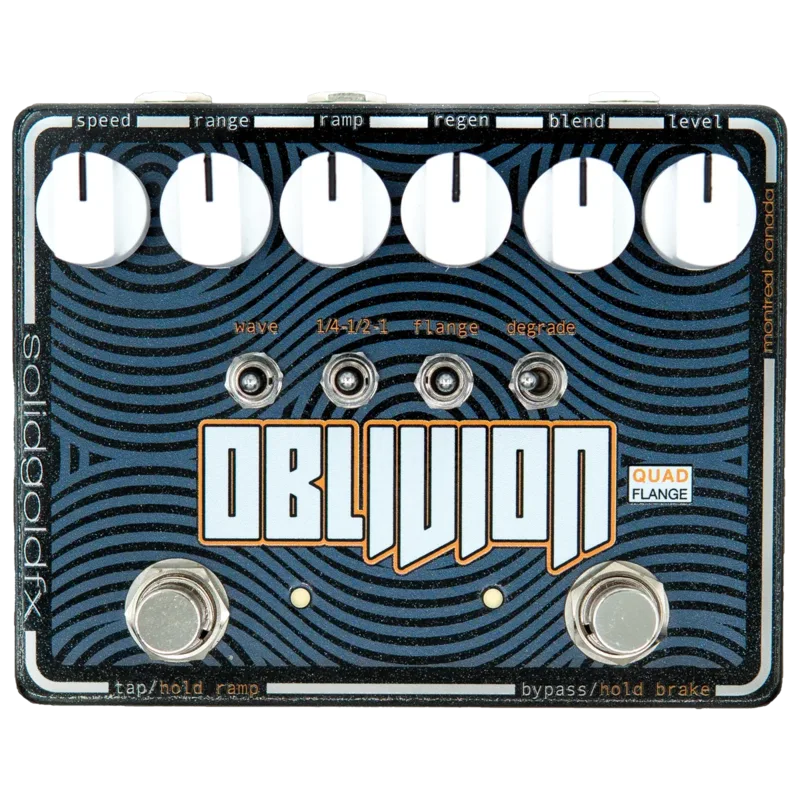
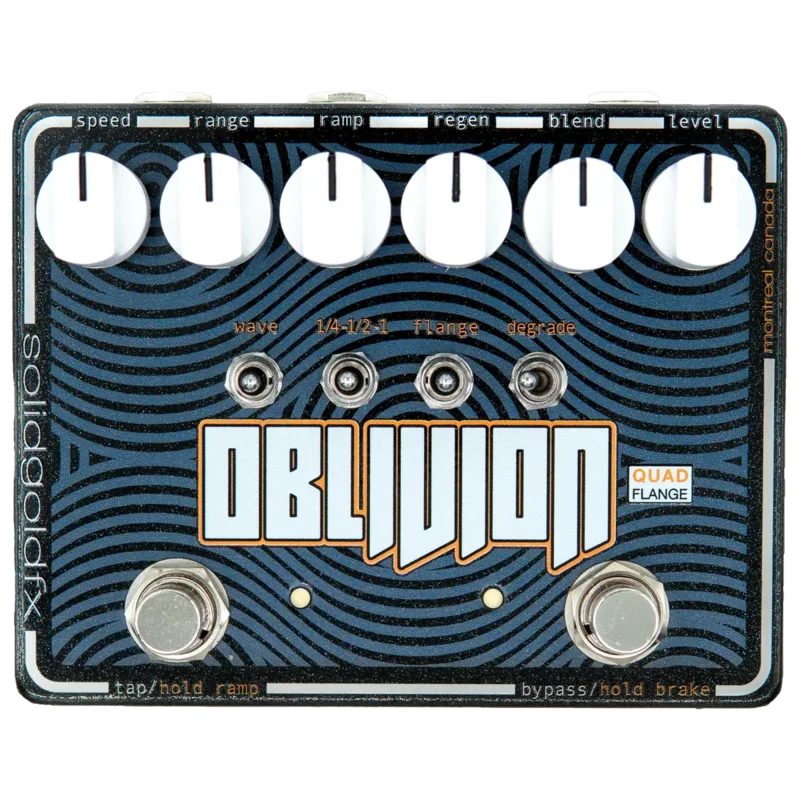
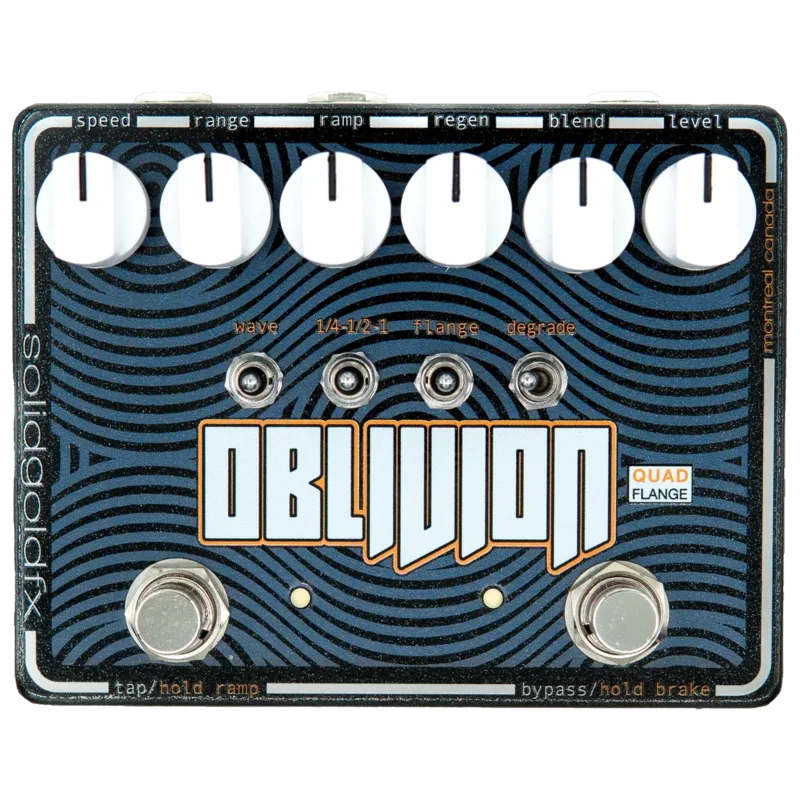
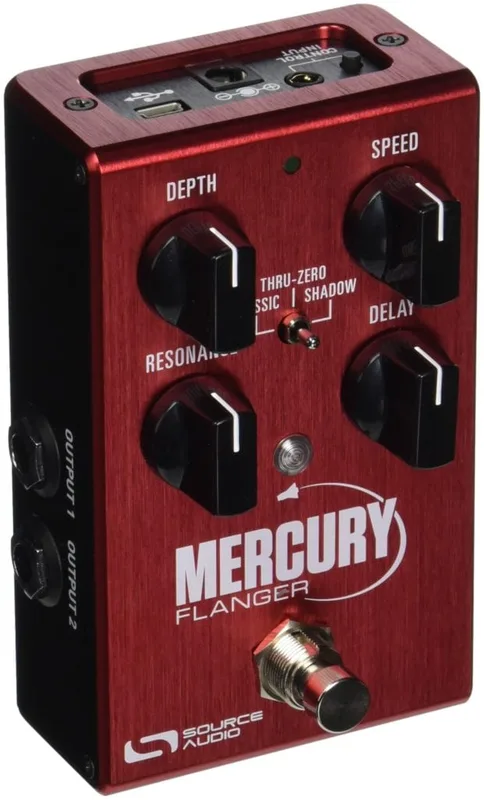
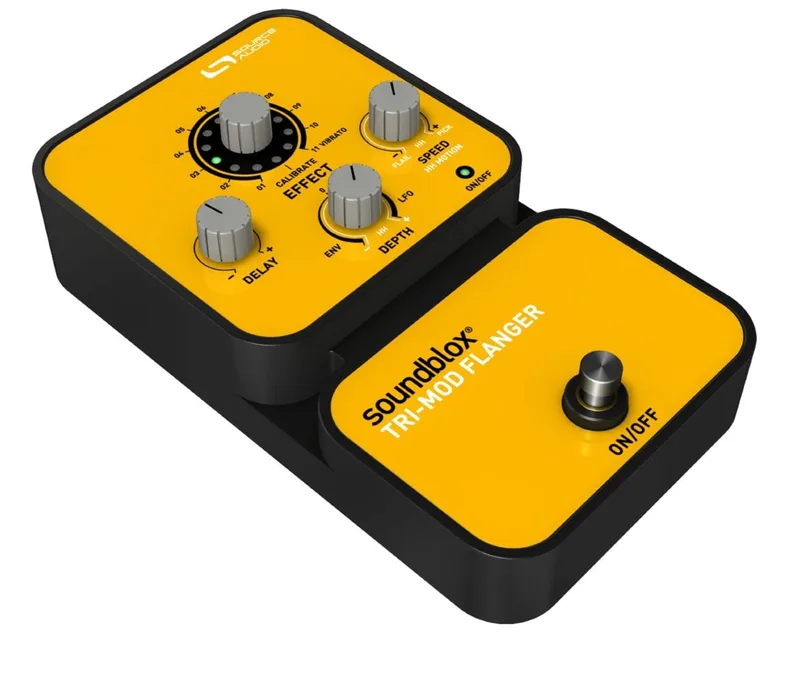
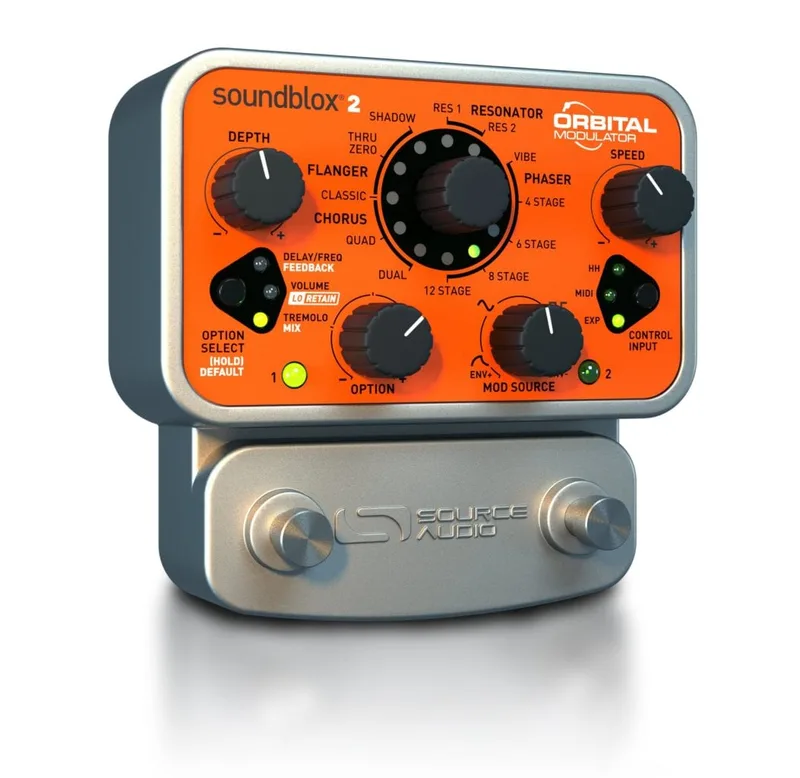
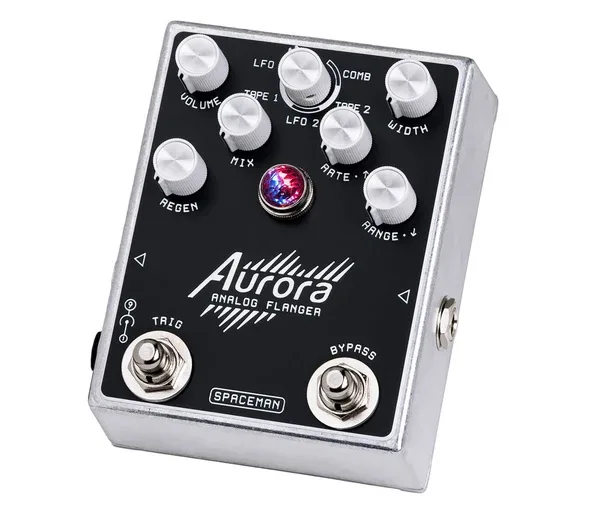
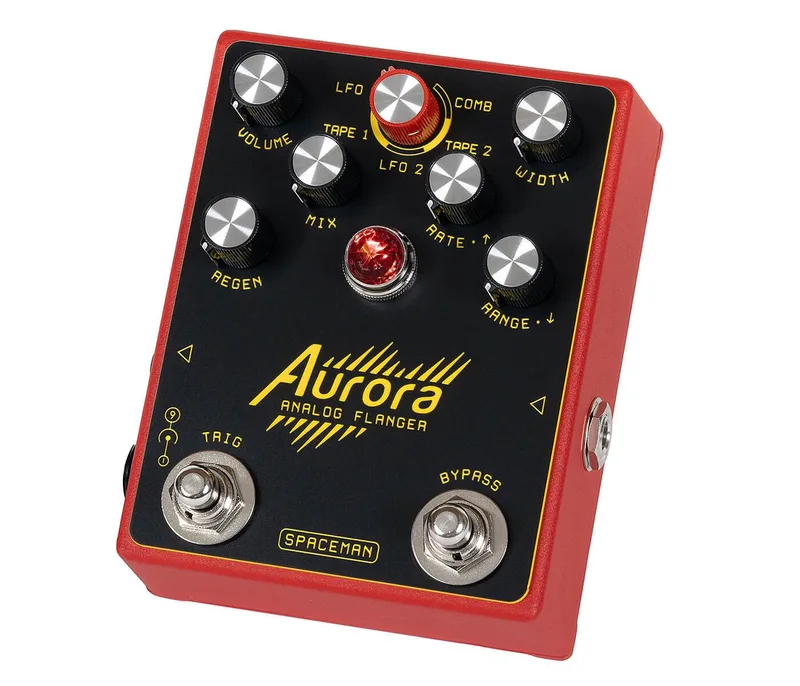
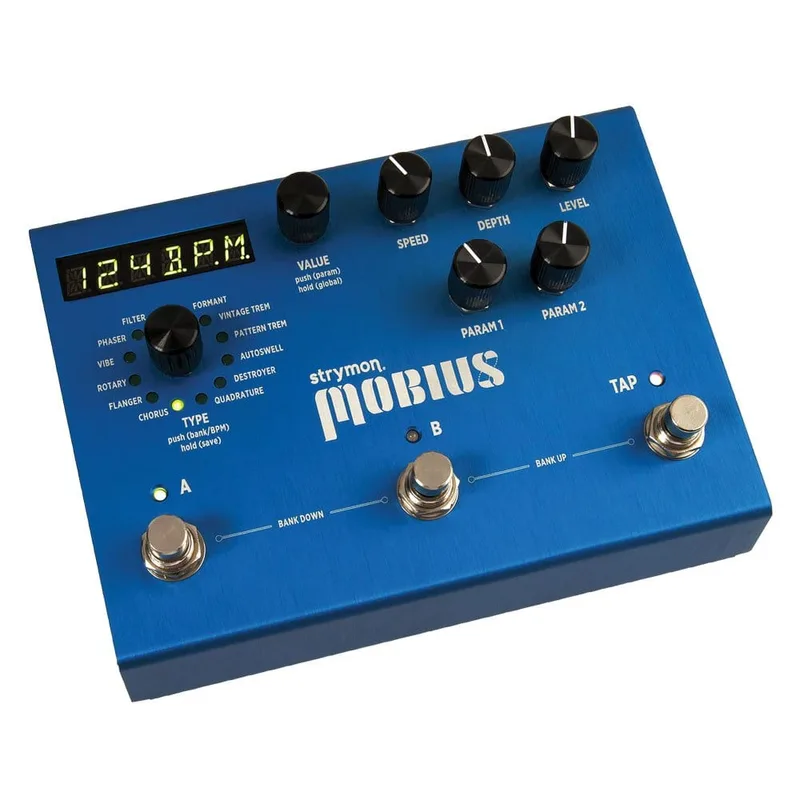
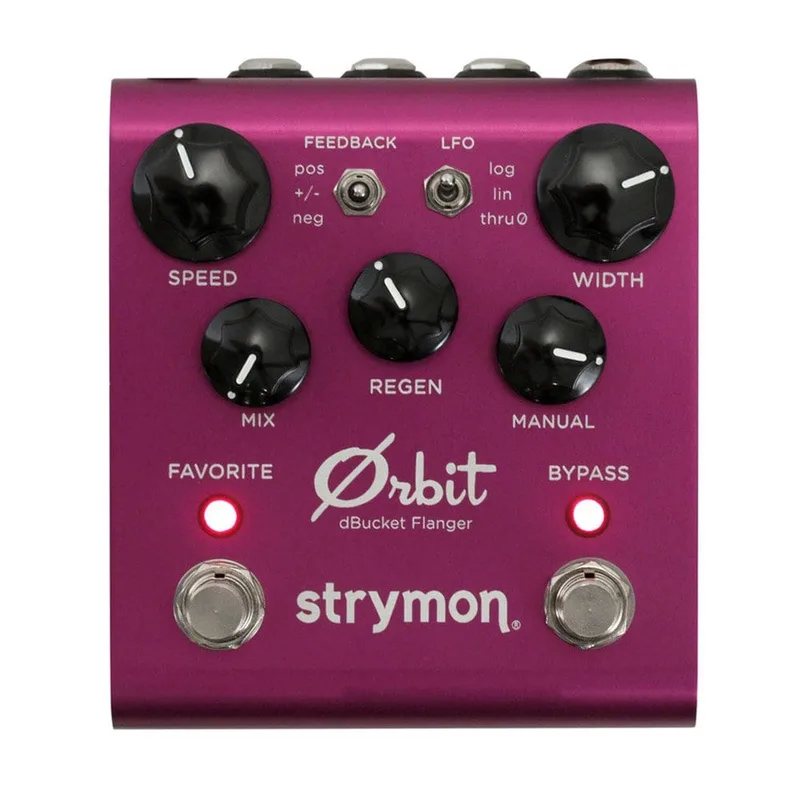
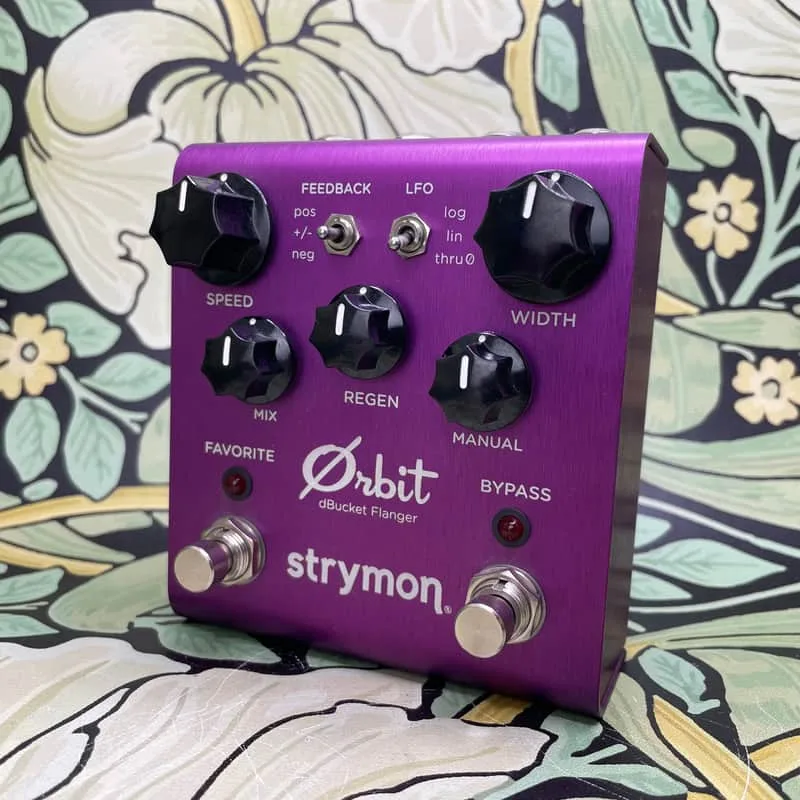
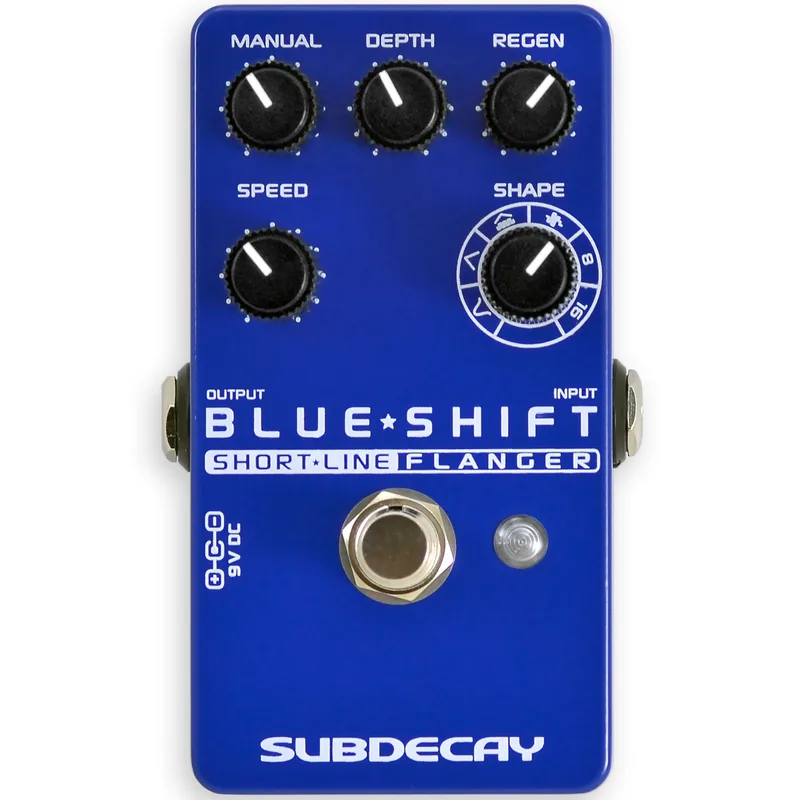
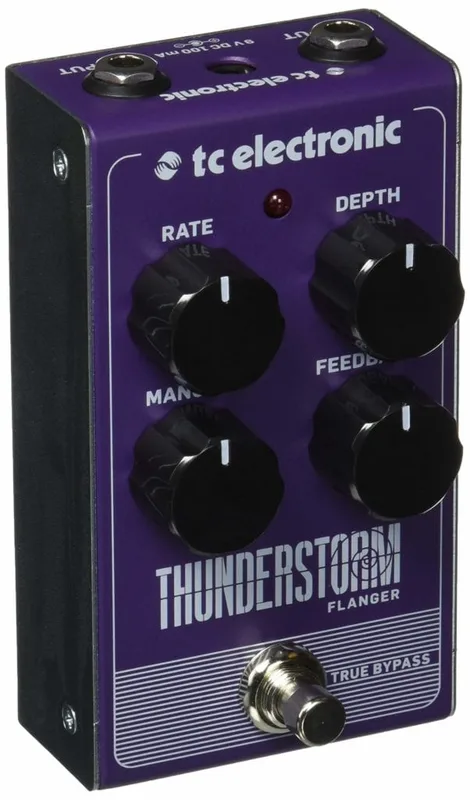
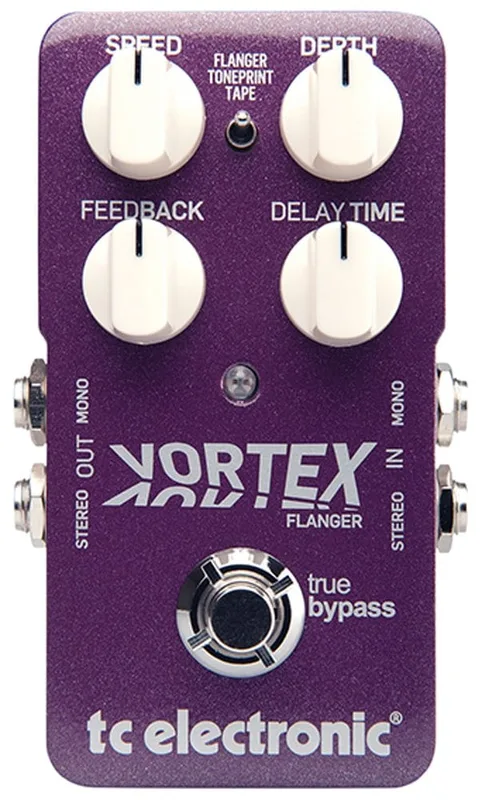
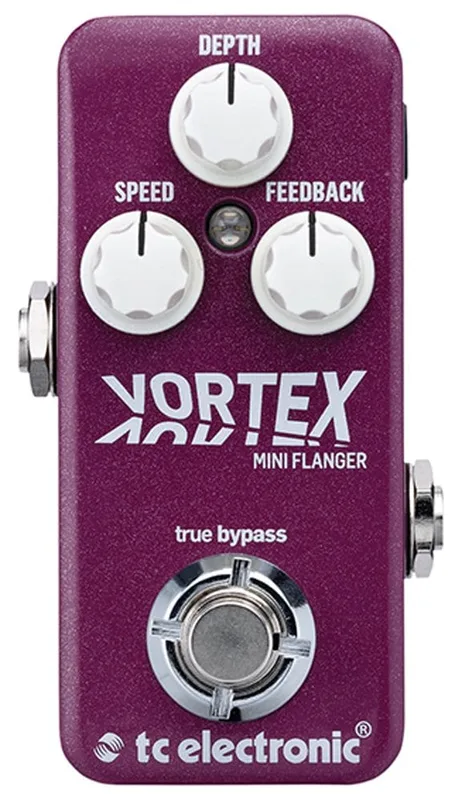
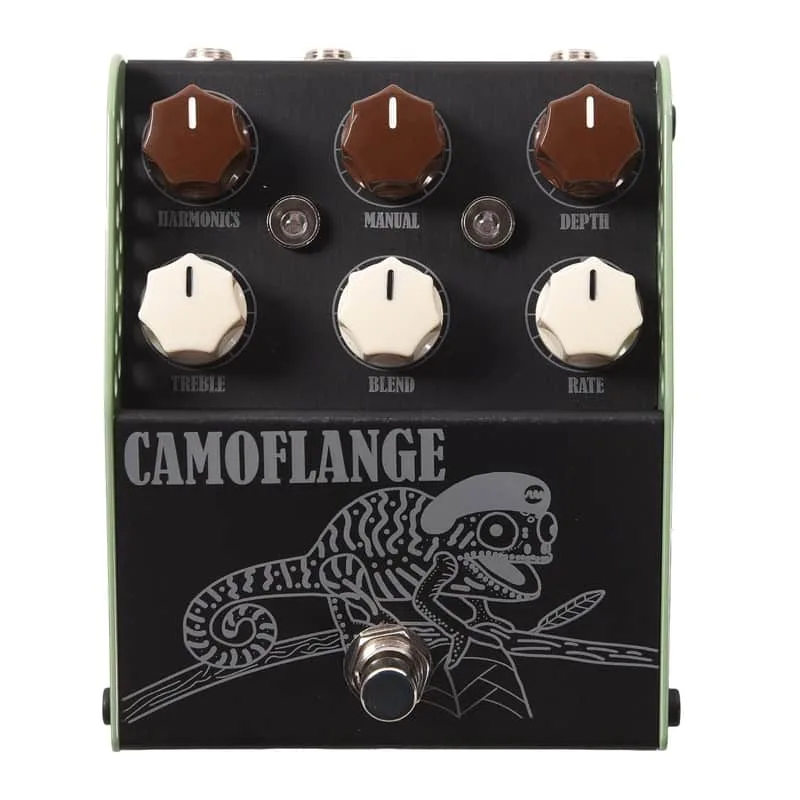
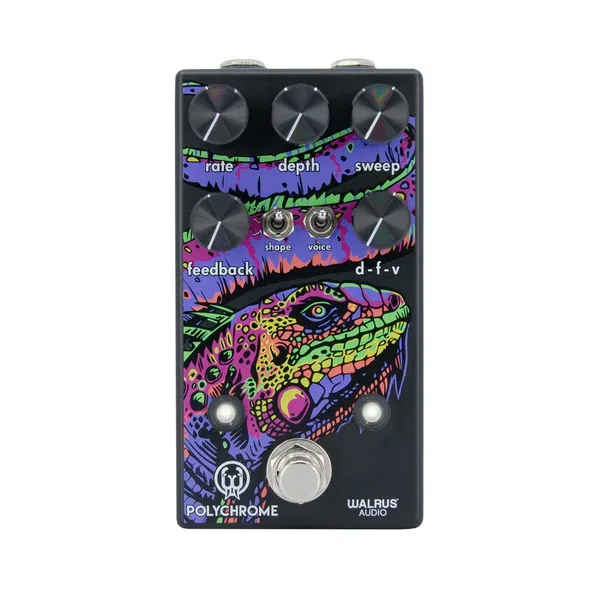
A flanger is a modulation effect that mixes a very short, constantly changing delay back with your dry signal. Because the delay is so short, the copy interferes with the original and carves a set of moving notches into the frequency response, which the ear hears as a sweeping, jet-plane whoosh. It is the most aggressive member of the modulation family that also includes chorus and phaser pedals, and it sits alongside delay and reverb as one of the time-based effects on a pedalboard.
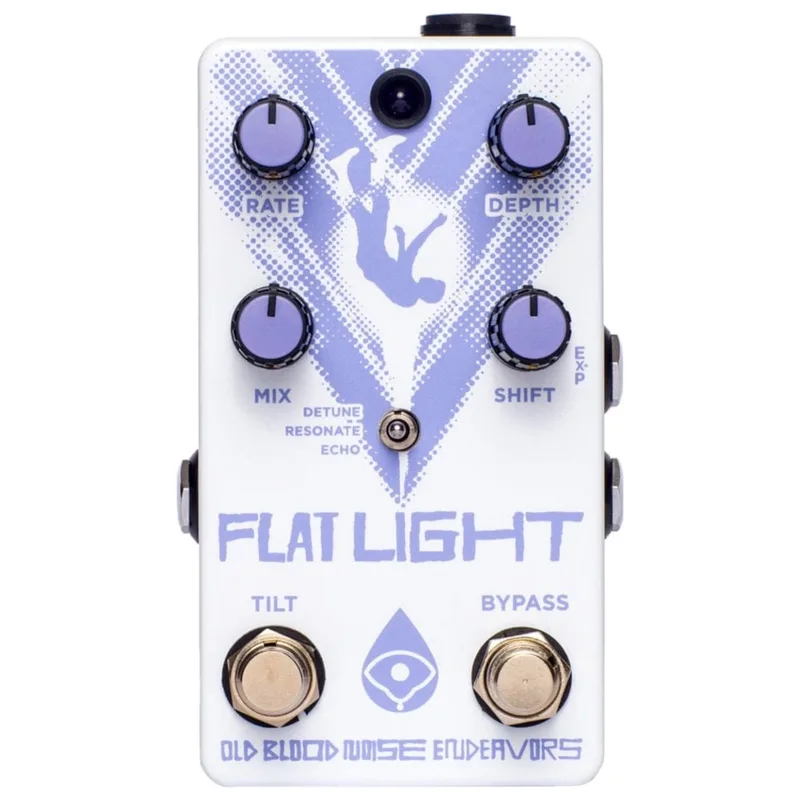
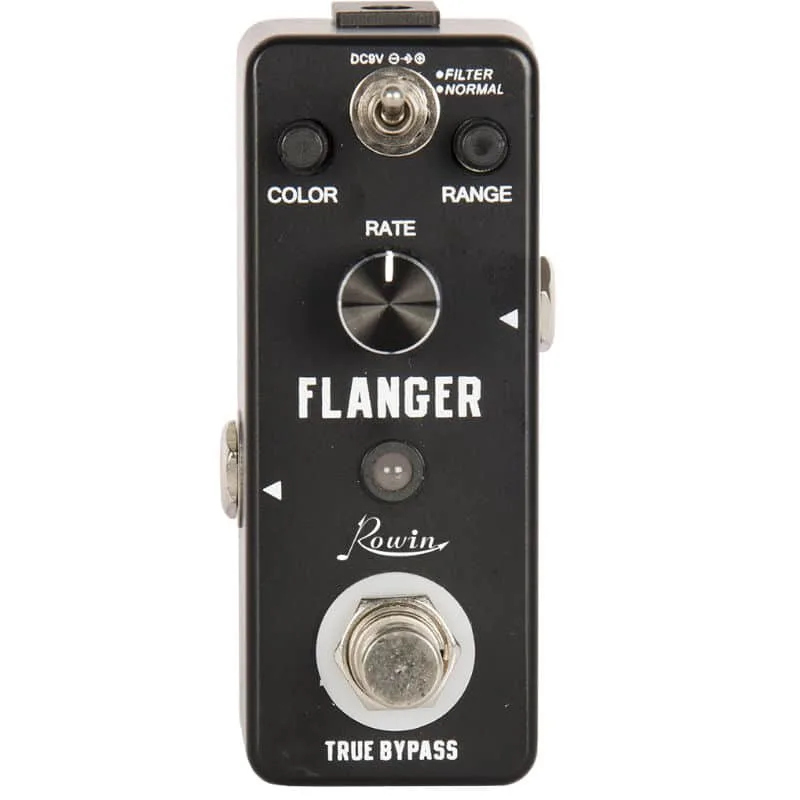
Flangers come in every shape and price class. Behringer's Ultra Flanger UF100 is a compact flanger effects pedal designed for electric guitar1, Old Blood Noise Endeavors describes its Flat Light as "a flanger unlike any other"2, and the Rowin LN-312 packs two switchable flanger effects into a mini enclosure3. What they all share is the same underlying trick: a delayed copy of your signal, swept up and down in time.
How a flanger works
Every flanger splits your signal into two paths. The dry path passes through untouched. The wet path goes through a short delay whose time is constantly changed by a low-frequency oscillator, or LFO. When the two paths are summed, frequencies where the peaks and dips line up reinforce each other and frequencies where they oppose cancel, producing a comb of notches that slides up and down as the delay time changes. That sliding comb is the flanger sound.
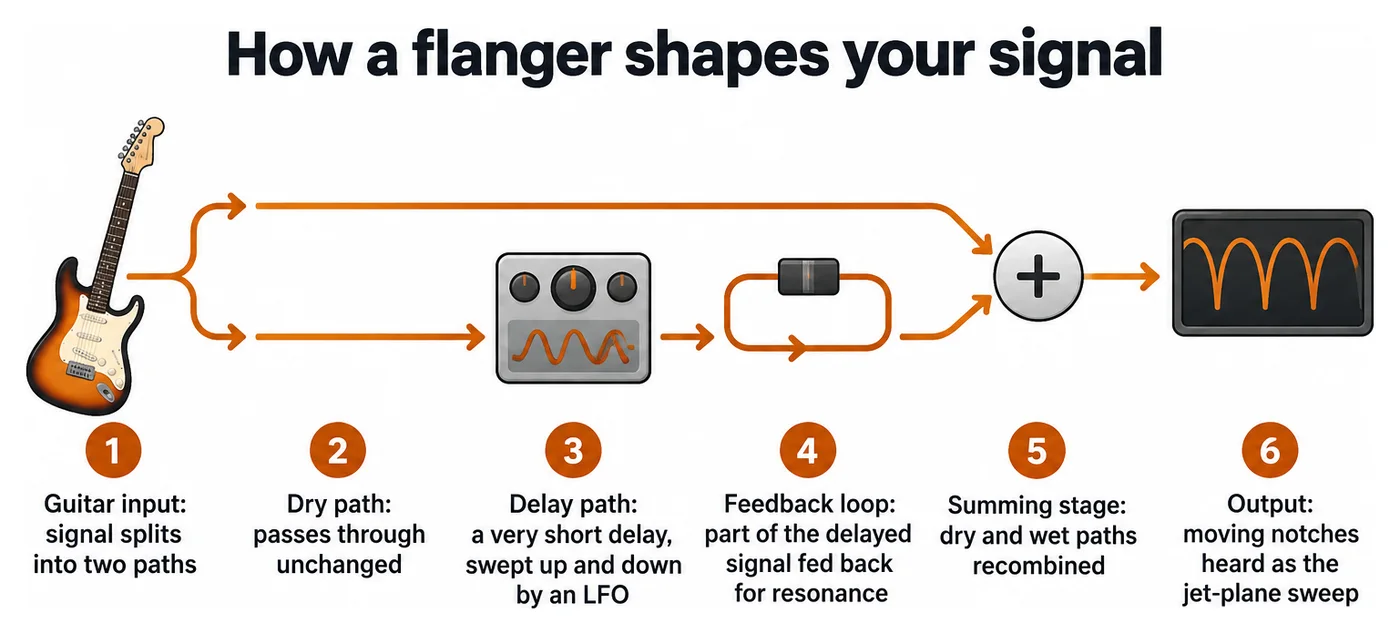
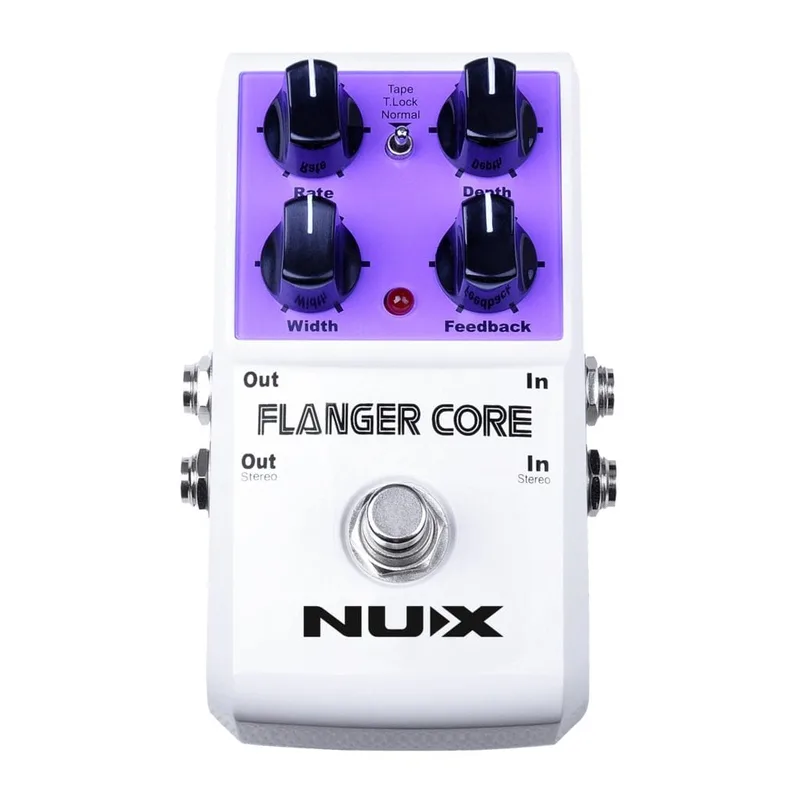
The depth of the LFO, meaning how far the delay time swings, controls how pronounced the sweep is. Feedback, sometimes called regeneration or resonance, feeds part of the delayed signal back through the delay to sharpen the notches, which is what makes a flanger go from a gentle shimmer to a full jet takeoff.
The delay element itself is what separates analog from digital flangers. Analog designs use a bucket-brigade device, or BBD chip, which passes the signal along a chain of capacitors, and the number of stages in the chip sets the character of the modulation. Digital flangers model the same process in software, which allows delay times and control schemes an analog circuit cannot reach.
History and landmark flangers
Flanging began as a studio trick, achieved by hand-drifting the speed of two tape machines playing the same material, before it was packed into pedals. The pedal era arrived in the 1970s and early 1980s, and much of today's market is still built on those circuits45.
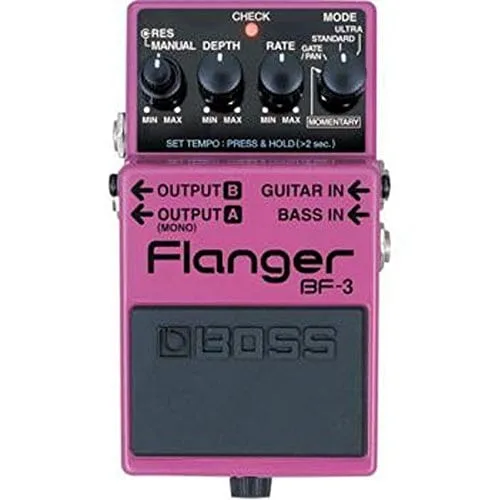
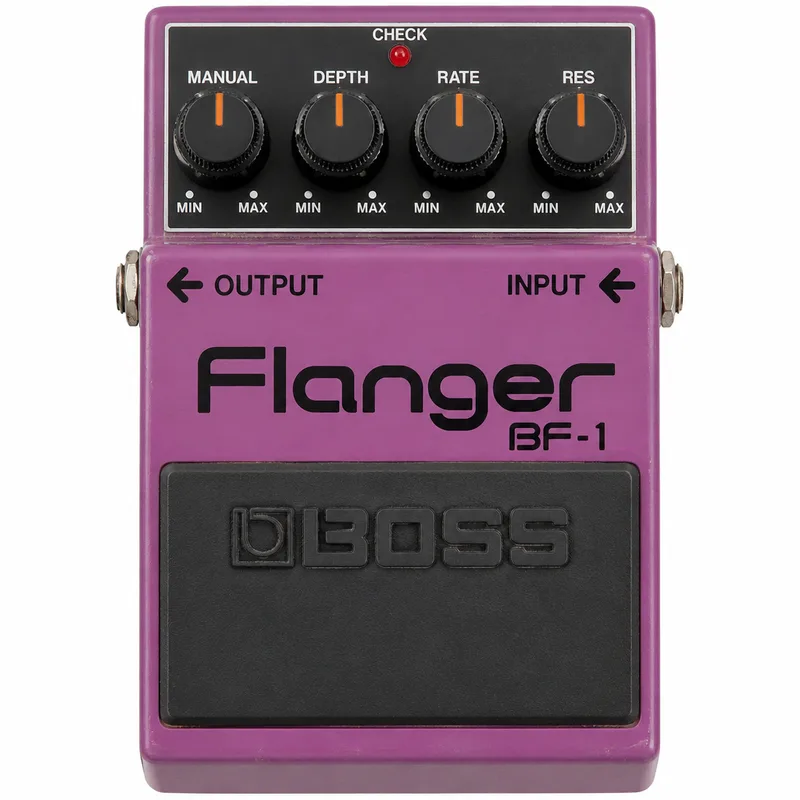
The BOSS BF-2 Flanger, appearing in 1981 and remaining a catalog fixture for over two decades, earned a reputation as one of the company's enduring modulation designs6. The Pearl FG-01 was a lesser known contemporary of some of the 1980's compact flanger pedals like the Boss BF-2 or DOD FX-757. Morley's history page notes that its Pro Flanger "is regarded today as one of the best Flangers of all time by Andy Martin"8.
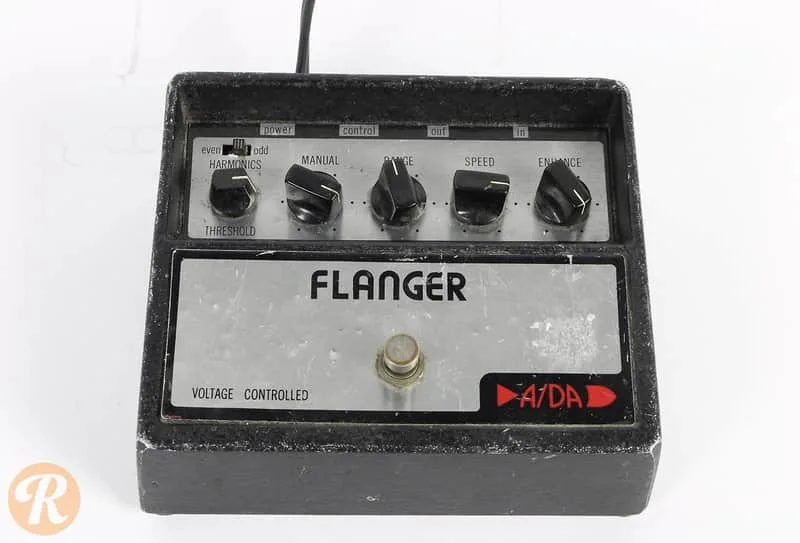
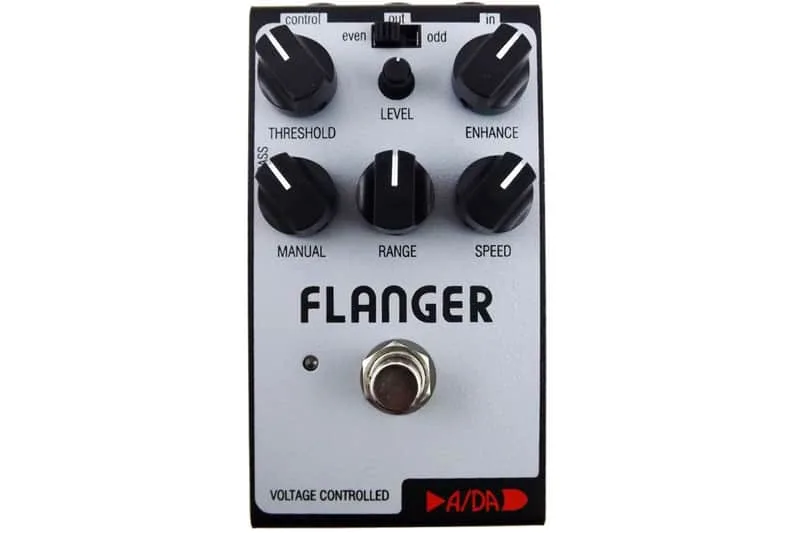
Other landmarks come from the pedal era. The BOSS BF-2 Flanger appeared in 1981 and remained a catalog fixture for over two decades, earning a reputation as one of the standouts of its type6. The A/DA Flanger, the first product developed by engineer Dave Tarnowski, began shipping in 19809, and the original A/DA Flanger "may be the most legendary pedal flanger ever built"10.
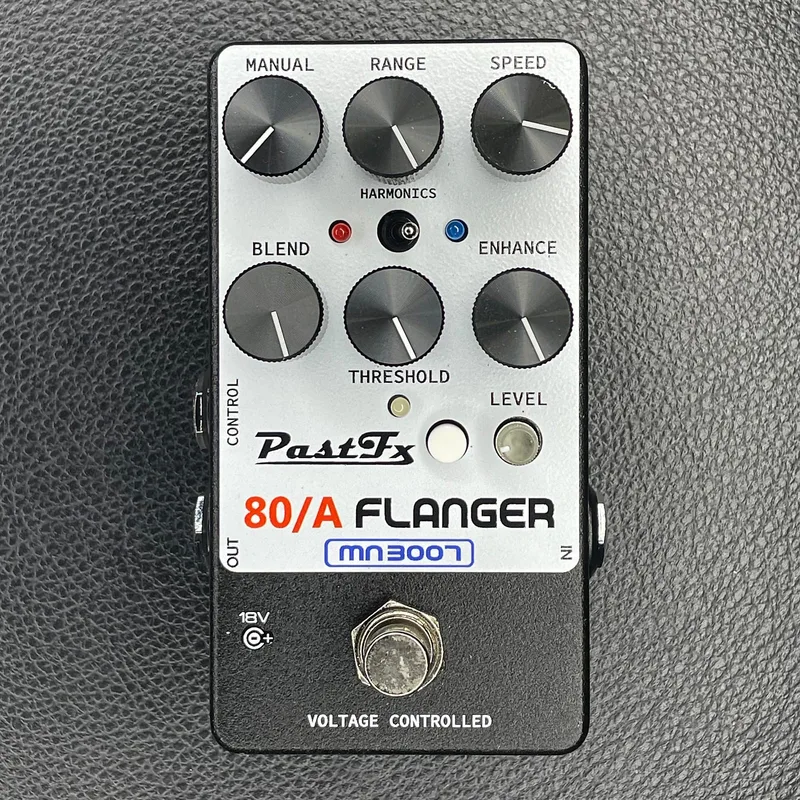
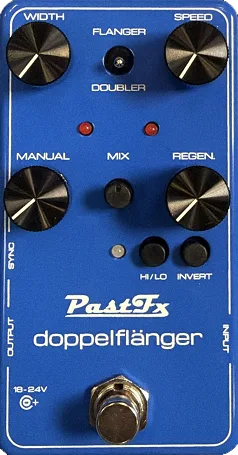
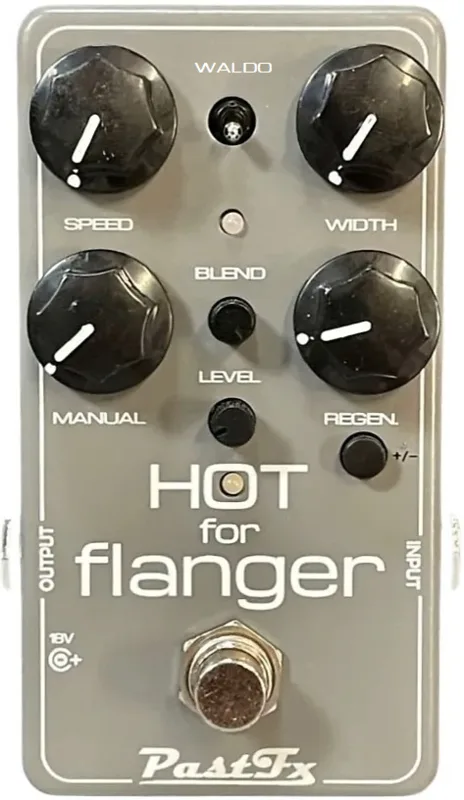
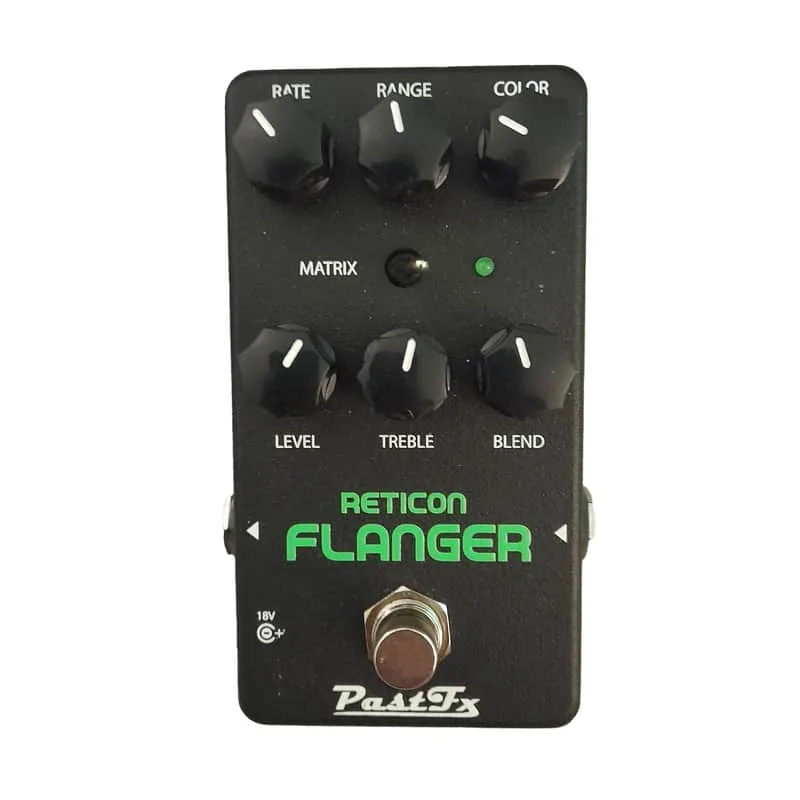
The vintage recreation scene is active. PastFx builds its 80/A Flanger "based upon a venerable late 70's, early 80's discontinued analog flanger pedal famously utilised by numerous musicians"11. Its Reticon Flanger is "a faithful recreation and expansion of perhaps the most notorious and controversial" vintage flanger12.
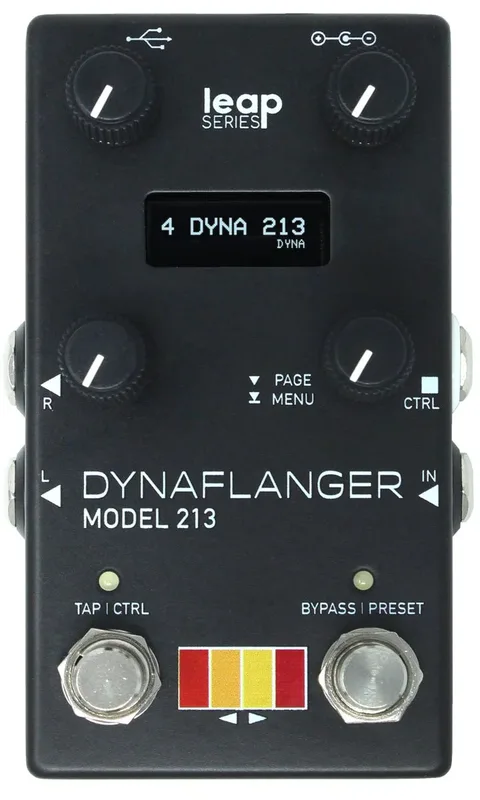
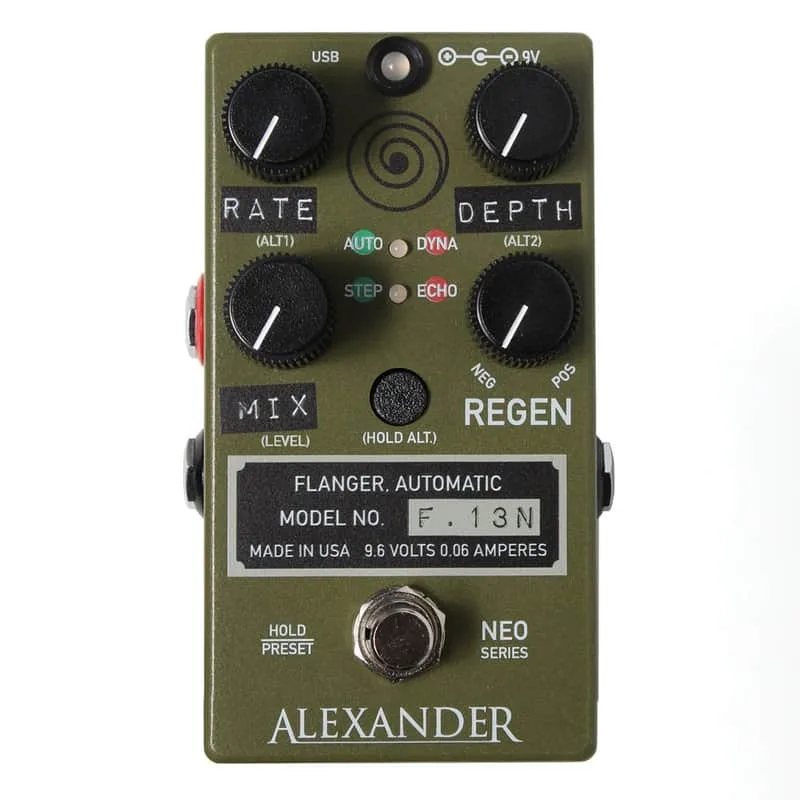
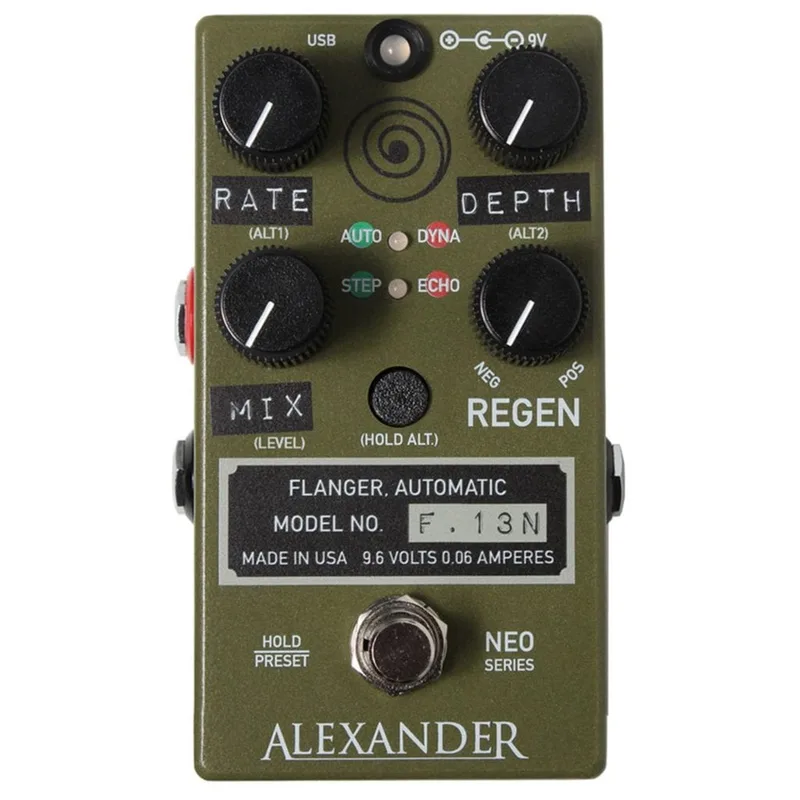
Alexander Pedals states that its F.13 and F.13N pedals "are benchmarks for flanging excellence"1314, with the company's roots firmly planted in flanging concepts, and its current Dynaflanger Model 213 continues that line as a Leap series flanger pedal15.
Styles of flanger
Not every flanger aims for the same sound, and knowing the styles helps you read a product page.
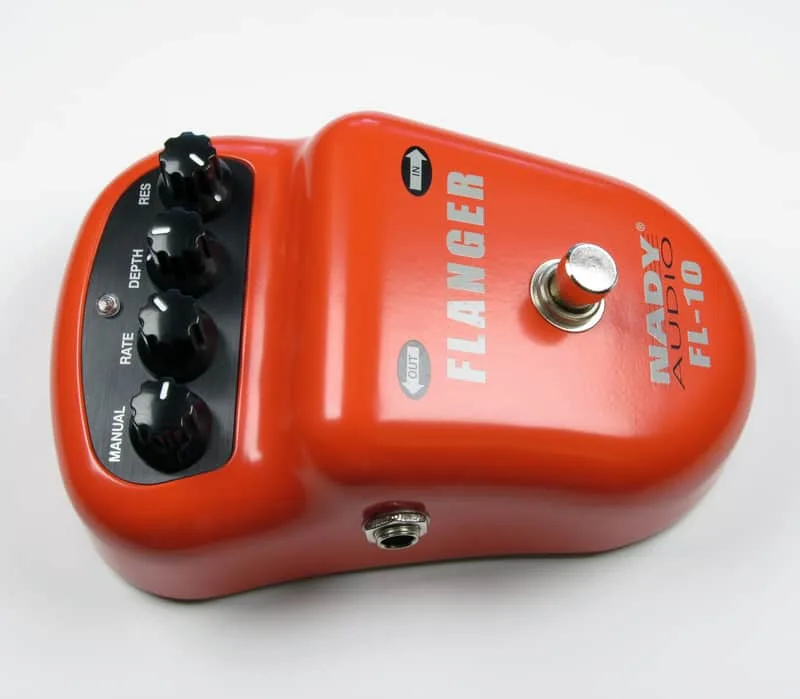
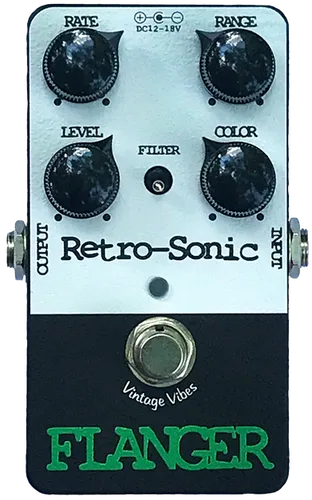
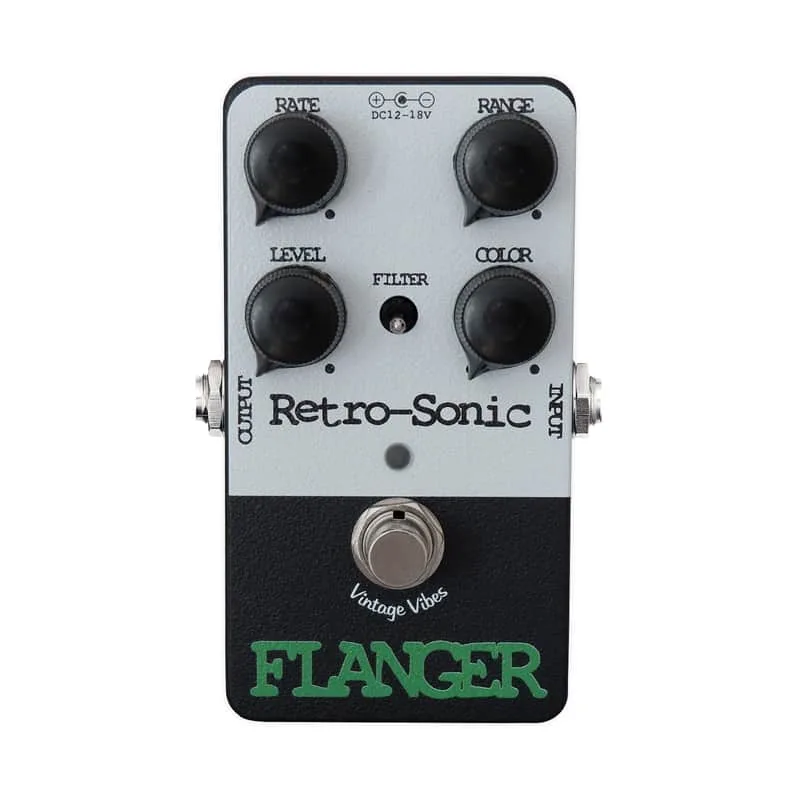
- Classic analog flangers recreate the BBD circuits of the late 1970s and early 1980s. The Retro-Sonic Classic Analog Flanger sits here59, and Nady's FL-10, a classic-style flanger pedal with four controls, offers dynamic flanging16.
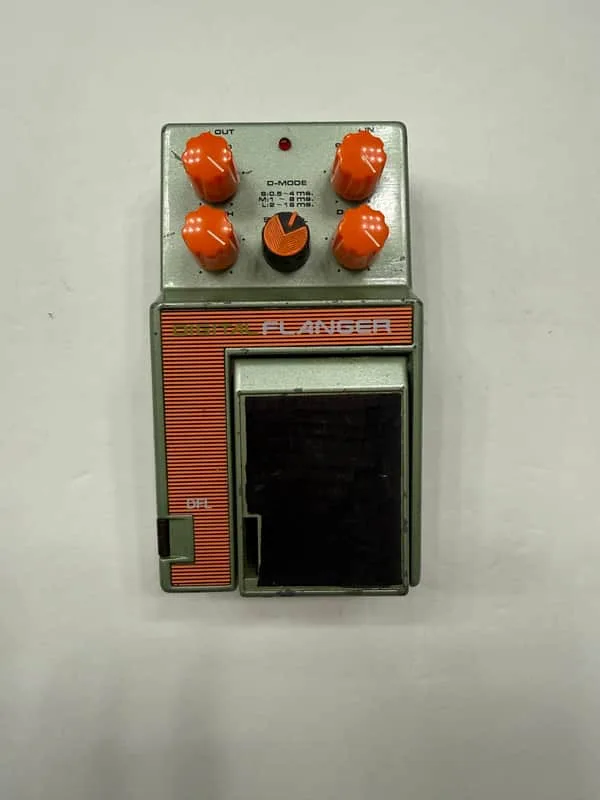
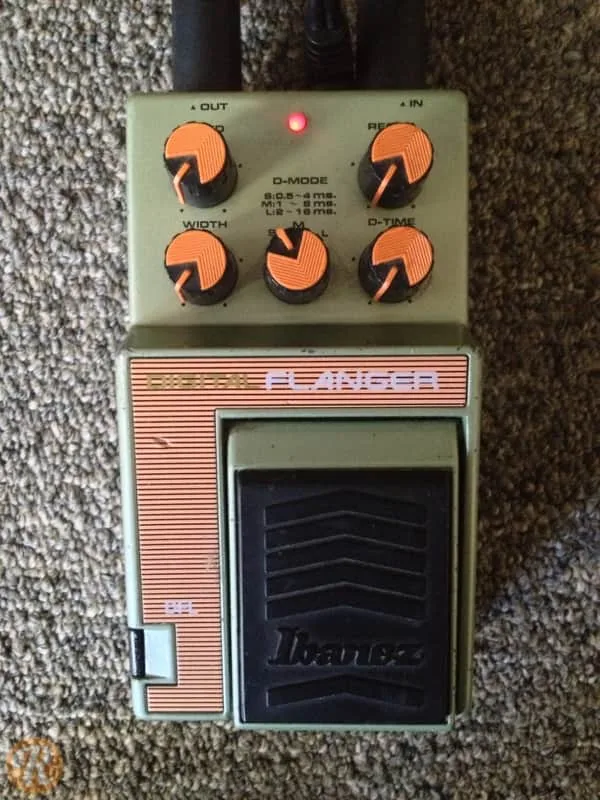
- Digital flangers replace the BBD with digital circuitry. Ibanez's DFL Digital Flanger is one example17.
- Compact pedals shrink the format. The Pearl FG-01 was a lesser known contemporary of 1980's compact flanger pedals like the Boss BF-2 or DOD FX-757, and Mr. Black's Mini Flanger offers three controls: width, recycle (regeneration) and more in a small enclosure18.
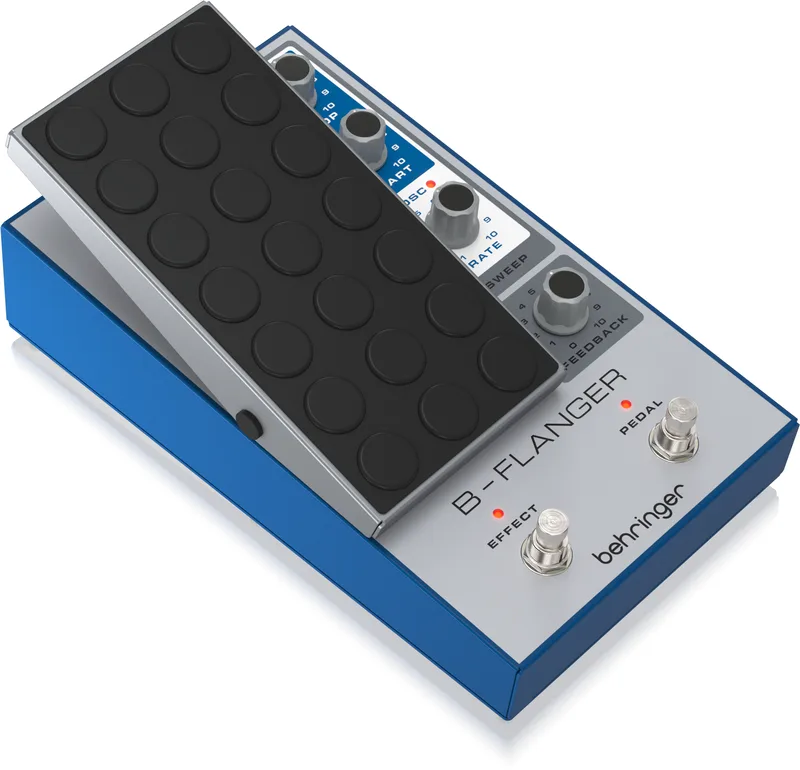
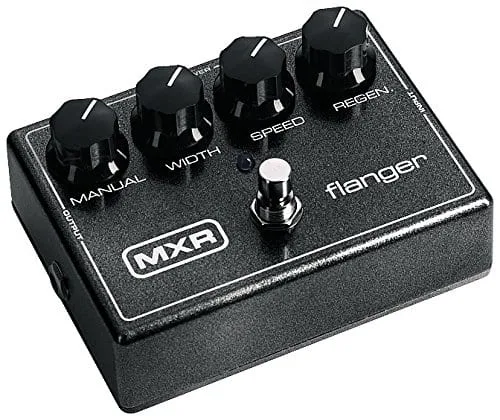
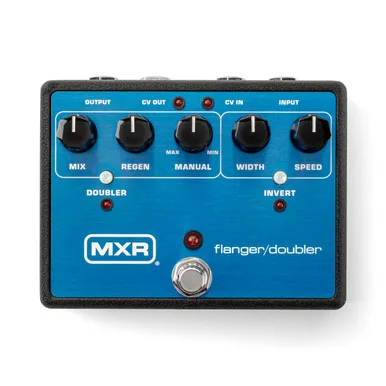
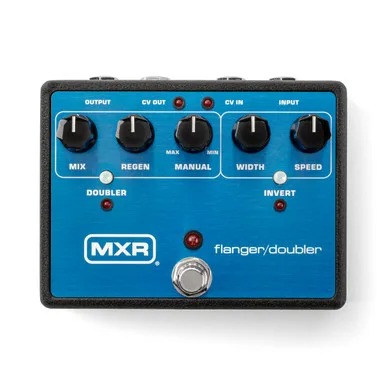
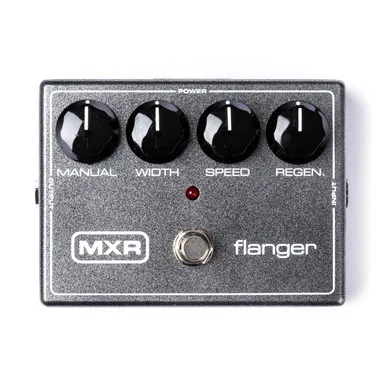
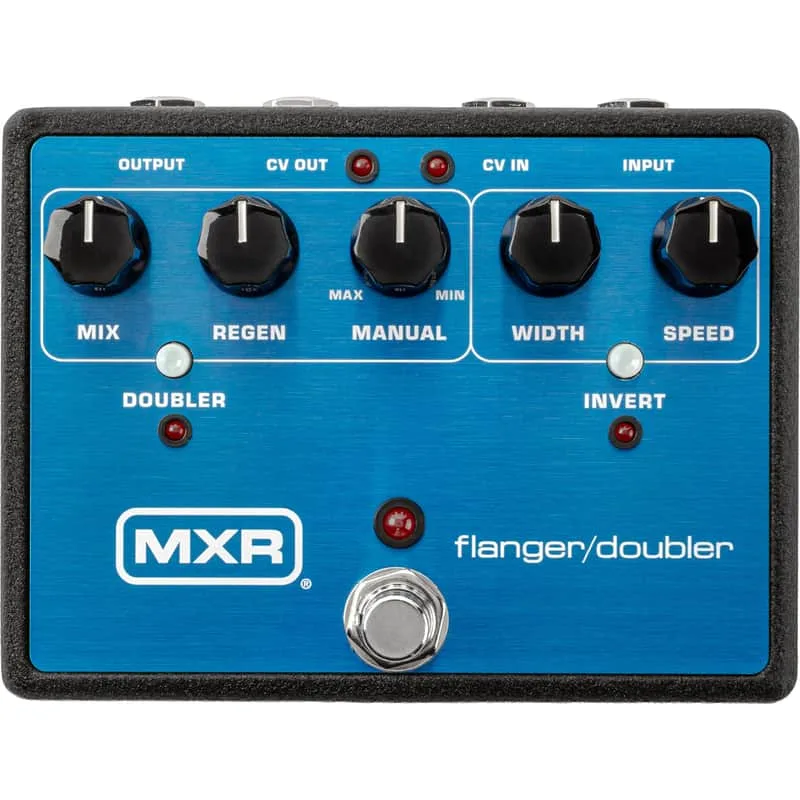
New entries keep arriving. Fender's Hammertone Flanger and Behringer's Pedal Flanger are both current flanger pedals1920, and MXR's M117R Flanger, "a staple of funky '70s sounds, from jet plane to space effects," remains in the lineup21.
The usual controls
Most flanger control panels are variations on the same few knobs. Here is what each one does, using makers' own descriptions.
| Control | What it does |
|---|---|
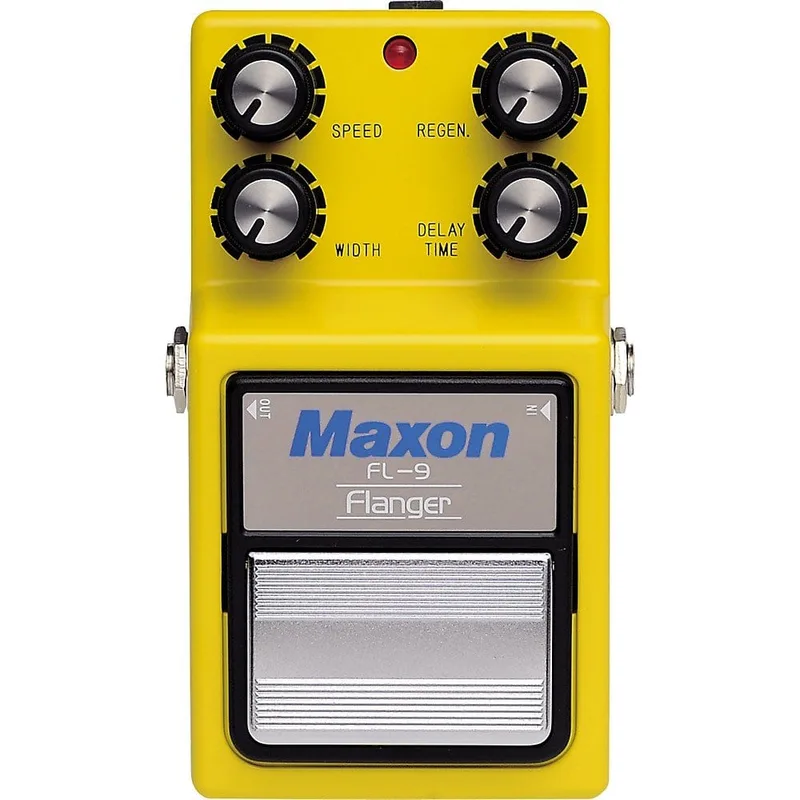
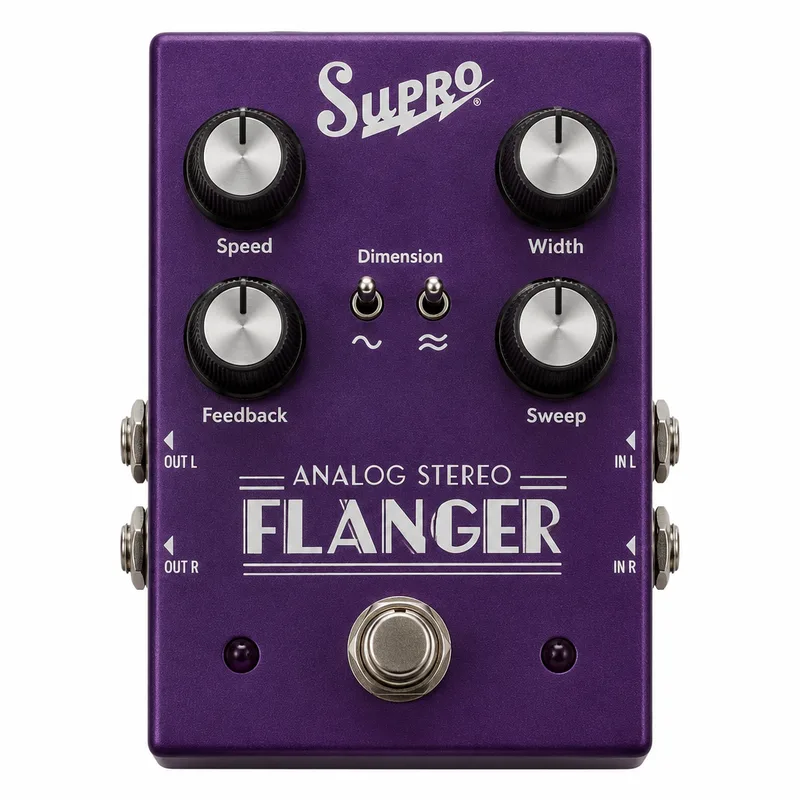
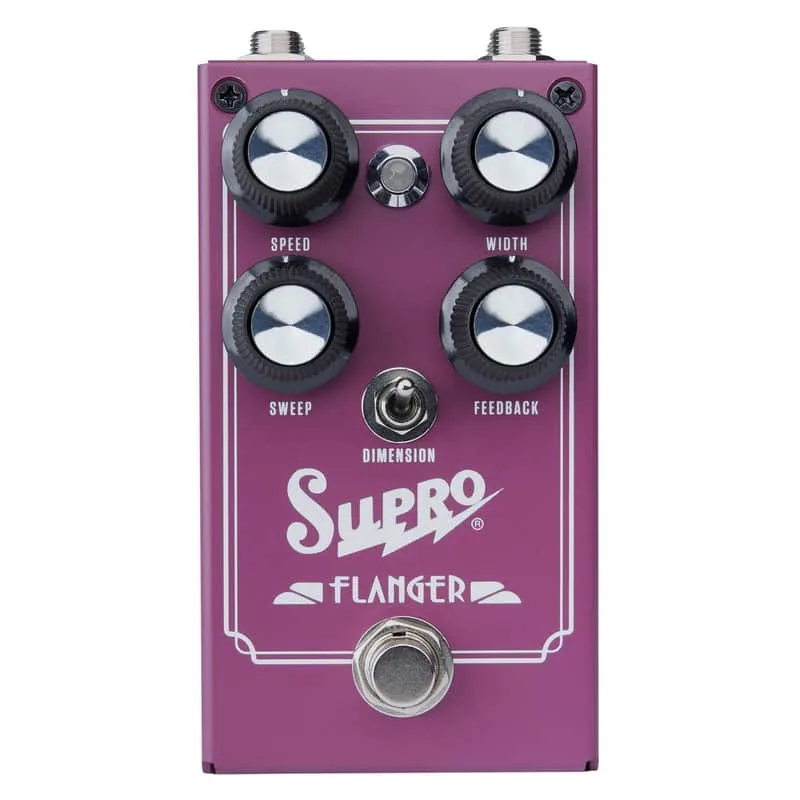
| Speed / Rate | Sets how fast the sweep cycles. Supro: "Speed: Sets the rate of modulation of the flanger effect"22. MODE MACHINES' MM-8 speed knob adjusts the speed of the flanger effect in normal mode23. |
| Depth | Sets how far the delay time swings, from a subtle shimmer to a deep sweep. Listed as LFO depth in Drolo's Molecular Patches reference24. |
| Feedback / Regeneration | Sets the resonance. On the Supro Flanger there is no resonance at center, clockwise adds positive feedback and counter-clockwise adds negative feedback22. The MM-8's feedback knob can be pushed up to an oscillator noise tone23. |
| Manual / Delay time | Sets the center delay time around which the LFO sweeps. |
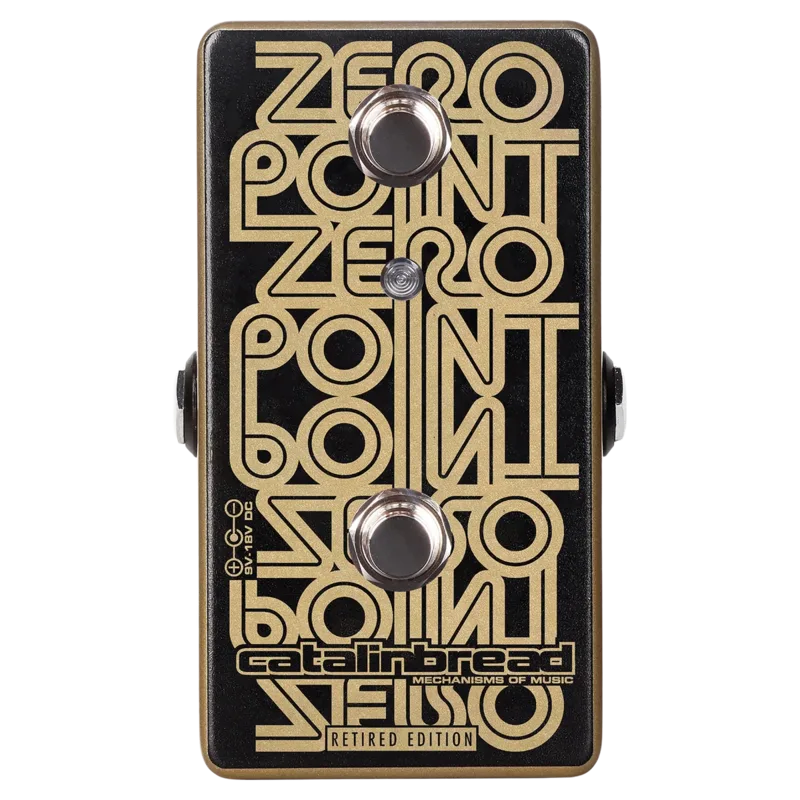
| Mix / Level | Balances wet and dry signal. Catalinbread's Zero Point Flanger carries an internal gain trimpot, factory-set for a very slight bump in volume when the pedal is engaged25. |
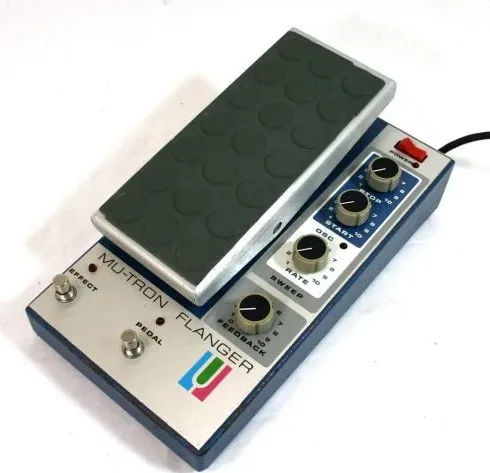
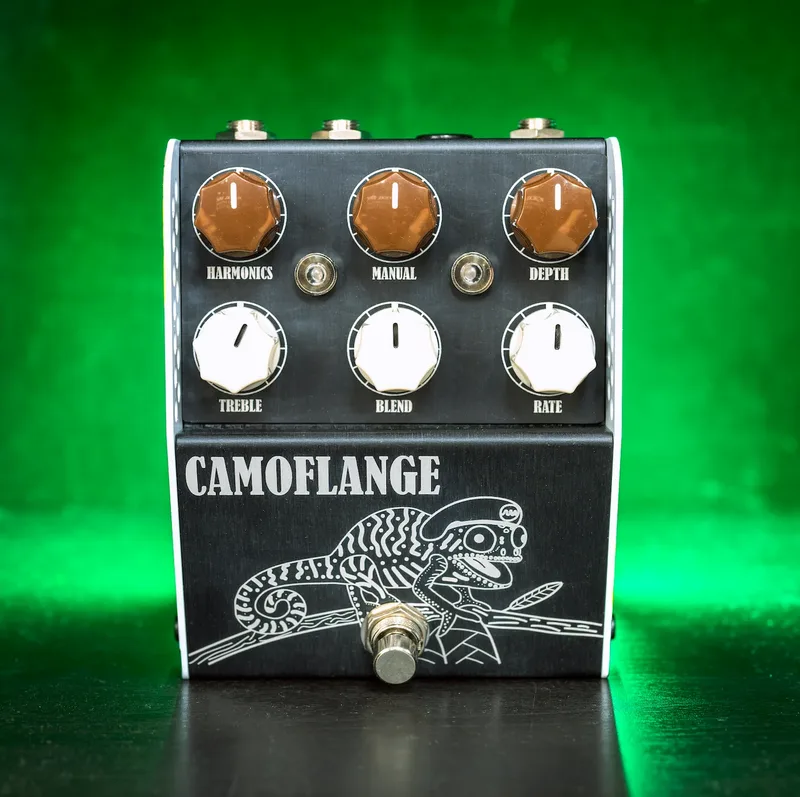
Some designs add their own twists. The Mu-Tron Flanger's pedal switches between the LFO wave and the pedal itself as the control source of the delay time, so you can perform the sweep by foot26. ThorpyFX's CAMOFLANGE offers very interactive controls plus a wet and dry output27. Strymon's Cloudburst accepts a standard TRS expression pedal for continuous control over the knobs of the pedal28. Zander Circuitry's Junipero adds a CTRL knob that introduces feedback for a more intense, vocal-like effect17.
If you build a flanger from a kit, expect setup work. Jeds Peds says of its Black Pearl Flanger that "you have to bias trimmers and ideally need a hertz meter (you can also set the latter by ear if you don't have one)"29.
Signal chain placement and power
A widely shared ordering for the pedalboard, from guitar to amp, runs: tuner first, before all other pedals, then wah directly after the tuner and before the drive section, compression close to the guitar because those units work best with an even-volume signal, then the drives, then modulation, then delay, then reverb, with an amp or cab simulator most commonly at the end of the chain, routed to a PA system, audio interface or headphones30. Modulation effects stand out in the mix when placed after the drive section, though positioning is not set in stone30. A looper should come before the delay, with the exact spot depending on how looped phrases should be effected30.
Two caveats from other makers are worth knowing. Origin Effects notes that any pedals that don't work with buffers, meaning certain vintage fuzz and wah pedals, should go before buffered tuners and before the compressor31. And Strymon advises positioning its Canoga flanger as the first pedal in the signal chain to maximize interaction with the instrument's pickups and volume knob32, a reminder that a flanger placed early responds to your playing dynamics in a way one placed late does not.
For power, check each pedal's requirements before buying: analog BBD flangers and digital designs draw different currents, and a pedal needing more current than a daisy chain supplies will misbehave. Fender's Hammertone Flanger uses pedalboard-friendly top-mounted input and output jacks and a true bypass footswitch, which RockBoard's PedalPedia says means it will integrate seamlessly into your rig33.
Questions to ask when choosing a flanger
- Analog or digital? Analog BBD circuits, like the PastFx 80/A11 or the MXR M22634, carry the vintage character and noise profile of their chips. Digital designs offer presets, stereo routing and control options such as expression inputs28.
- How much feedback do you want? If the jet-plane roar is the point, look for a wide feedback range, including the MM-8's ability to reach an oscillator noise tone23. If you want a subtler texture, a centered feedback control like the Supro's gives you a clean off position22.
- Do you need through-zero? The dip-through-zero effect is a distinct sound, available from pedals like the Junipero17 and the Zero Point Flanger17, but not from every flanger.
- Mono or stereo? The Supro Flanger is full-stereo with a Dimension switch that crossfeeds the two channels22; many compact flangers are mono only.
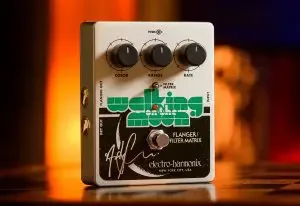
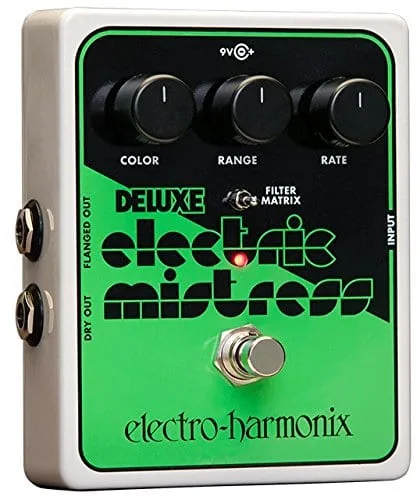
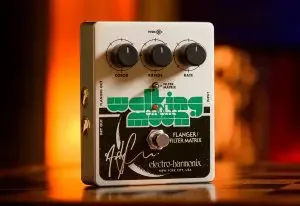
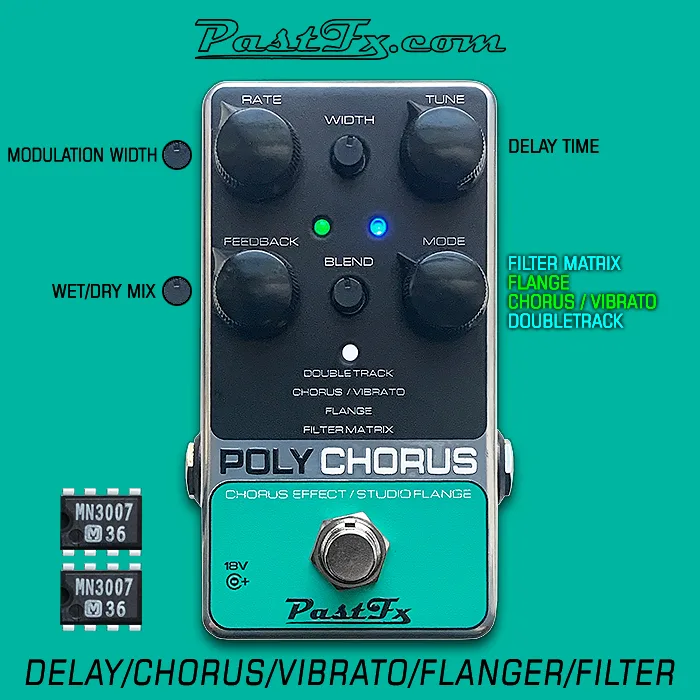
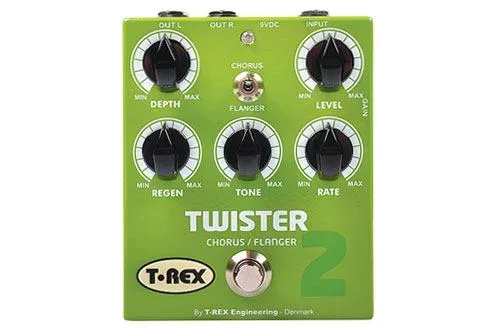
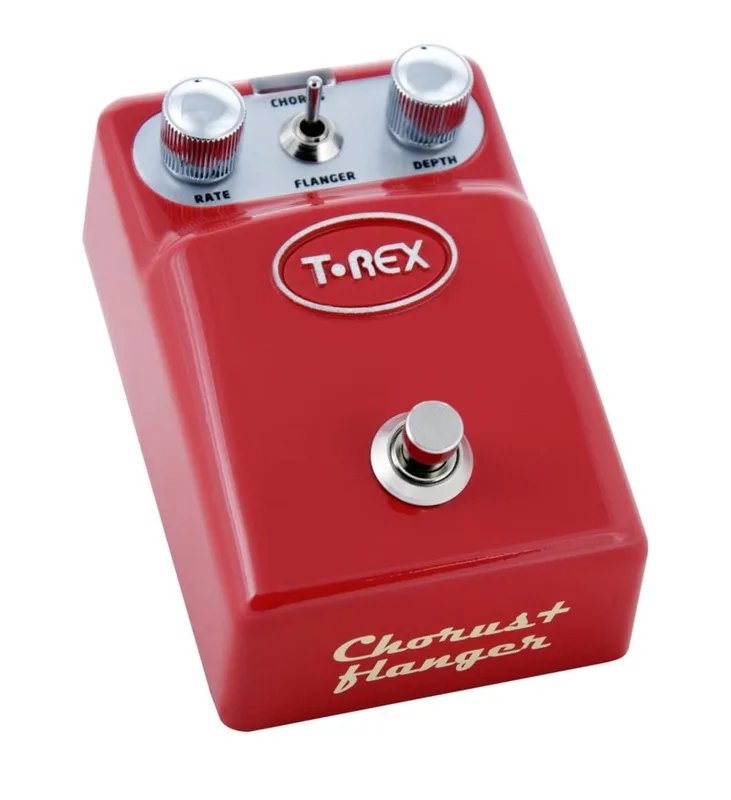
- Do you want flanging combined with other effects? The Twister II covers chorus and flanger in one pedal35, and multi-mode units like the Echoflanger reissue add chorus, slap back and filter matrix modes15.
- Is it for a small board? Mini pedals like the Rowin LN-3123 and compact units like the Behringer UF1001 trade control count for space.
Questions
What is the difference between a flanger and a chorus?
They are the same family of effect: both mix a delayed copy of your signal back with the original, and both sweep the delay time with an LFO. A chorus uses a longer delay and a slower, shallower sweep to sound like several guitars playing together. A flanger uses a much shorter delay, which makes the comb filtering audible as the jet-plane whoosh. The T-Rex Twister II is an example of a pedal that puts both in one box35.
What is the difference between a flanger and a phaser?
A flanger creates its notches with a short modulated delay, while a phaser creates them with phase-shift stages, so the notches are spread differently across the frequency range and the phaser sounds smoother and more vocal. The two are close cousins: Zander Circuitry describes its Junipero through-zero mode as "the strange lovechild of a traditional flanger and a phaser"17.
Should a flanger go before or after distortion?
BOSS's signal chain guide places modulation effects after the drive section, so the sweep stands out in the mix. It also notes that placement is not set in stone, and some players prefer modulation before drive for a subtler, more compressed sweep30.
What does the feedback knob on a flanger do?
It feeds part of the delayed signal back into the delay path, which sharpens the notches and makes the sweep more resonant and intense. On the Supro Flanger, the Feedback knob sets the amount of resonance: centered there is none, clockwise adds positive feedback and counter-clockwise adds negative feedback22. MODE MACHINES notes its MM-8 feedback knob can be pushed up to an oscillator noise tone23.
What is a through-zero flanger?
A through-zero flanger lets the delayed signal pass through the same delay time as the dry signal, so the two cancel completely for a moment before the sweep continues. The effect is a distinctive suck or dip that a normal flanger, whose delay never reaches zero, cannot produce. Examples include the Zander Circuitry Junipero17 and the Catalinbread Zero Point Flanger17.
Sources (35)
- The Flange With No Name by Behringer, RockBoard PedalPedia, 2026
- Old Blood Noise Endeavors, Old Blood Noise Endeavors
- LN-312 FLANGER by Rowin, RockBoard PedalPedia, 2026
- 5 great phaser pedals guitar players need to try | MusicRadar, MusicRadar, 2021-05-17
- The 7 Best Flanger Pedals: From Gilmour to Van Halen, gearnews.com, 2025-10-06
- The PX-1 Plugout FX: Timeless BOSS Pedals Reborn, BOSS (articles.boss.info), 2025-06-06
- Kingmaker24.pdf, madbeanpedals.com, 2024-07-18
- The Morley History, Morley (www.morleyproducts.com)
- Gear Watch: A/DA Reissue Flanger, No Treble, 2010-10-01
- MXR revives Dimebag's favorite rack unit in pedal form, guitarworld.com, 2026-08-11
- 80/A MN3007 Flanger, PastFx, 2026
- PastFx_Manuals_-_Reticon_Flanger.pdf, PastFx, 2021
- Dynaflanger Guitar Modulation Flanger Effects Pedal Alexander, Alexander Pedals
- BM-13-Phaser by Behringer, RockBoard PedalPedia, 2026
- Guitar Pedal X, Guitar Pedal X
- FL-10 Flanger Pedal, Nady
- Junipero, Zander Circuitry, 2020-05-31
- Mr. Black crams old-school BBD-style tones into the $99 Mini Flanger, Guitar World, 2020-02-19
- New Pedals: BSRI Geometry Stacks Flanger, Delicious Audio, 2026-05-18
- Behringer Pedal Flanger: Is it a Wah? Is it a Flanger?, gearnews.com, 2026-09-18
- Guitar Pedal X, Guitar Pedal X
- Flanger - Supro USA, Supro USA, 2024-10-14
- MM-8 | MODE MACHINES, MODE MACHINES, 2022-01-25
- Molecular patches reference, drolofx.com
- Zero Point Flanger (Limited Edition Gold), Catalinbread Effects
- Mu-Tron Flanger, Musitronics Mu-Tron
- CAMOFLANGE, thorpyfx.com
- Cloudburst Ambient Reverb, Strymon (www.strymon.net), 2026-07-06
- Black Pearl Flanger, Jeds Peds
- The Ultimate Guide to Guitar Effects Pedal Order and Signal Chain, BOSS (articles.boss.info), 2023-03-01
- Tech Tips: Where in the Chain, Origin Effects, 2024-05-17
- Where should I use Canoga in my effects chain?, Strymon
- hammertone flanger by Fender, RockBoard (rockboard.de PedalPedia), 2026
- M226.pdf, Jim Dunlop, 2026
- → T-REX EFFECTS ← Pedals for guitar and bass players!, T-Rex Engineering