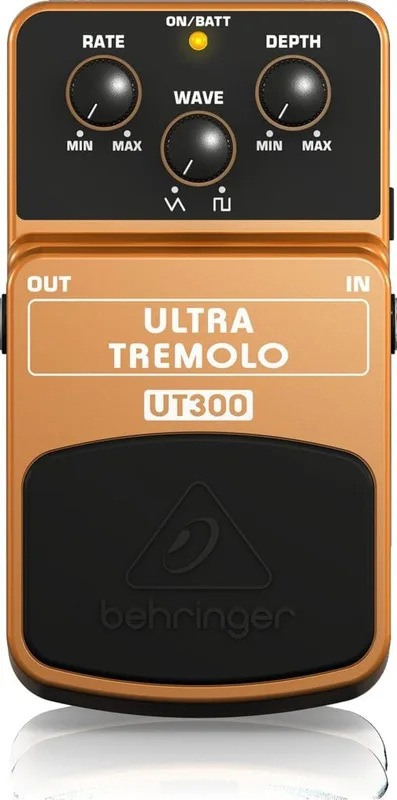
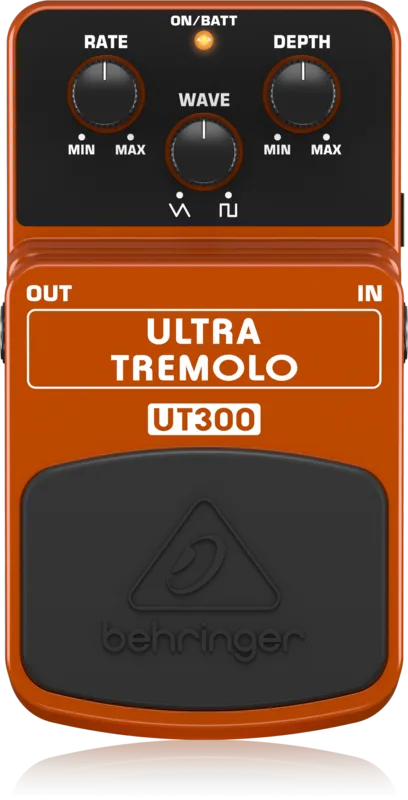
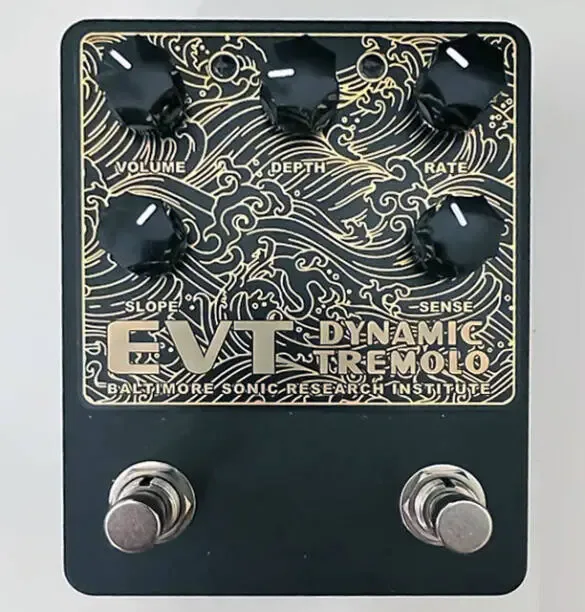
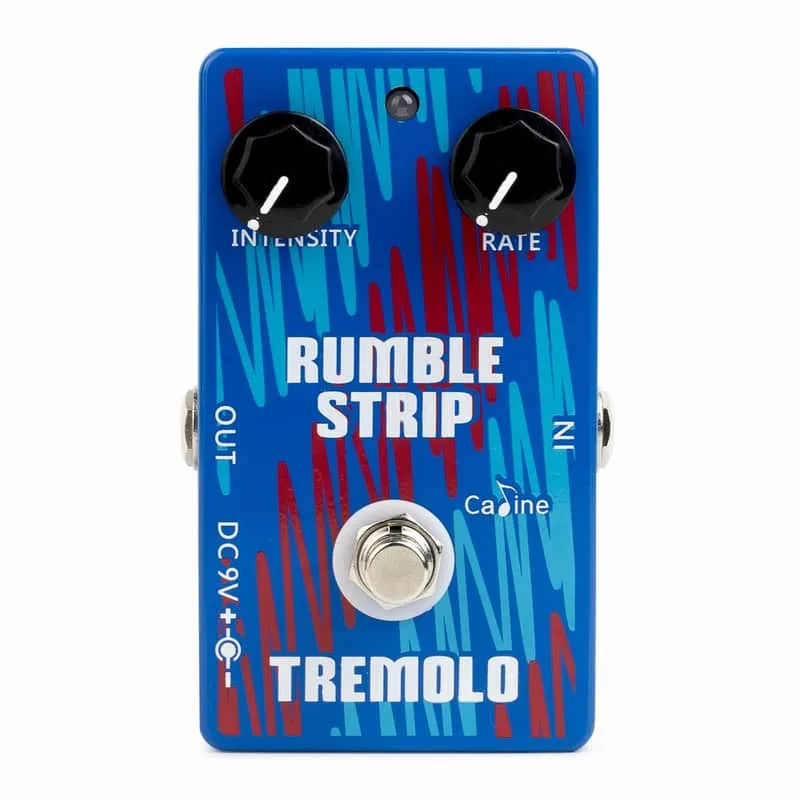
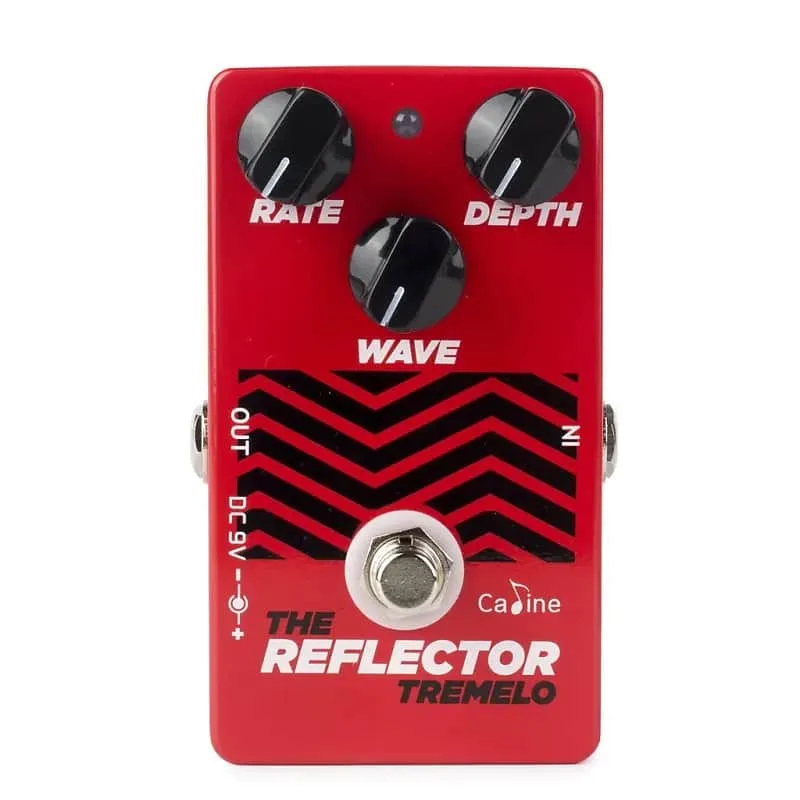
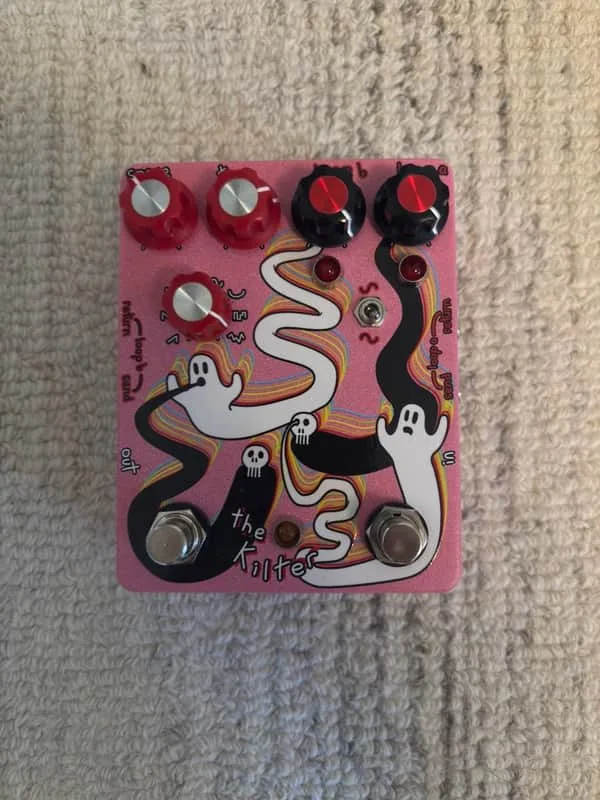
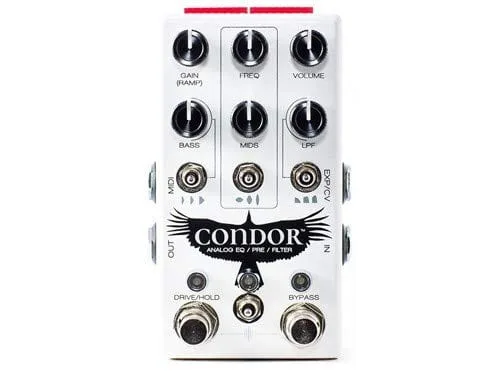
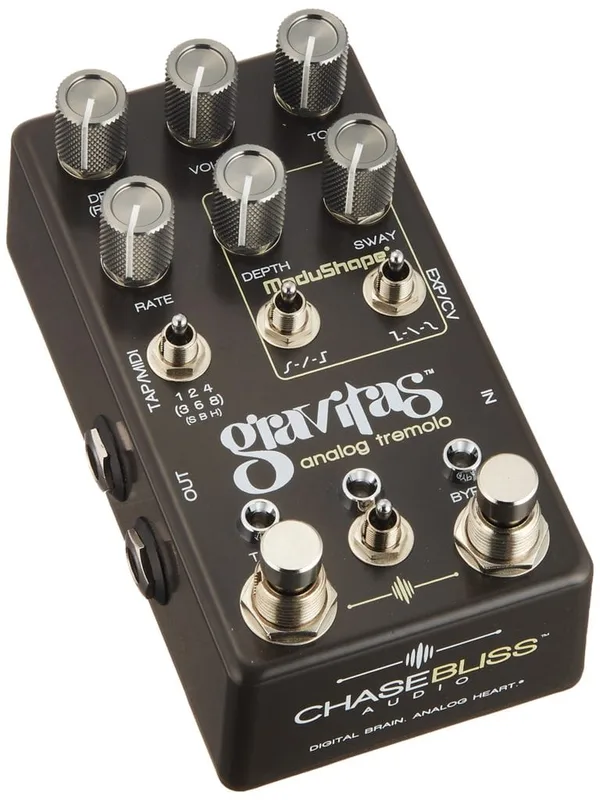
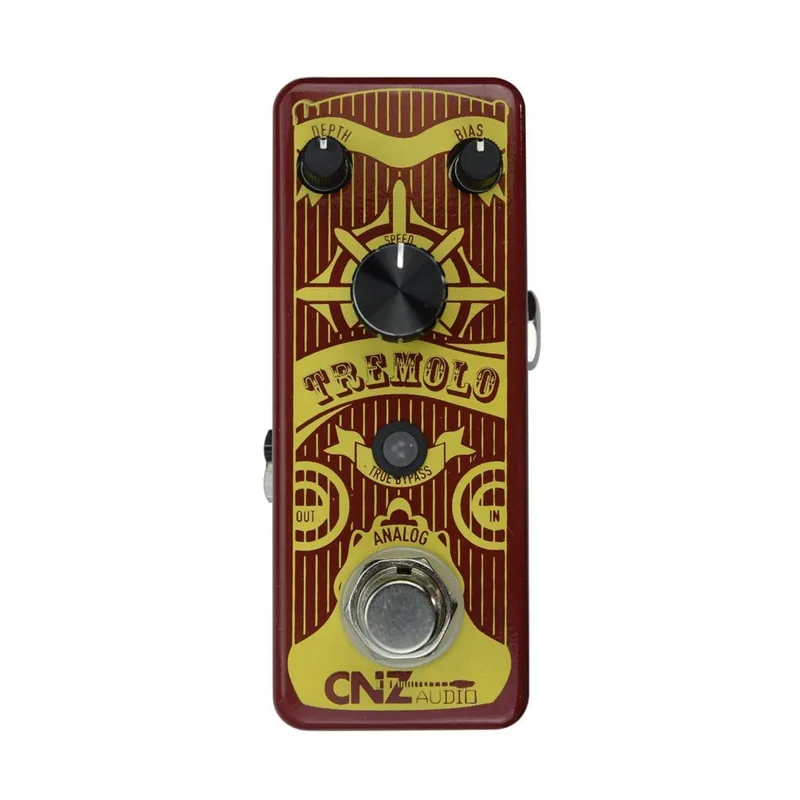
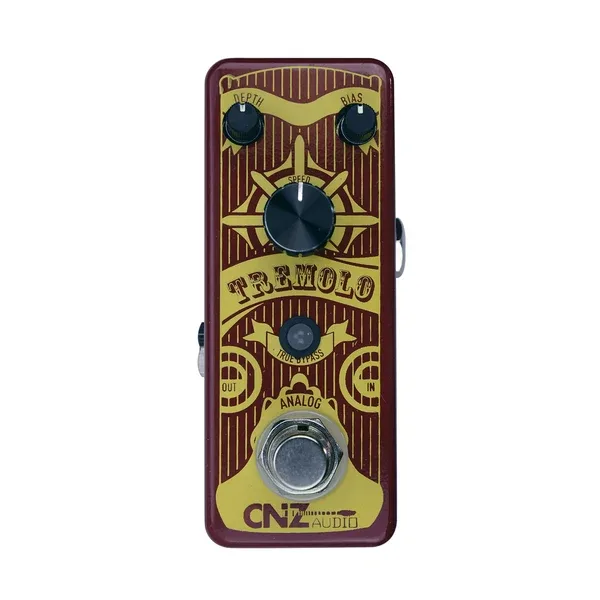
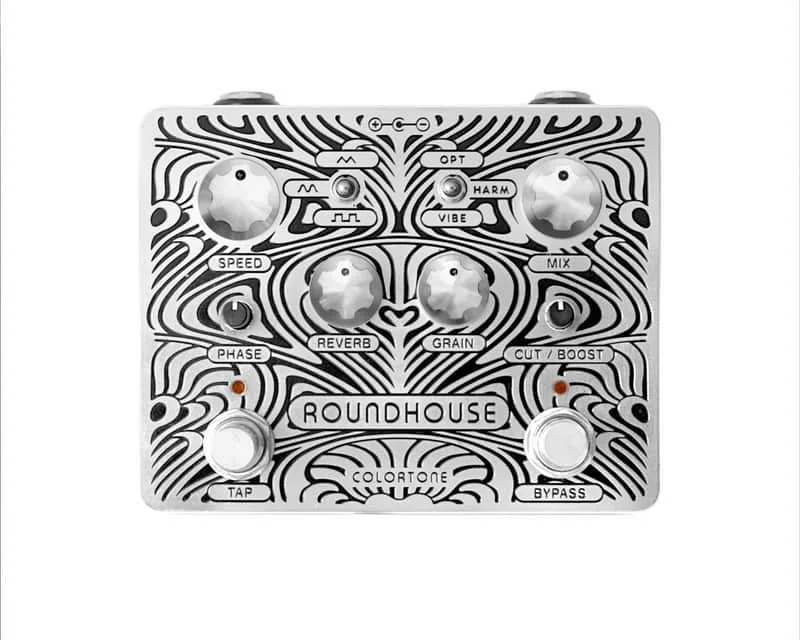
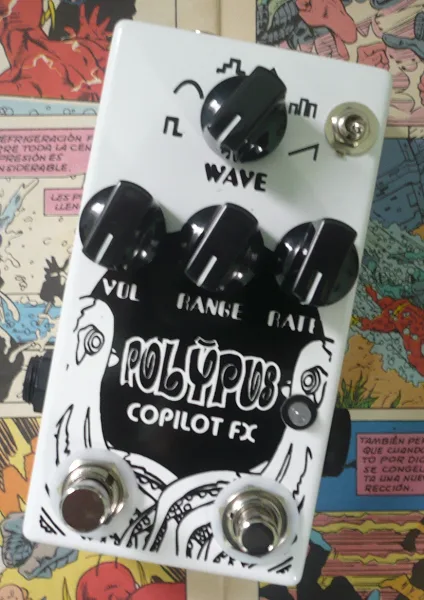
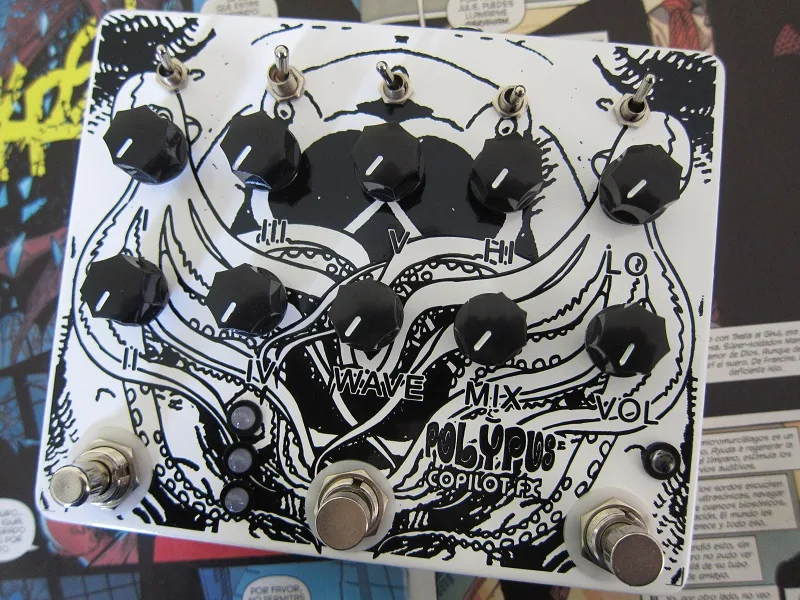
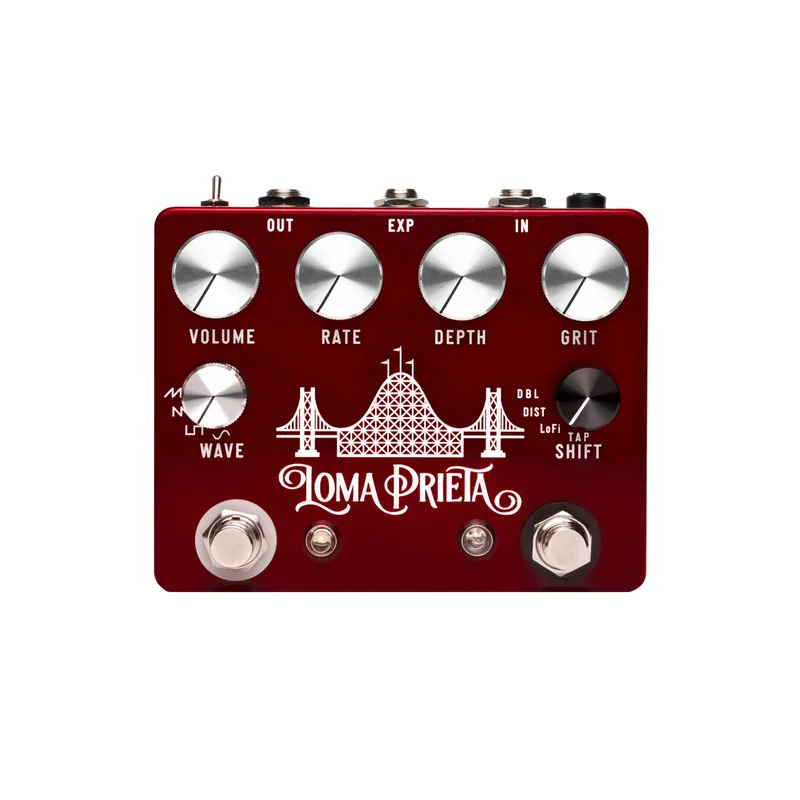
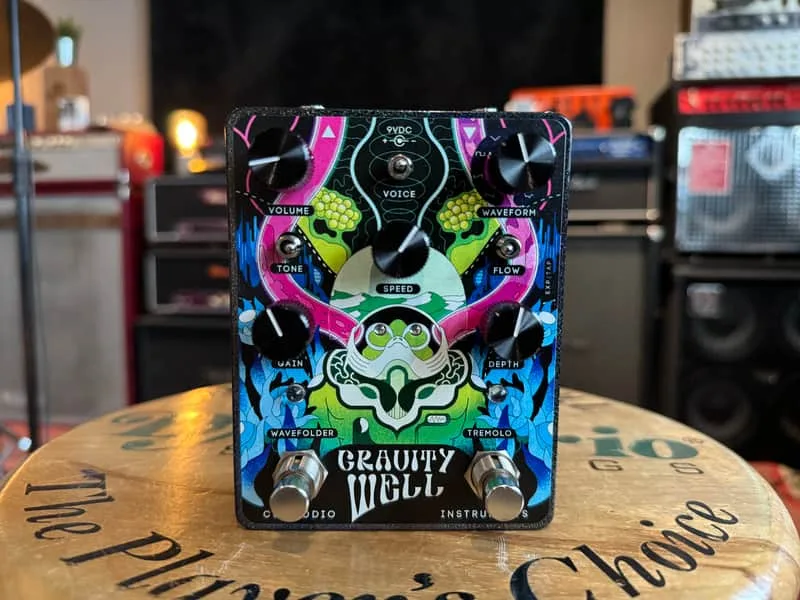
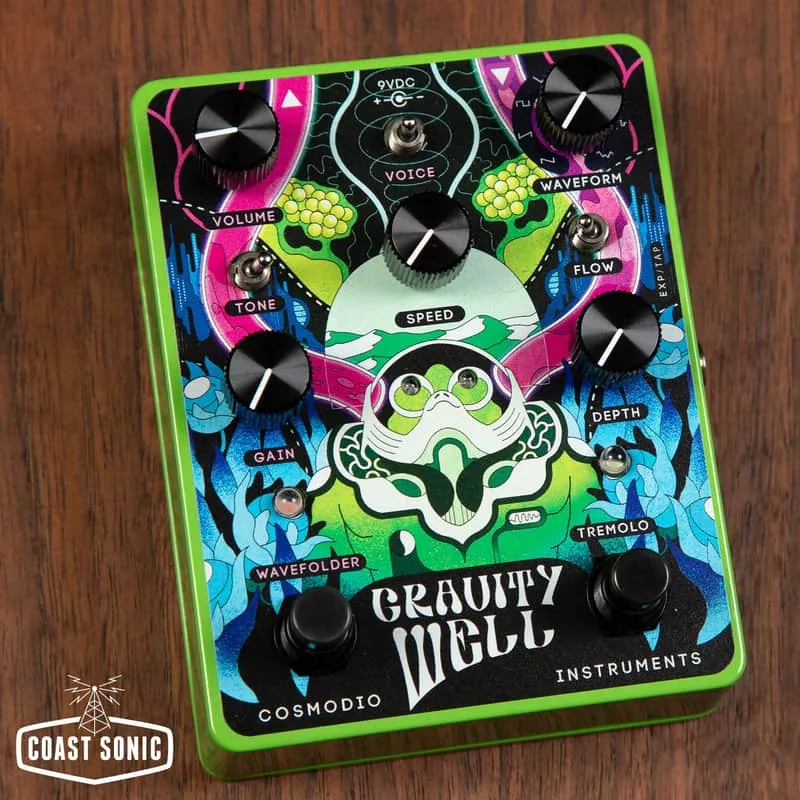
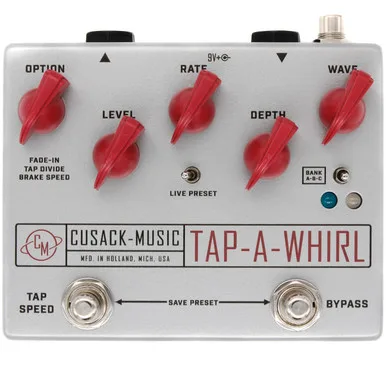
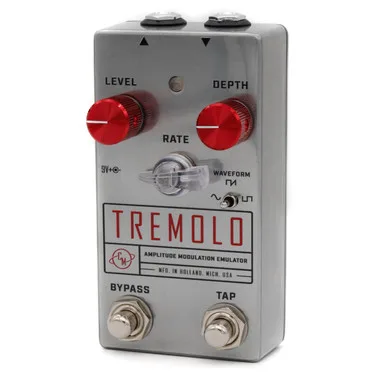
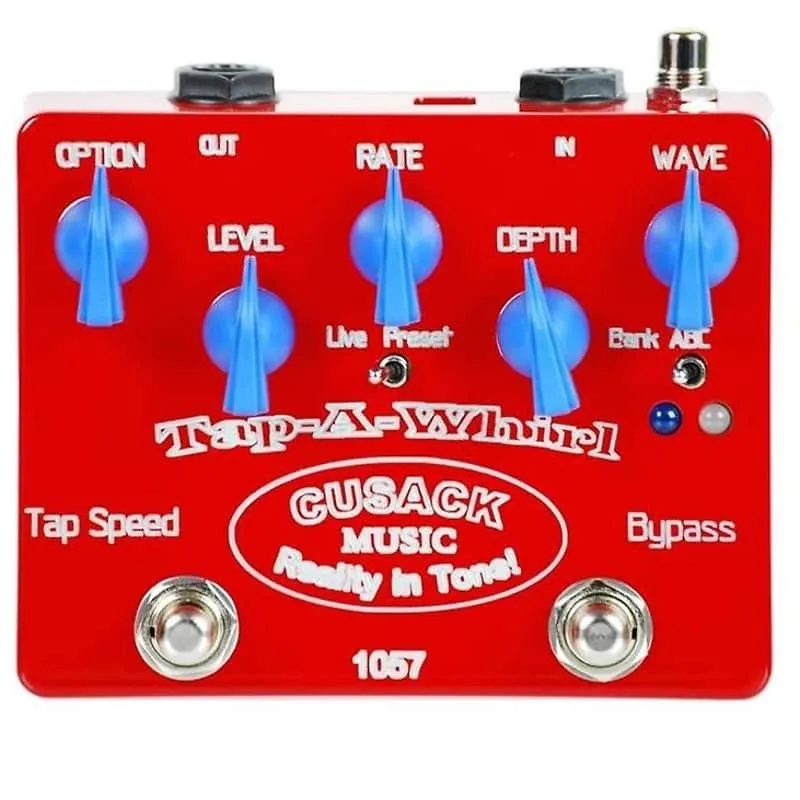
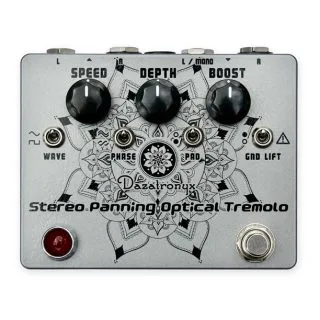
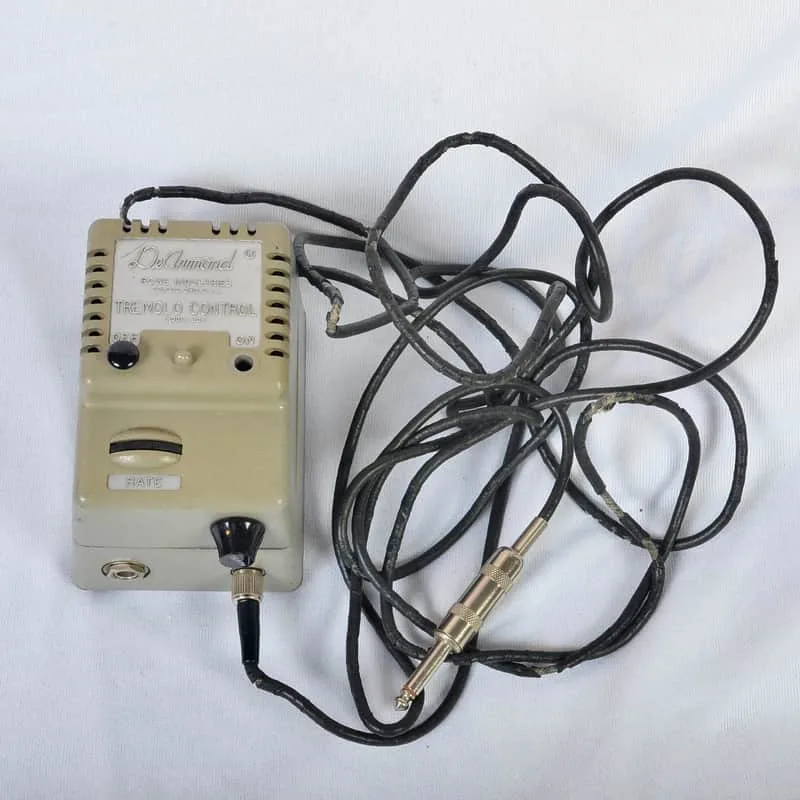
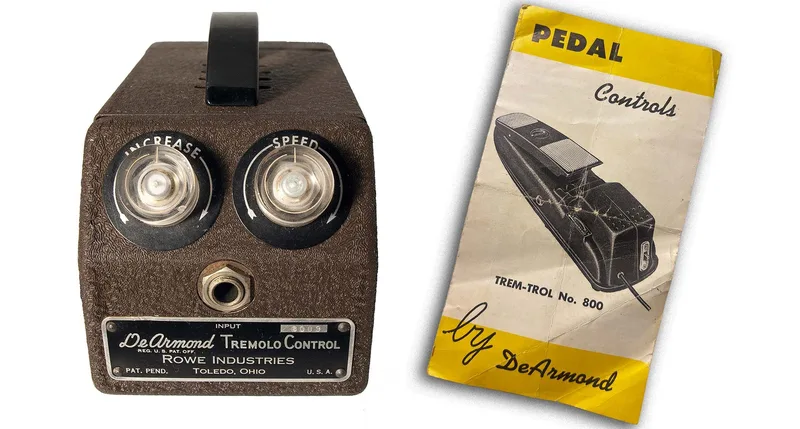
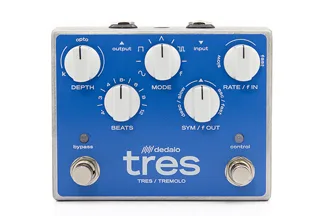
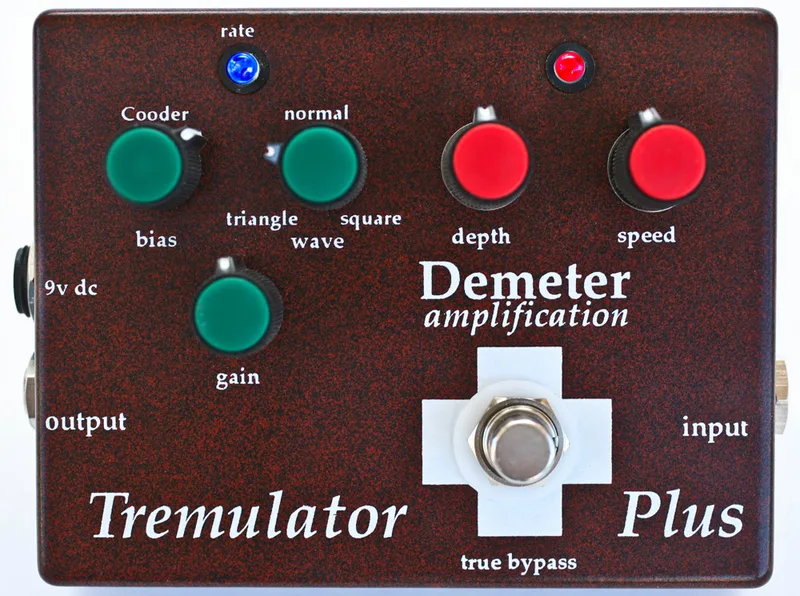
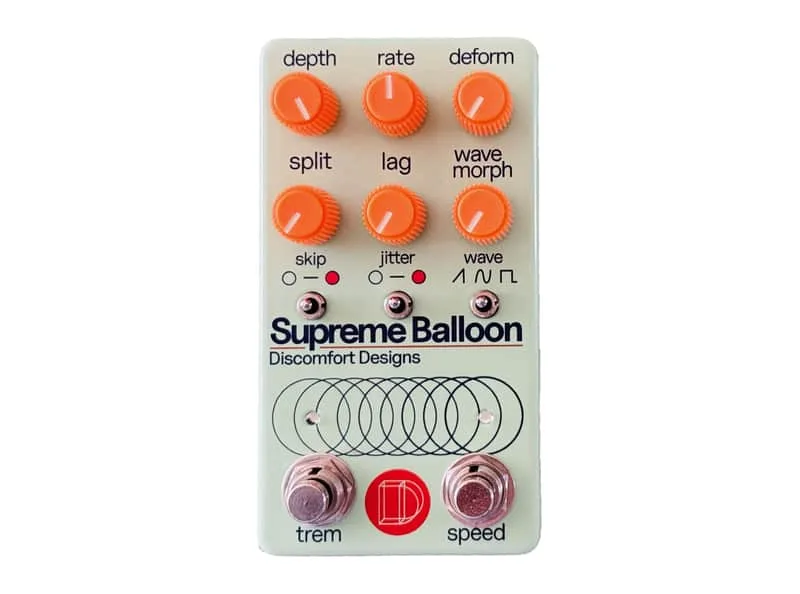
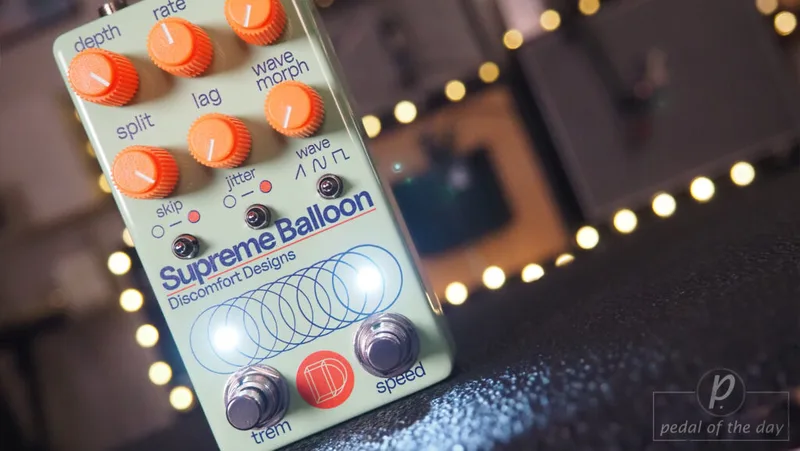
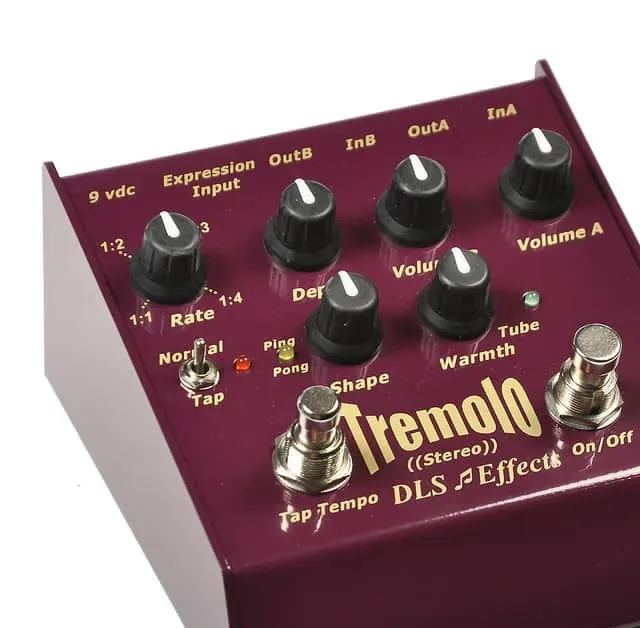
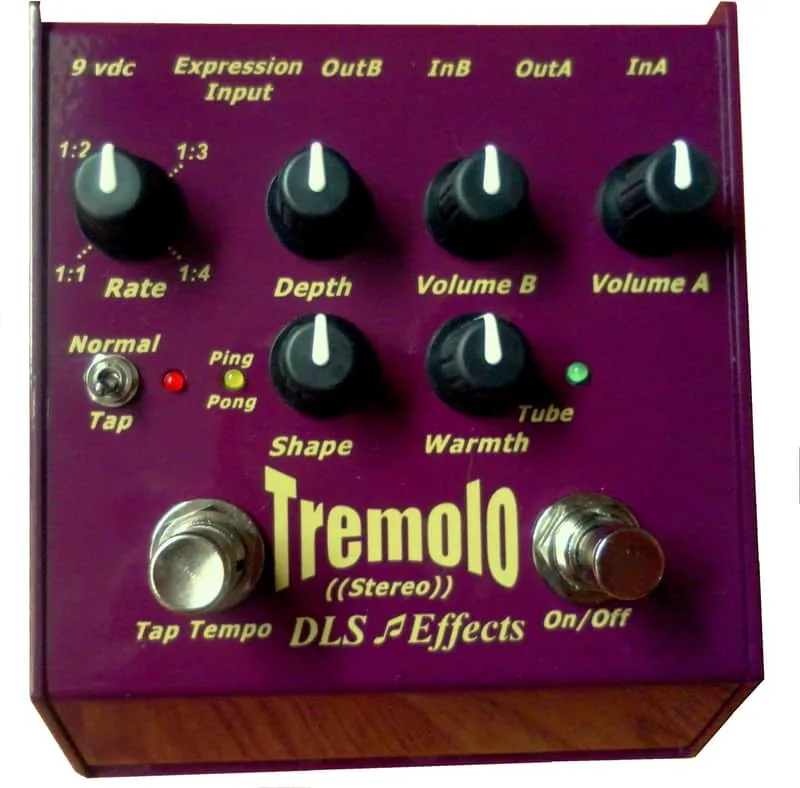
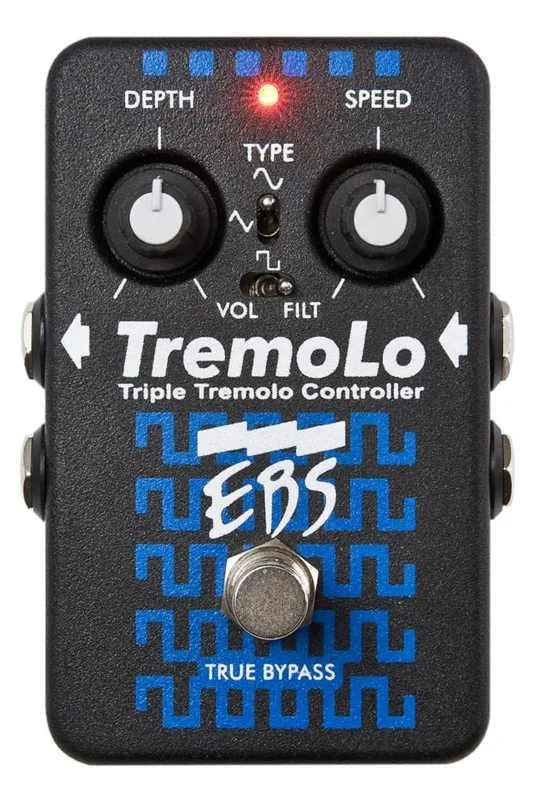
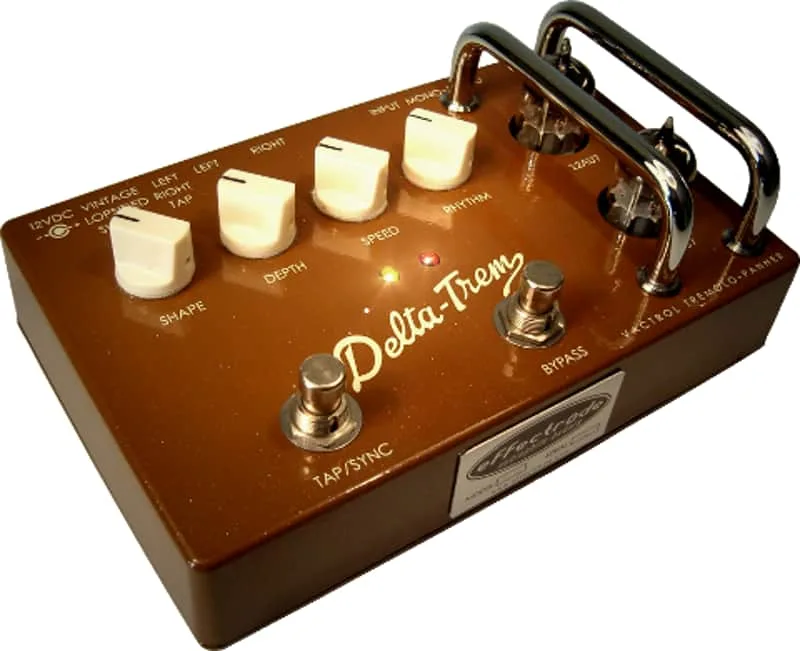
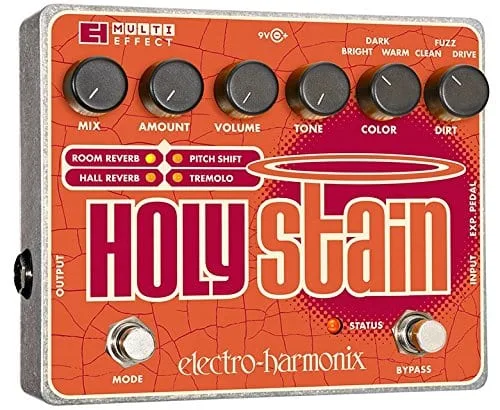
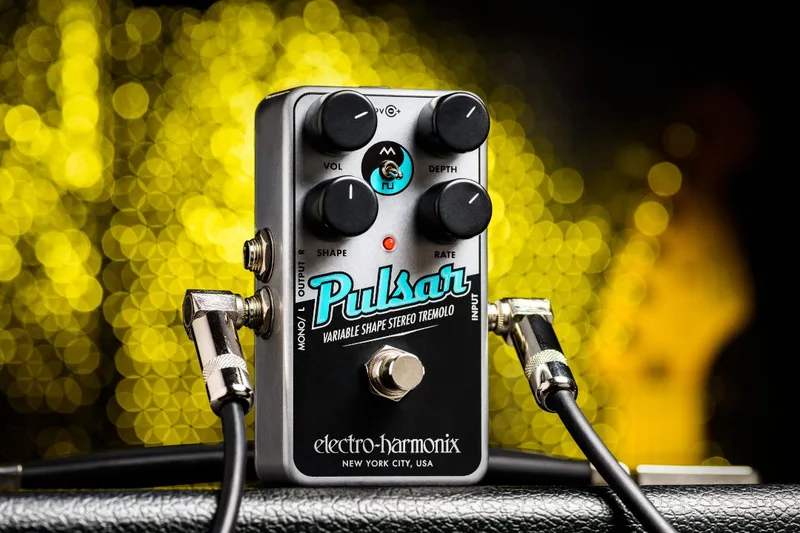
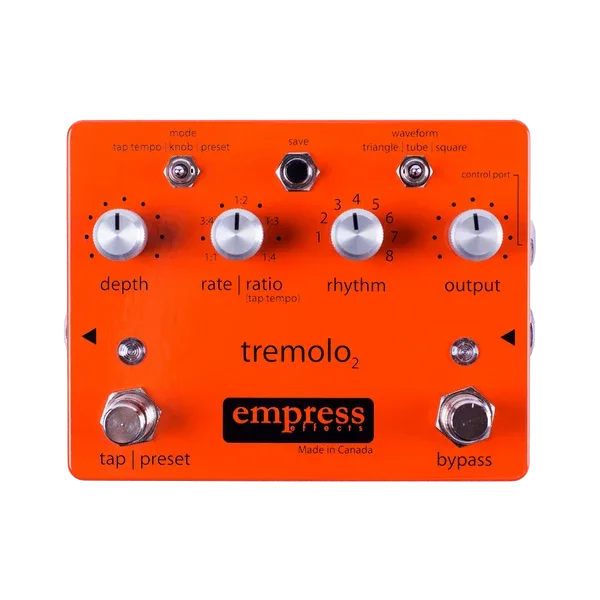
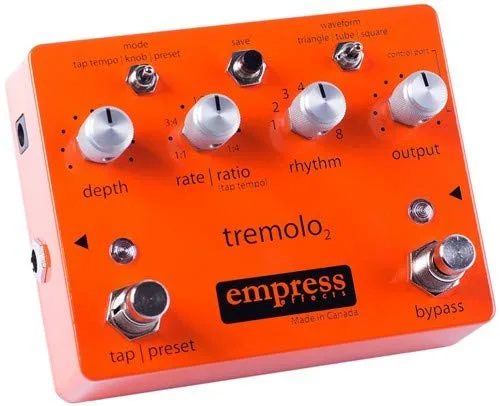
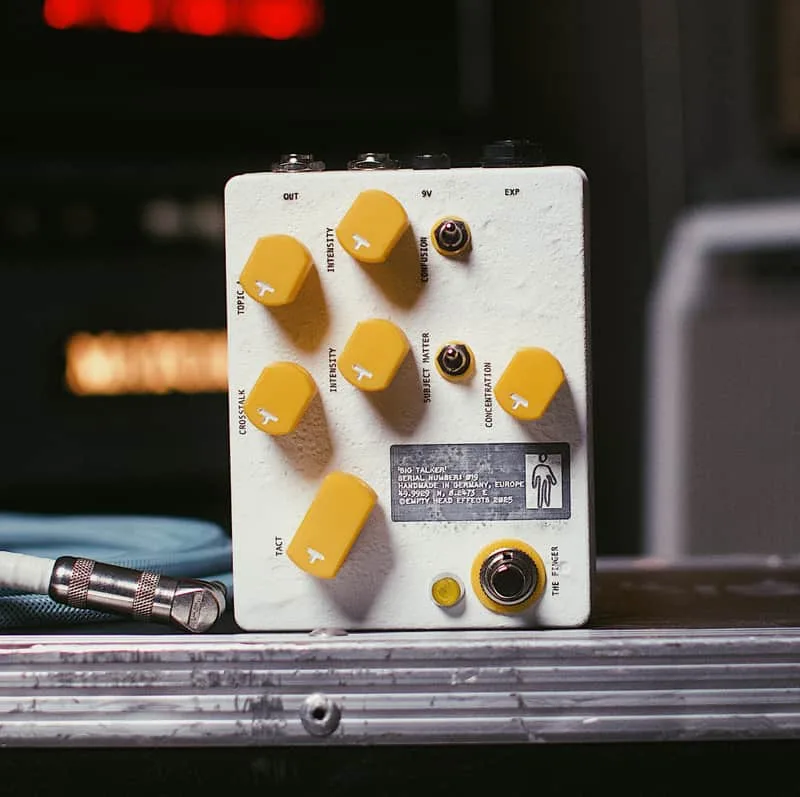
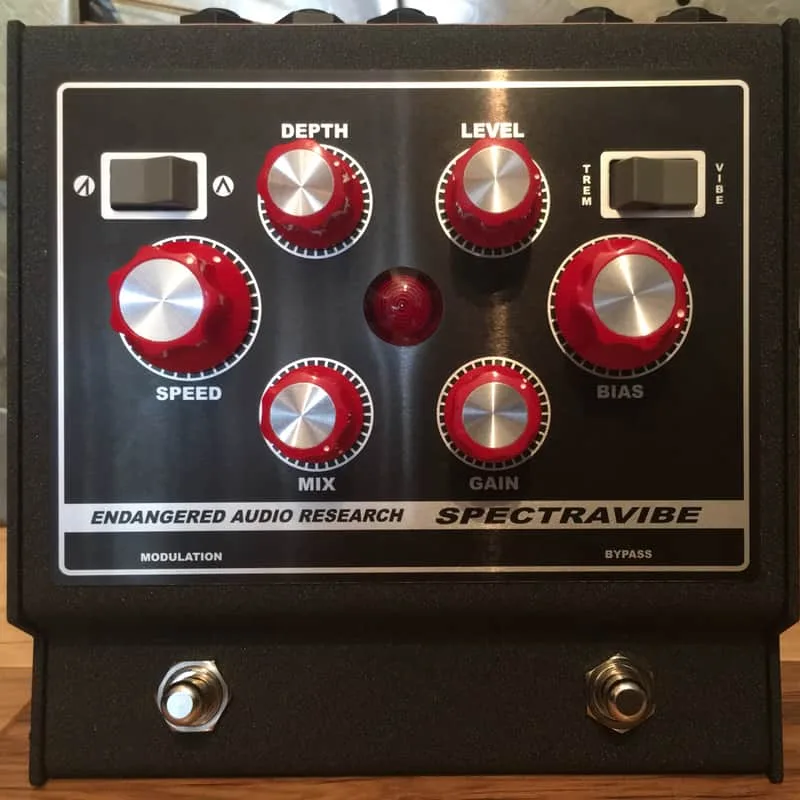
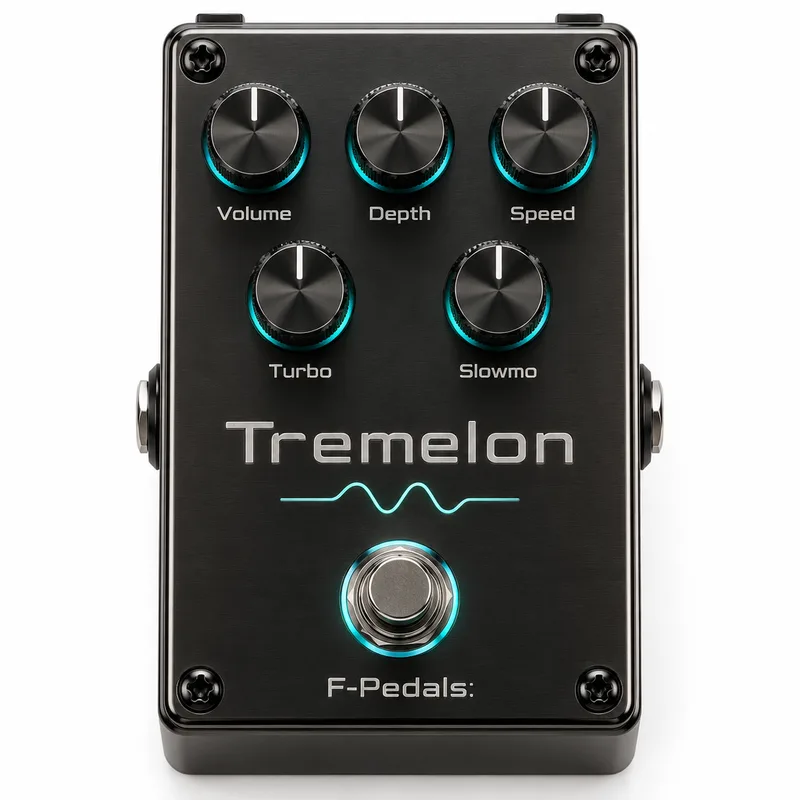
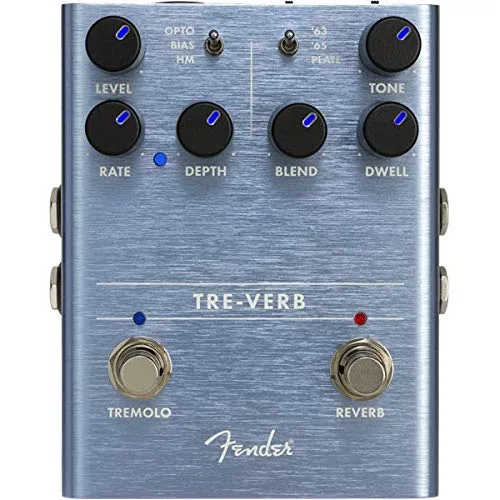
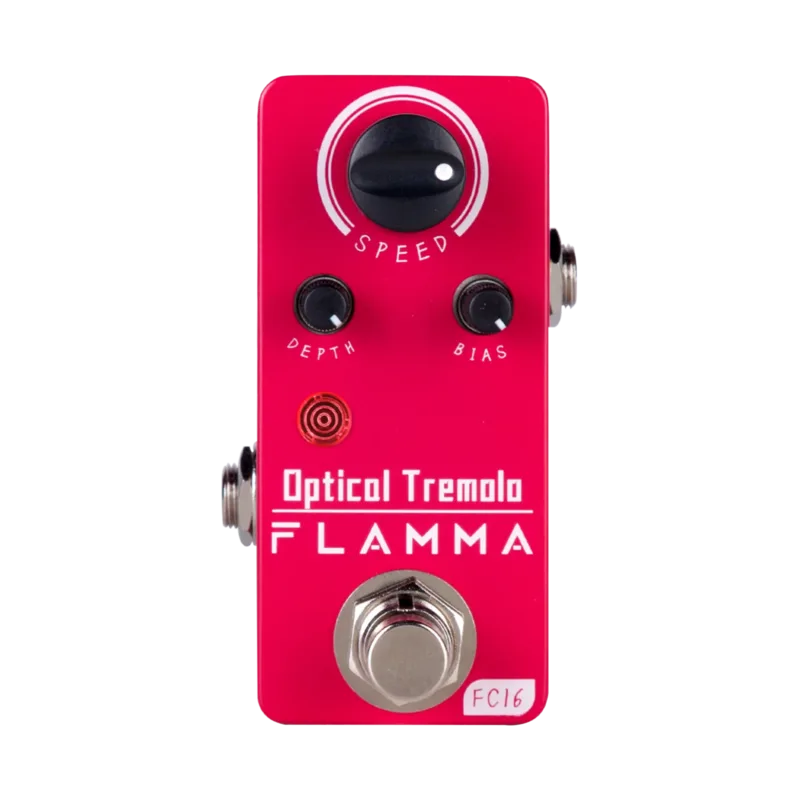
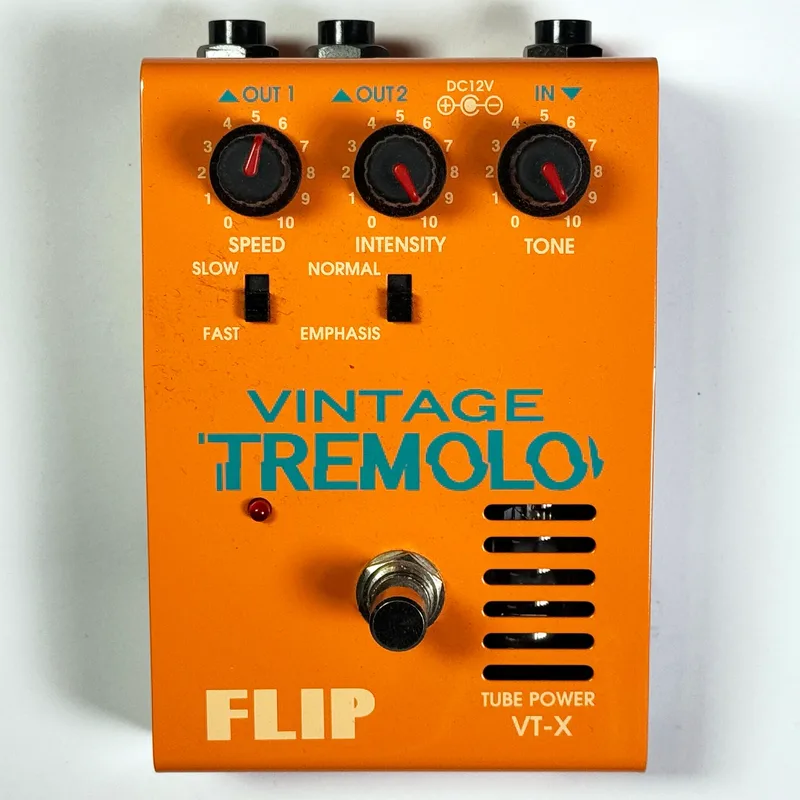
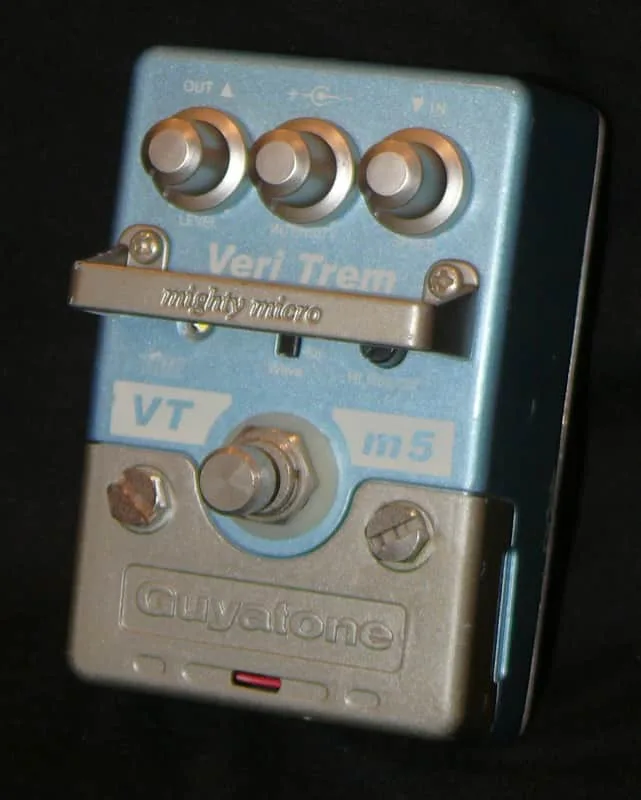
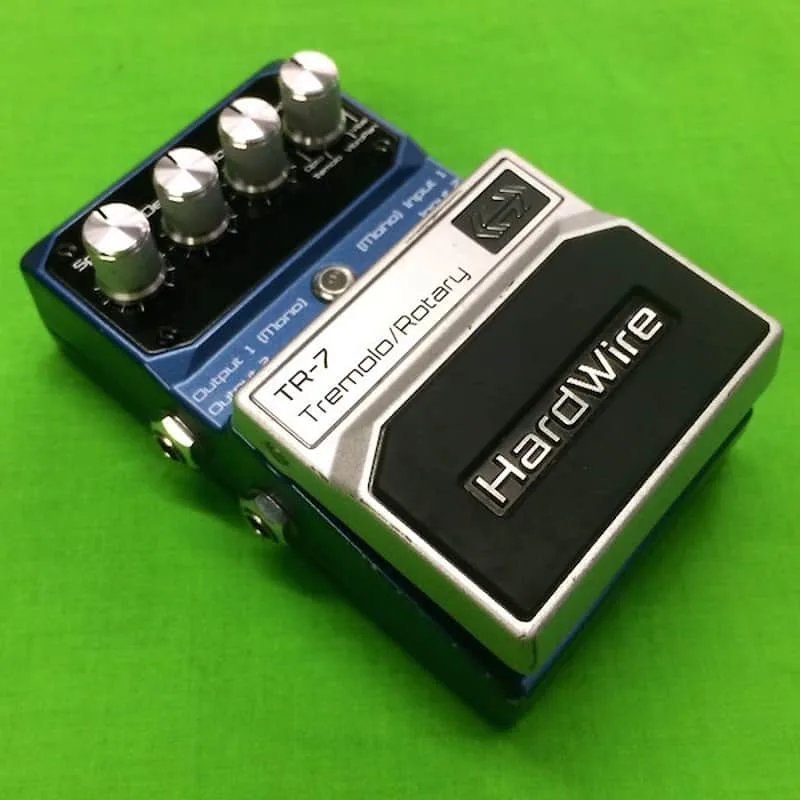
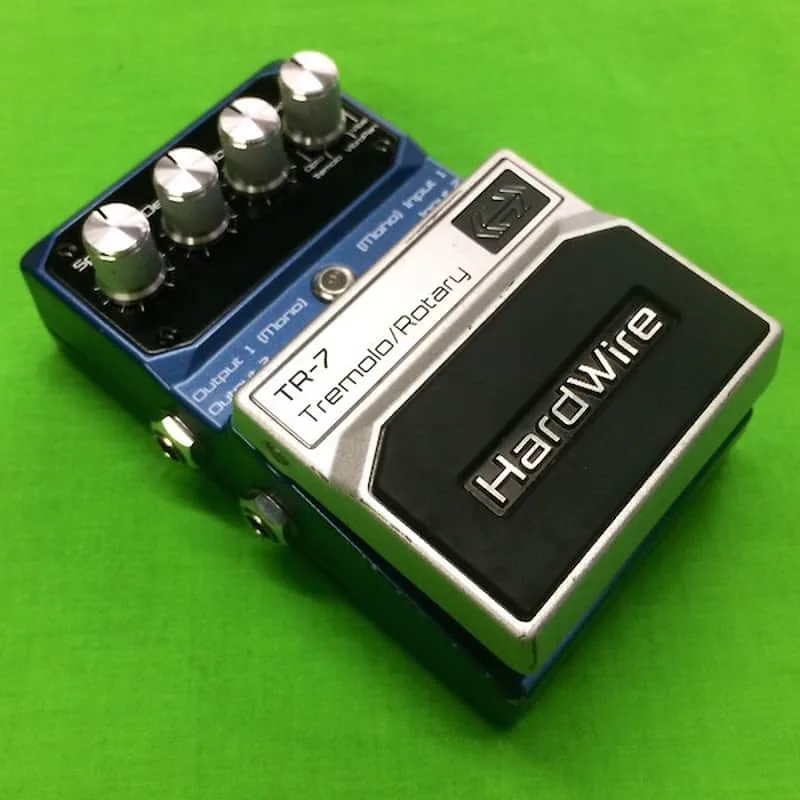
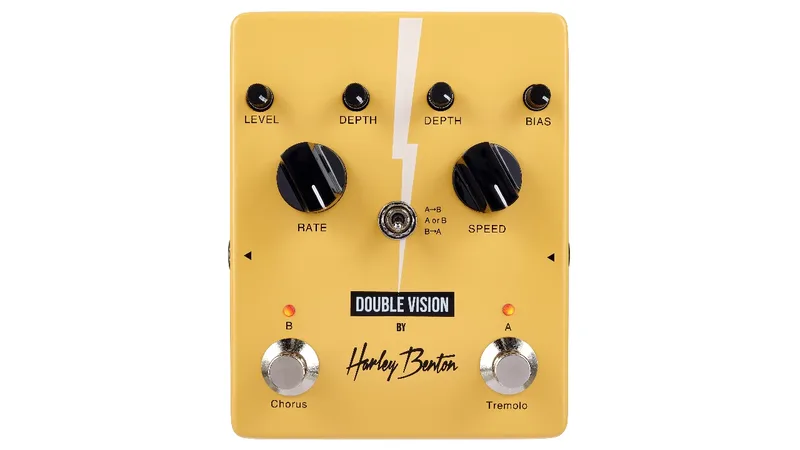
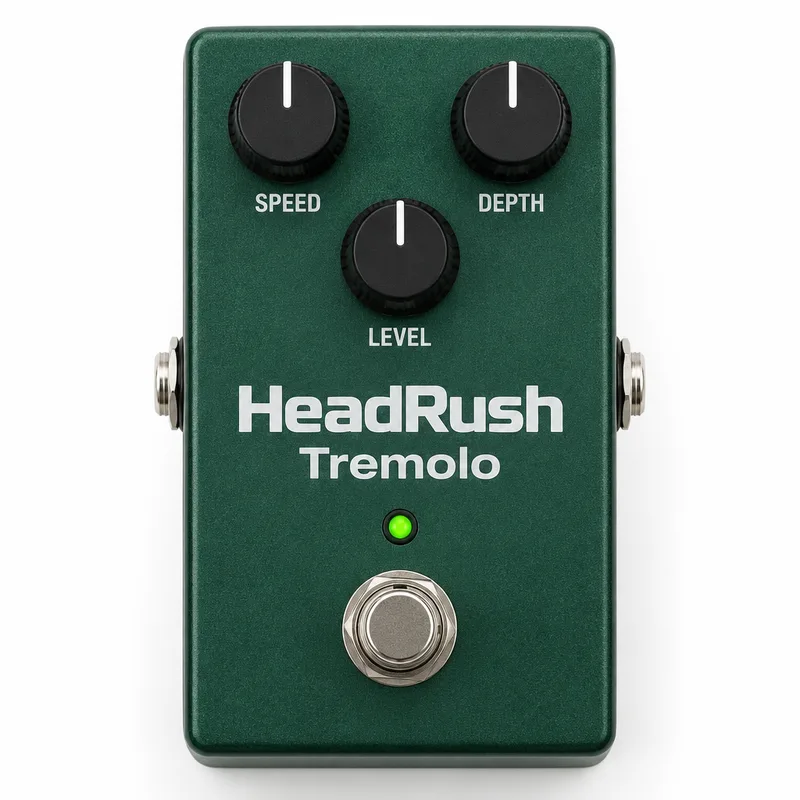
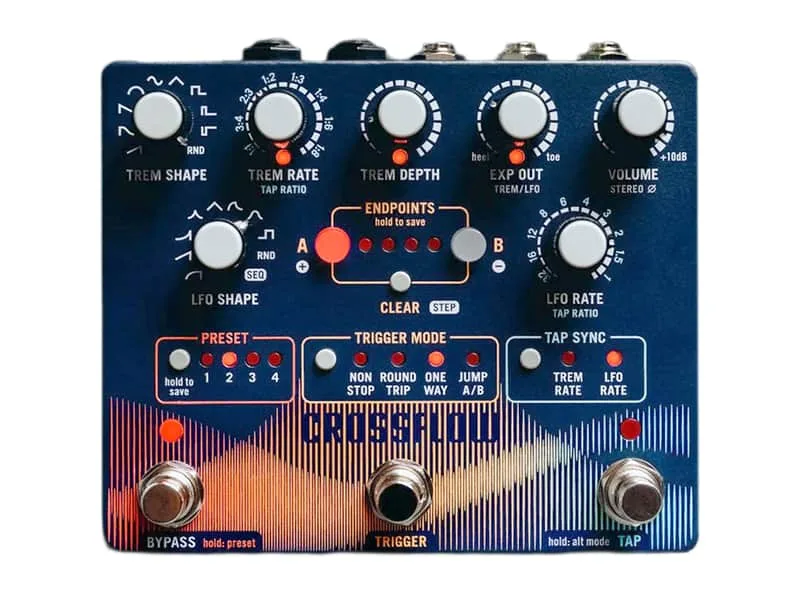
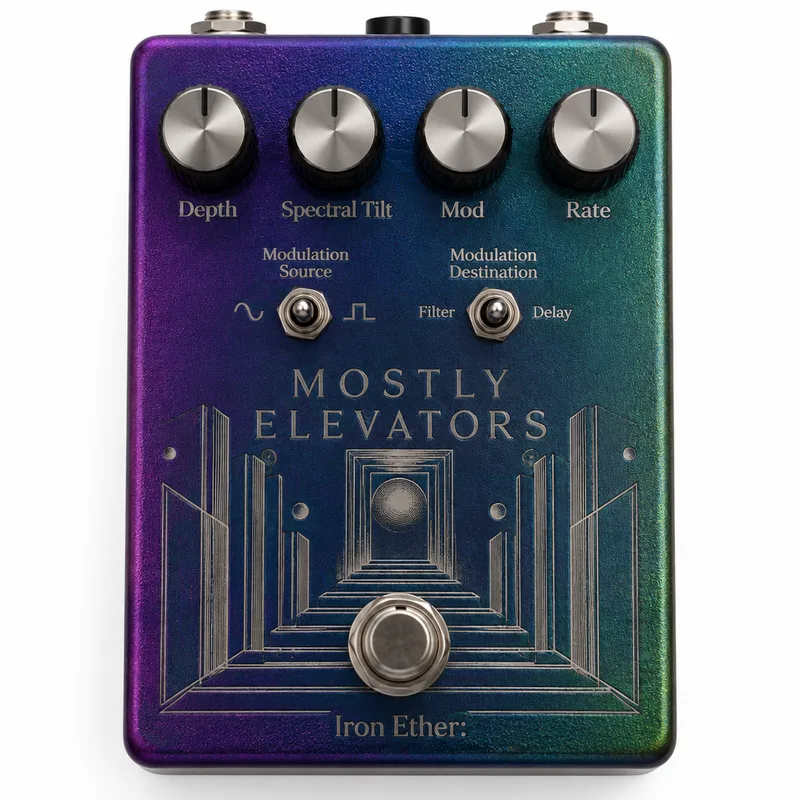
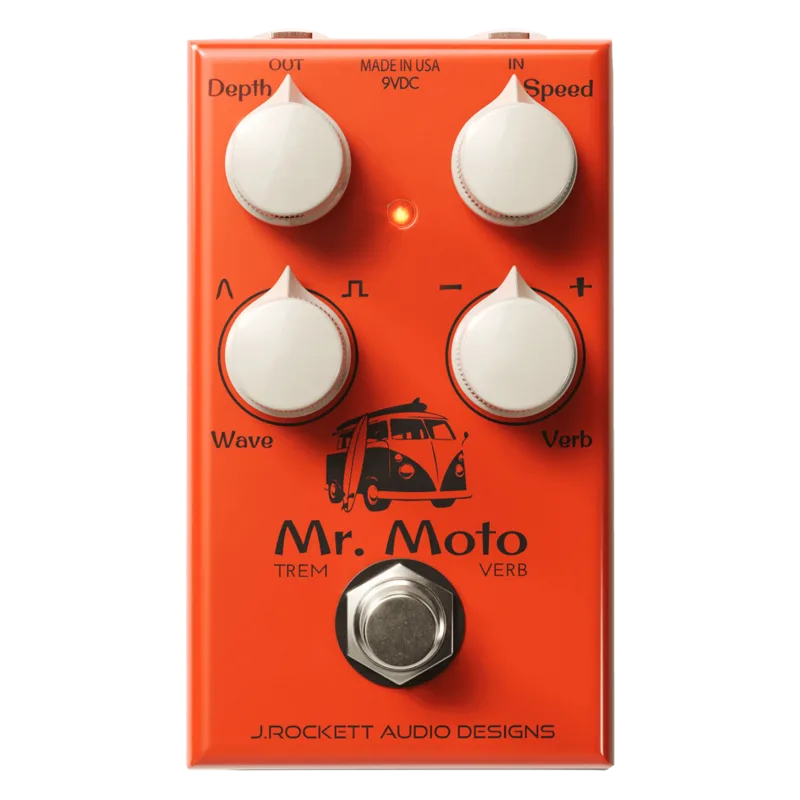
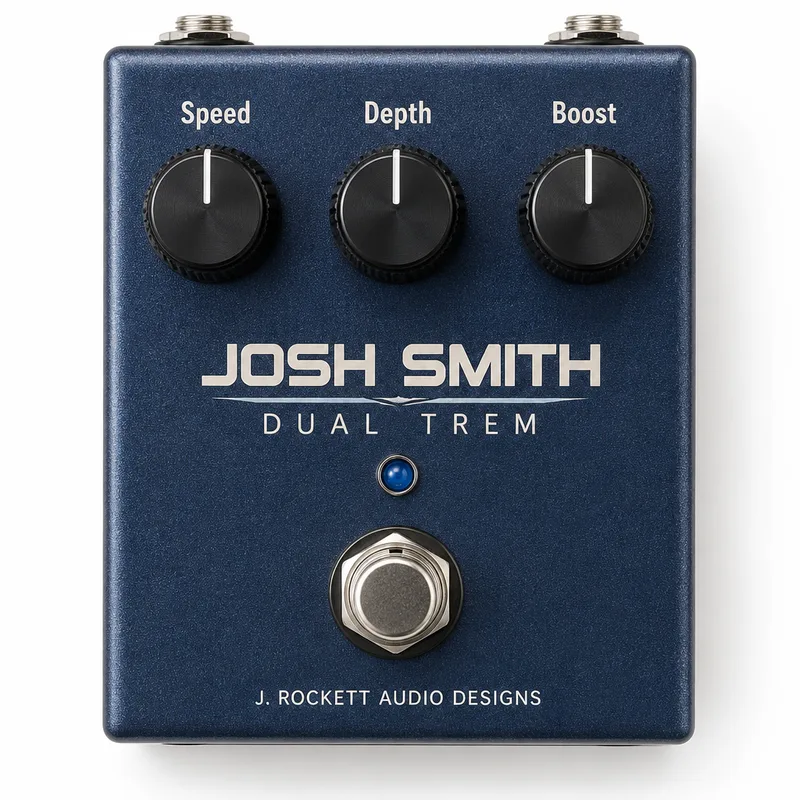
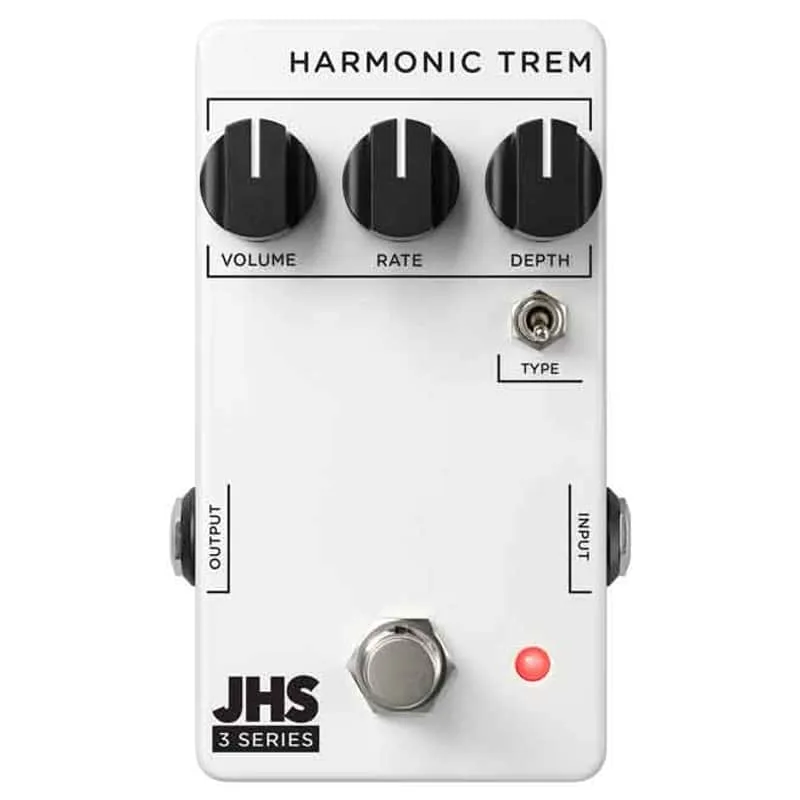
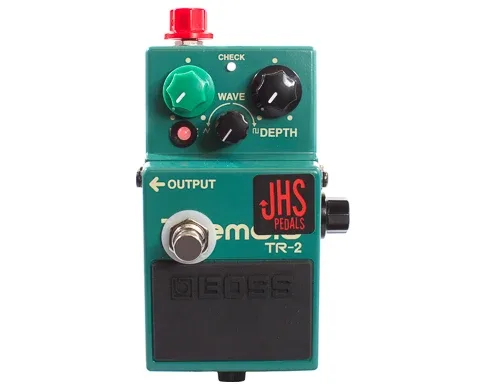
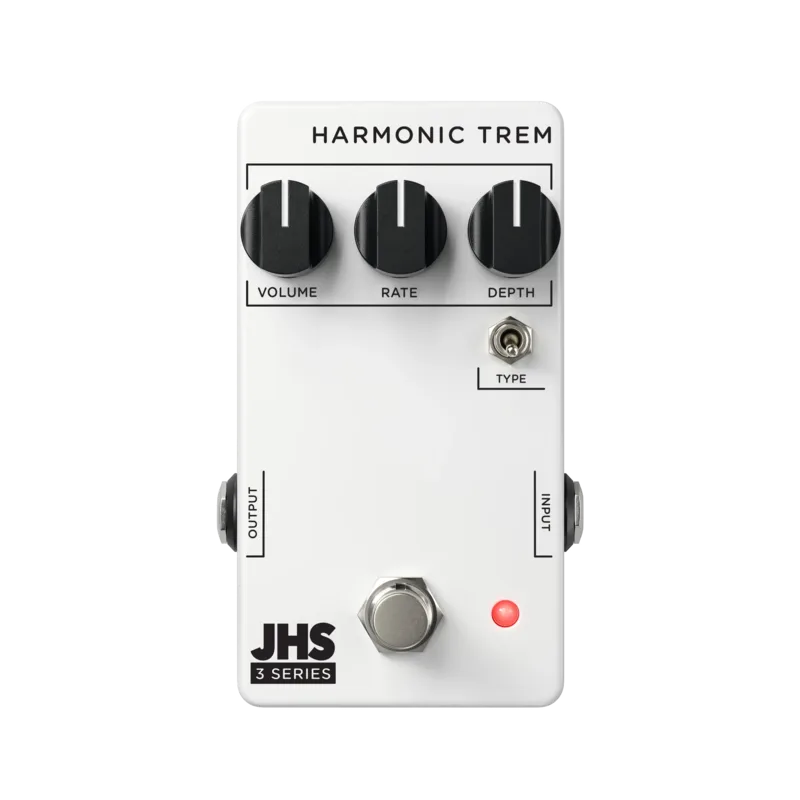
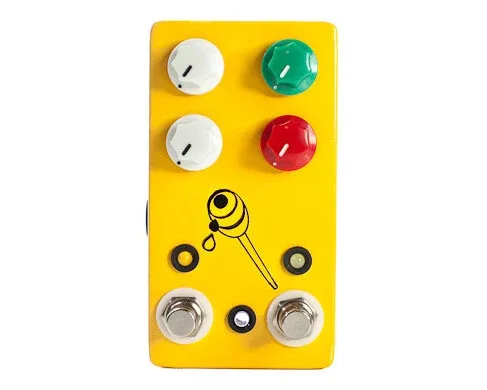
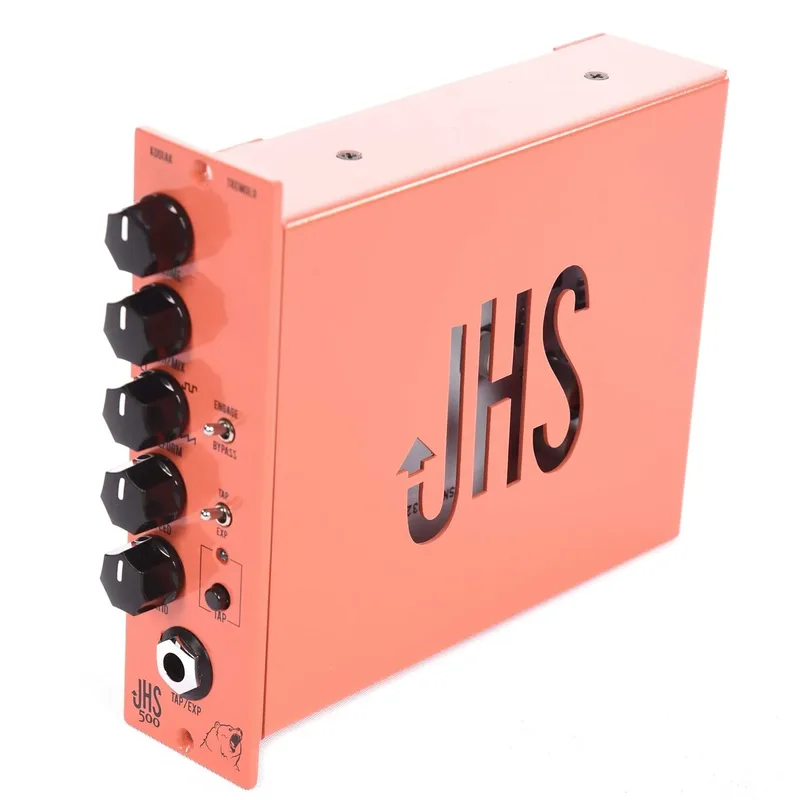
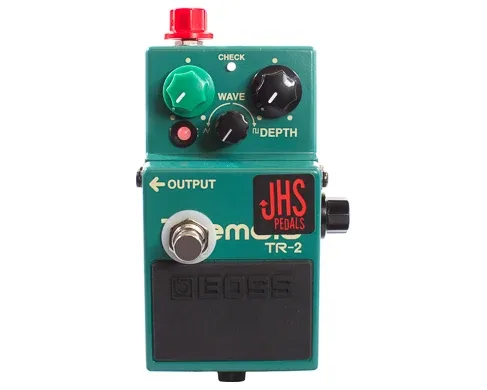
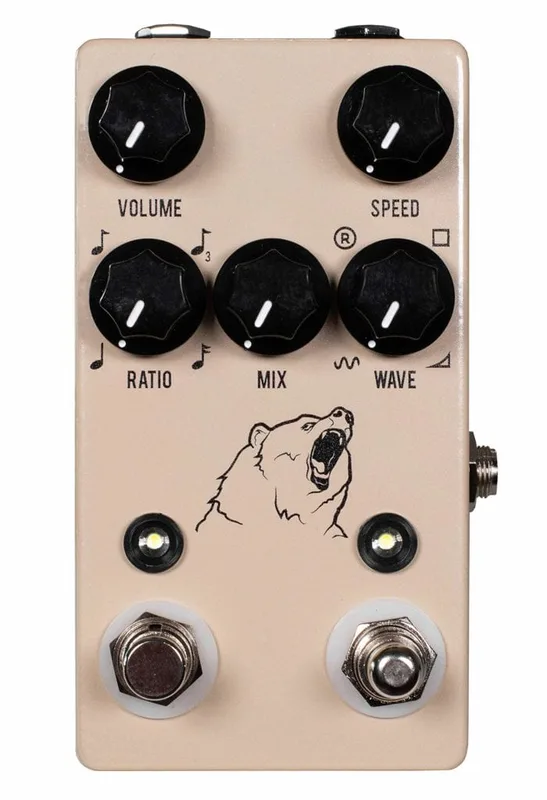
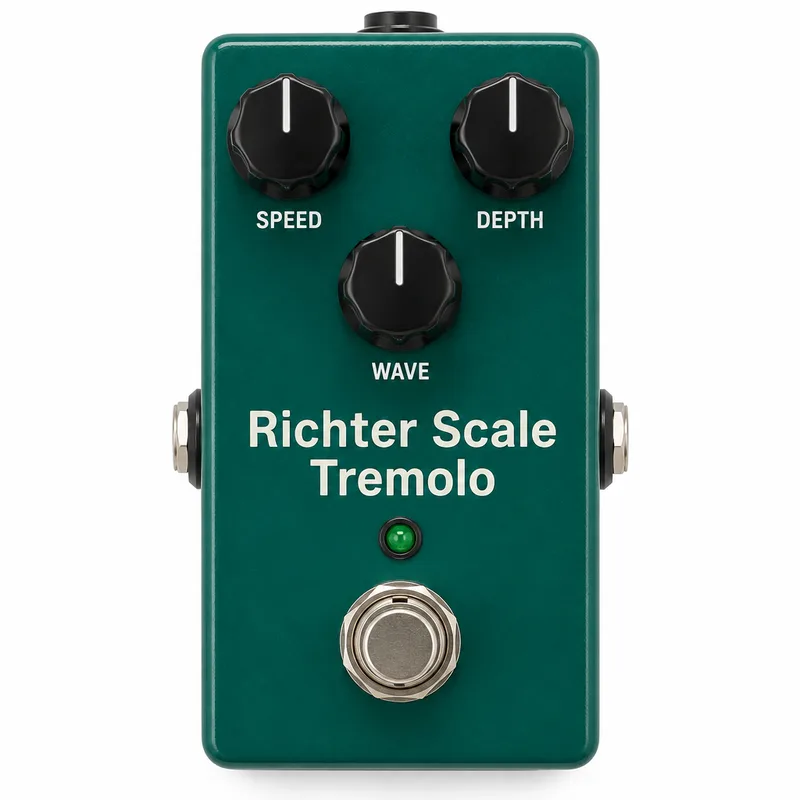
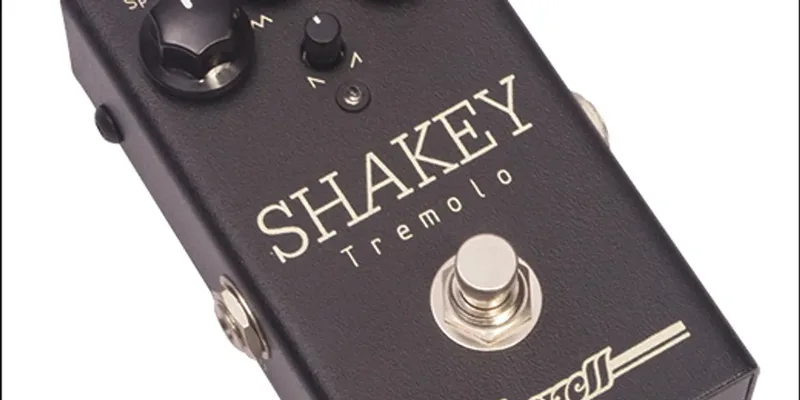
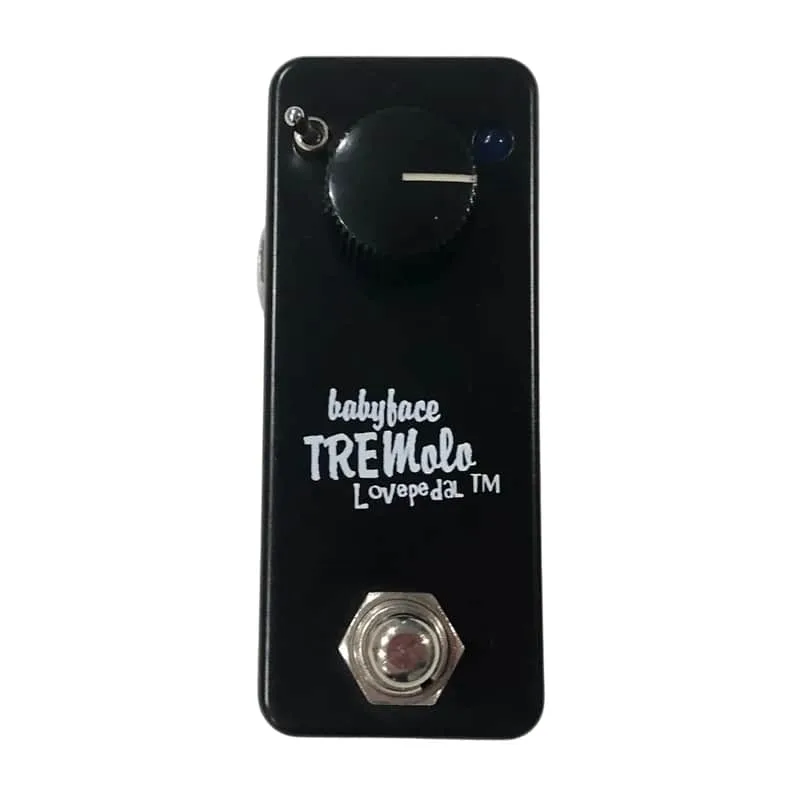
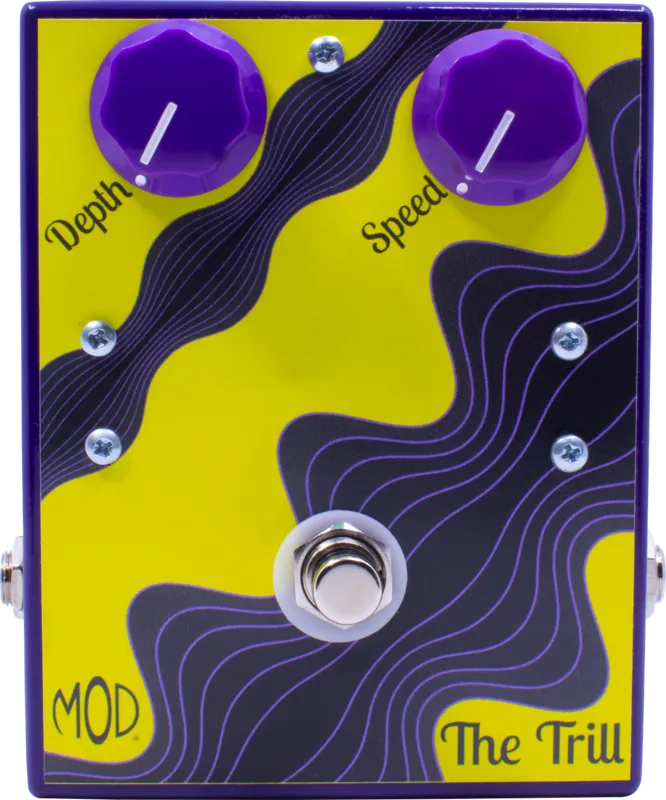
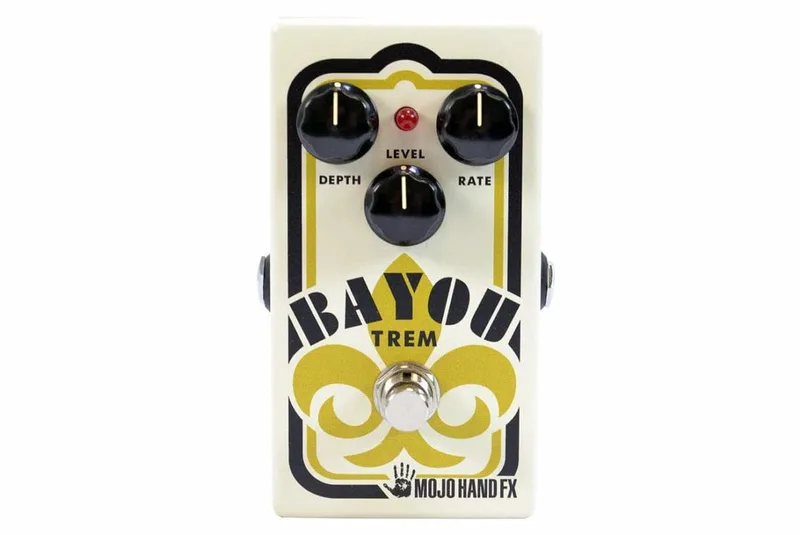
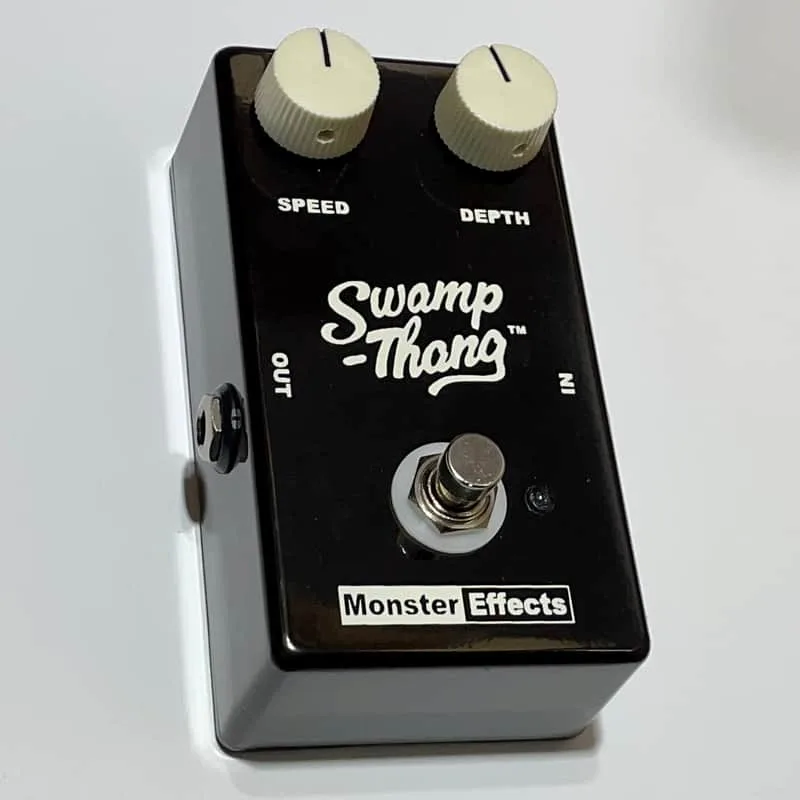
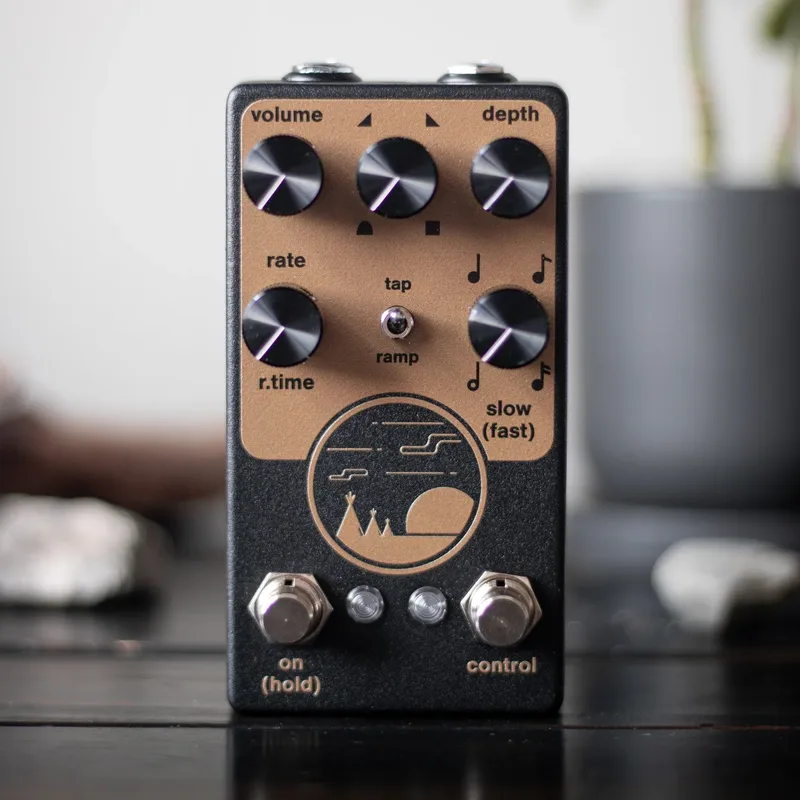
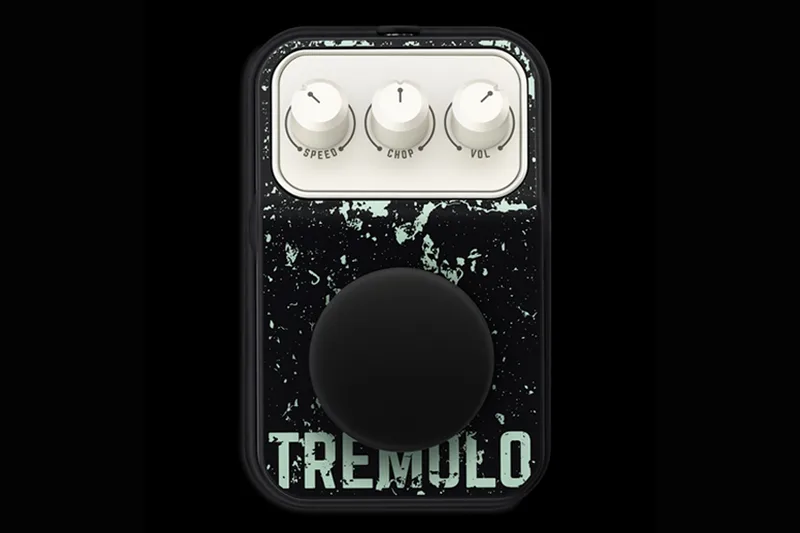
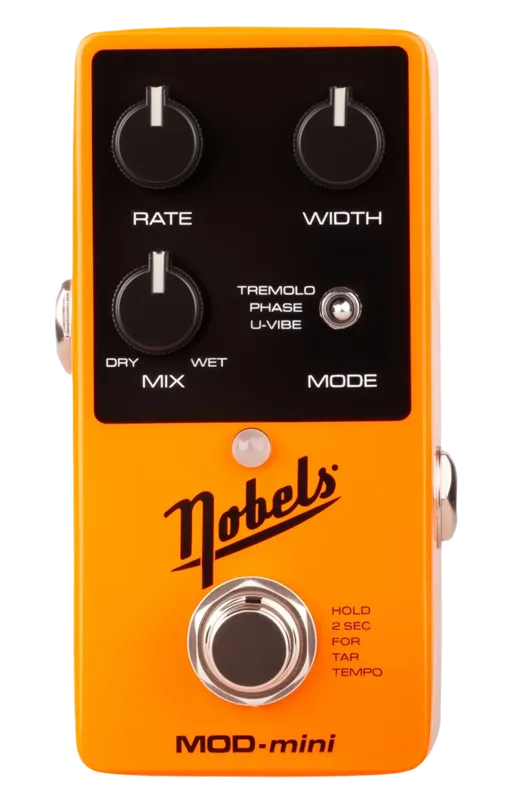
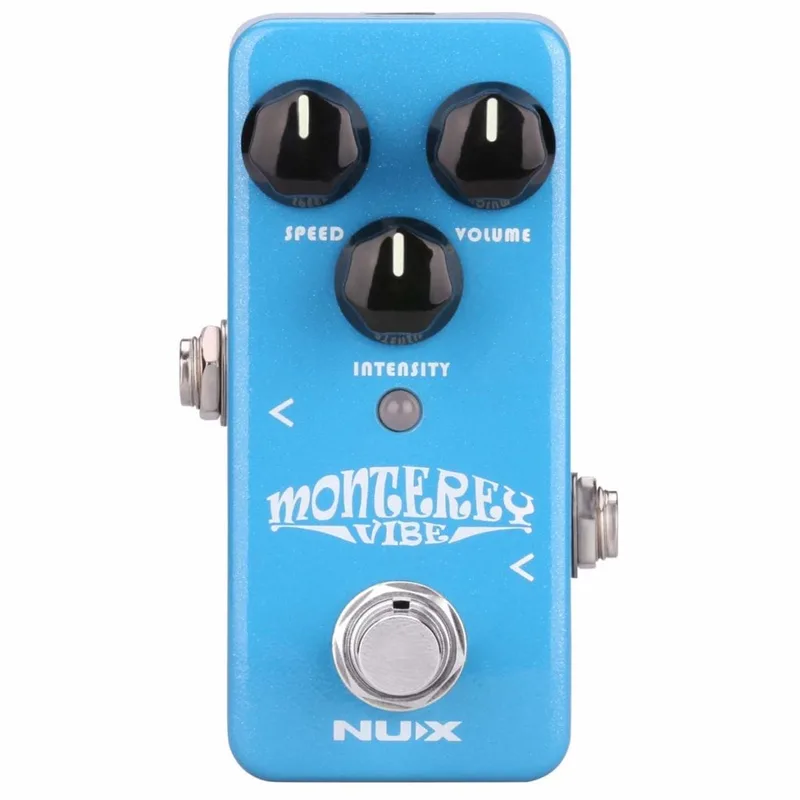

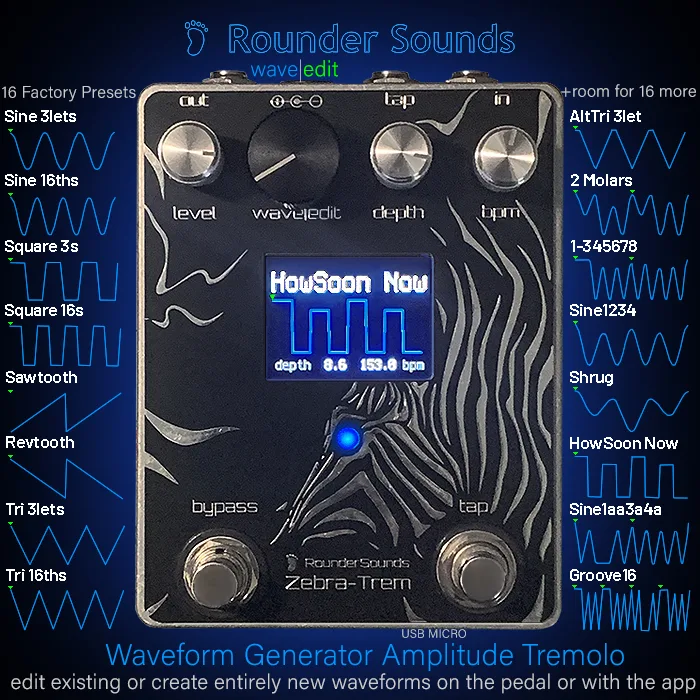
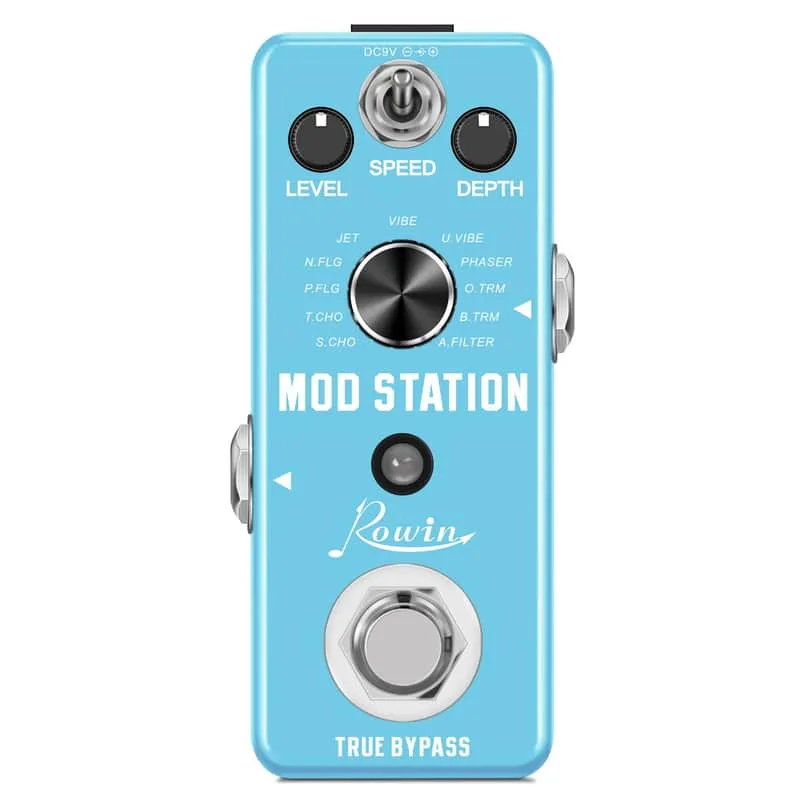
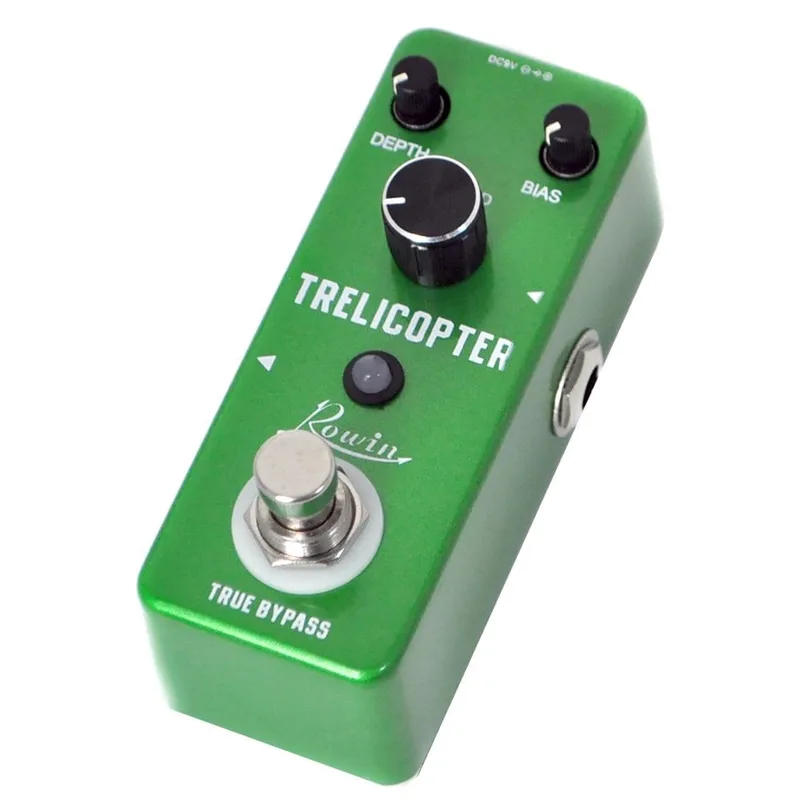
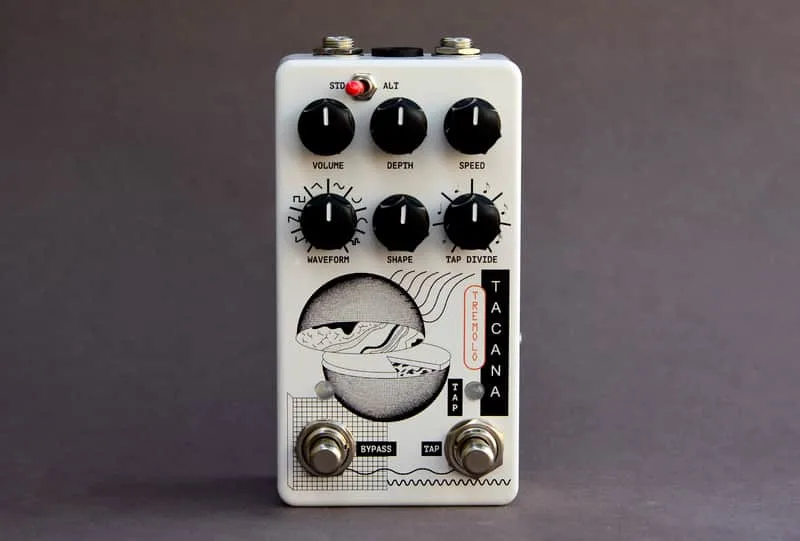
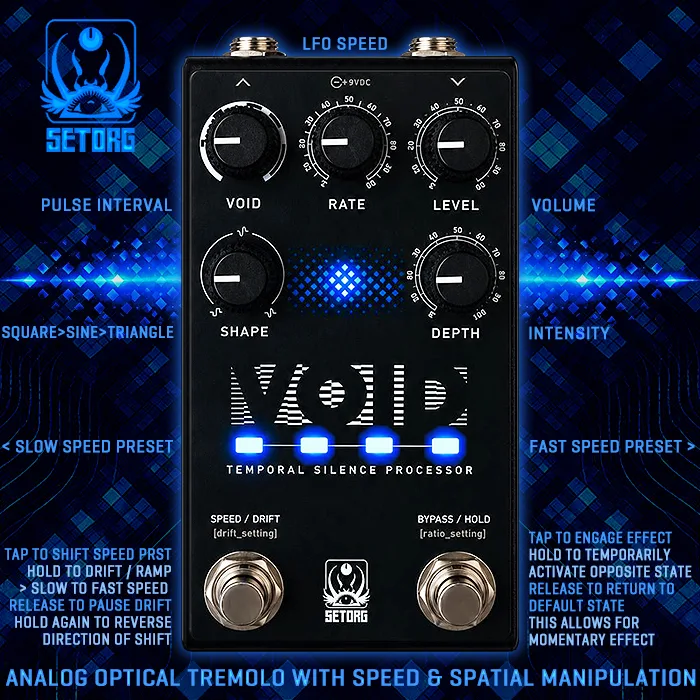
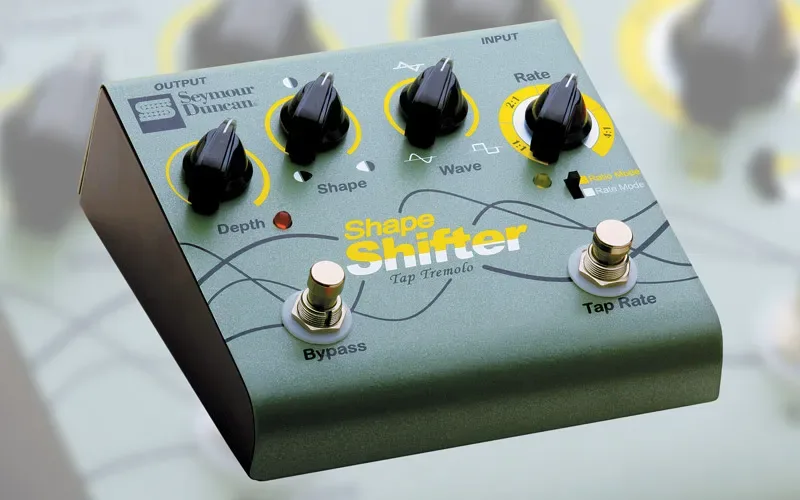
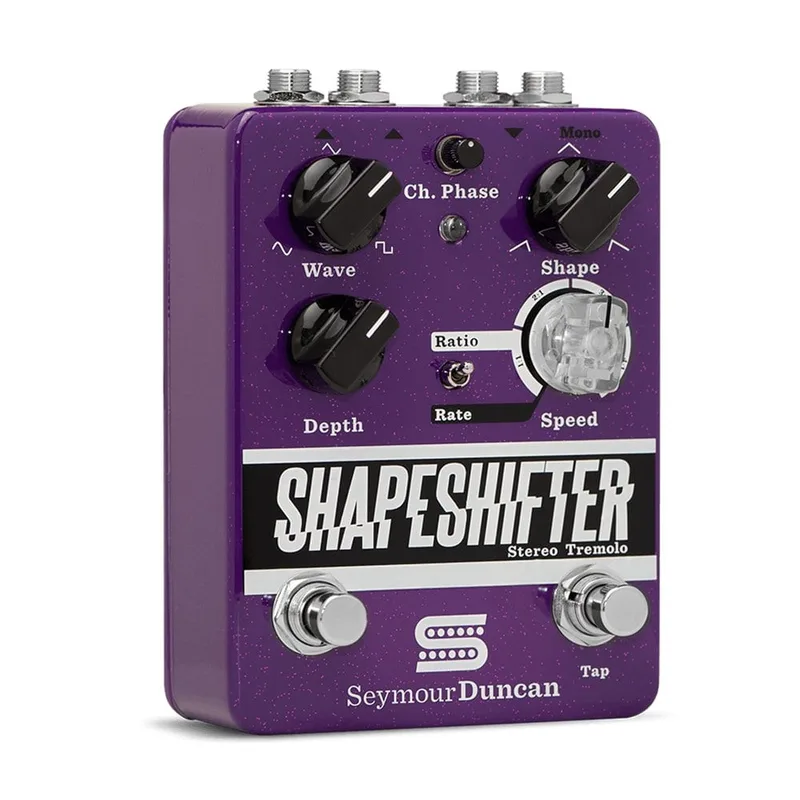
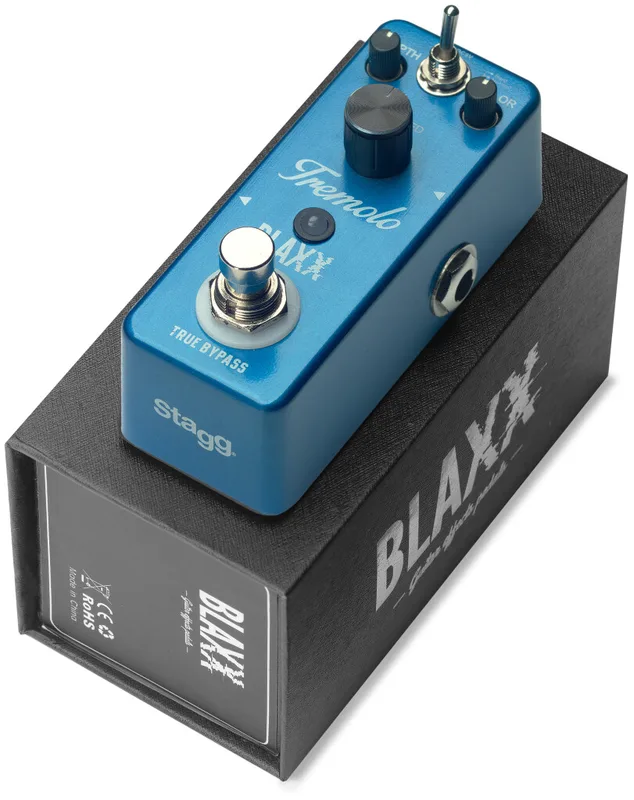
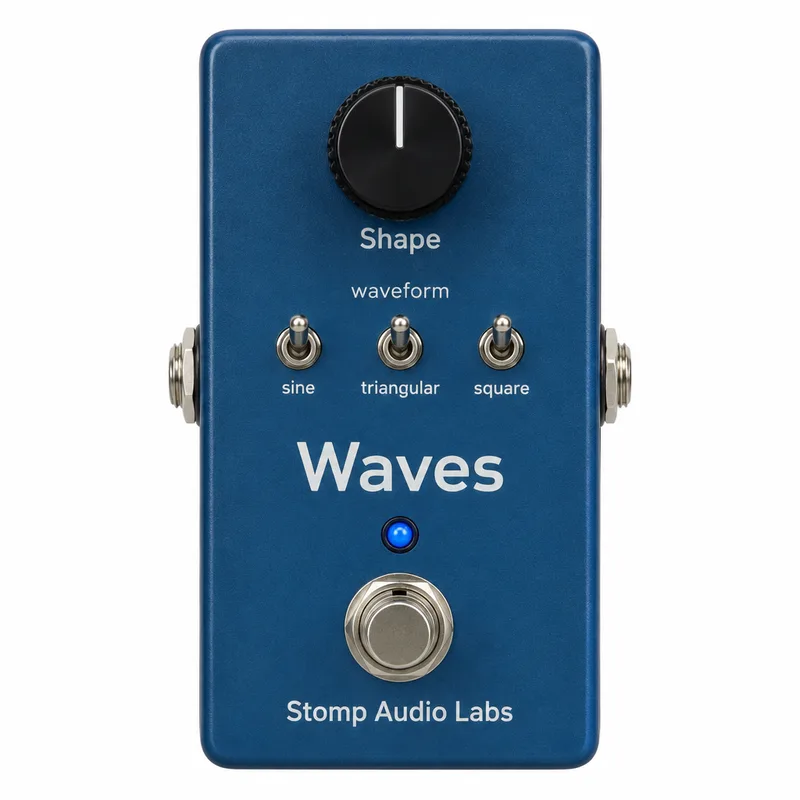
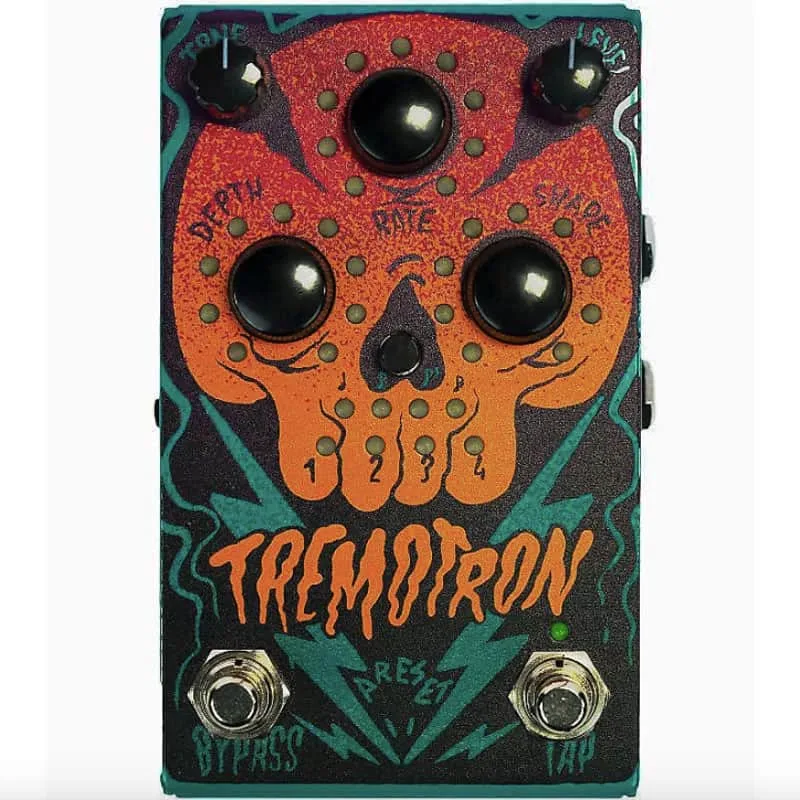
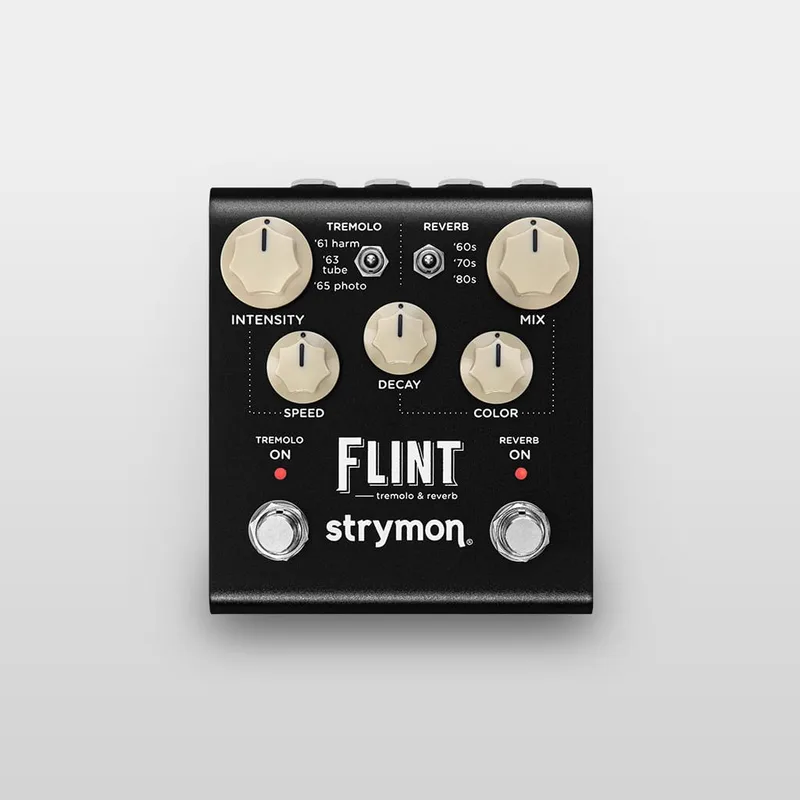
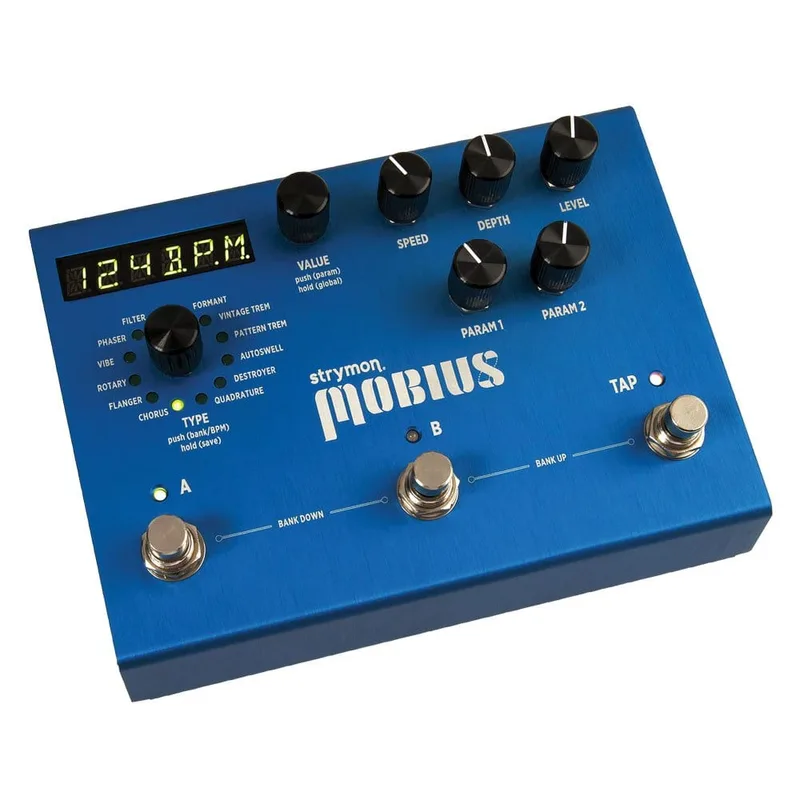
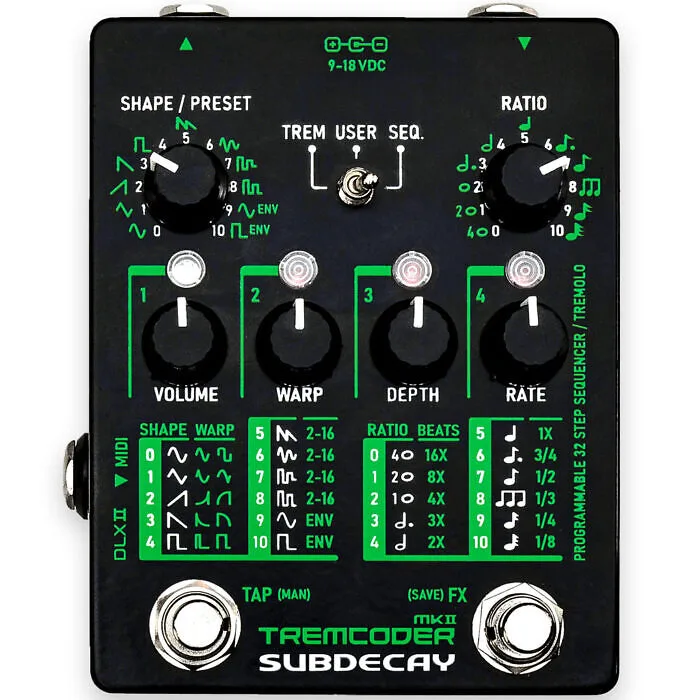
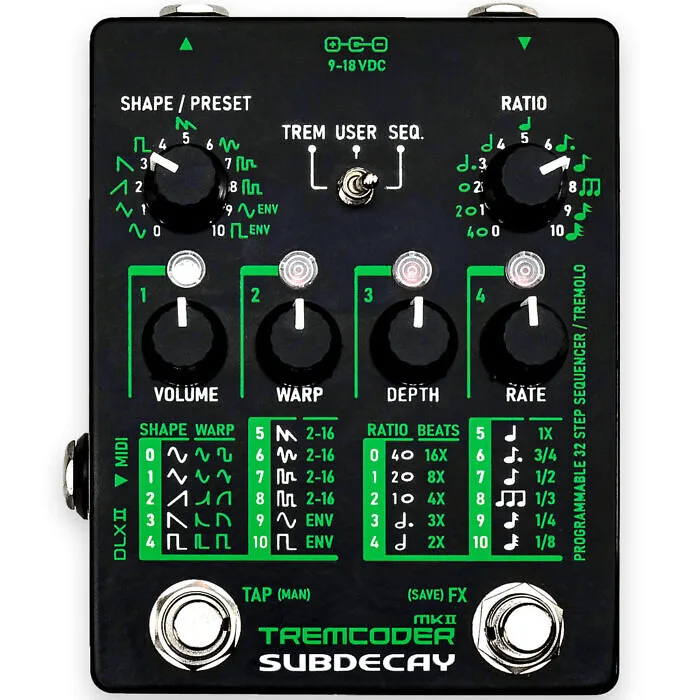
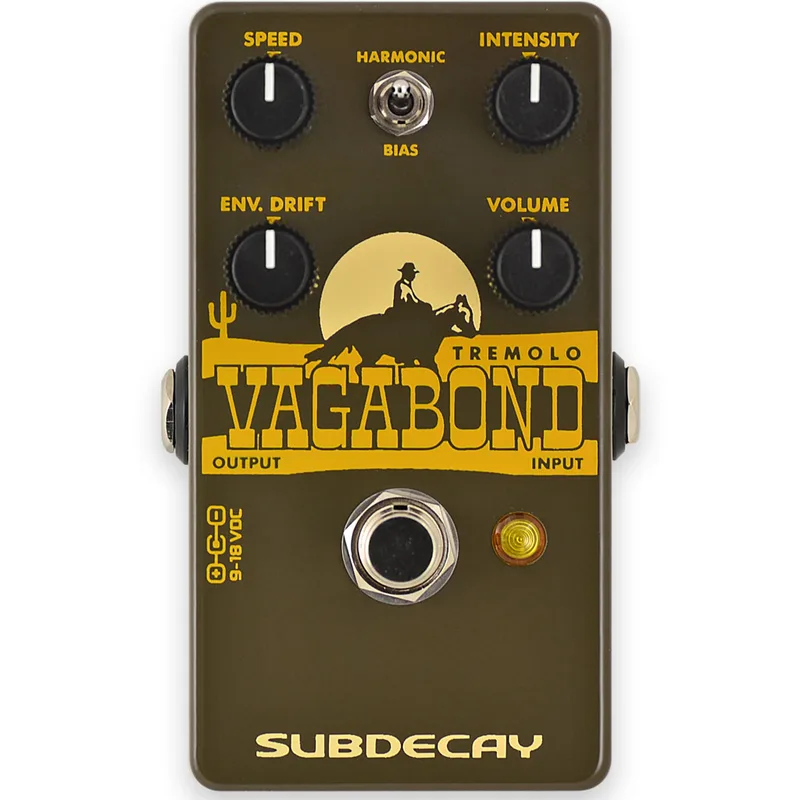
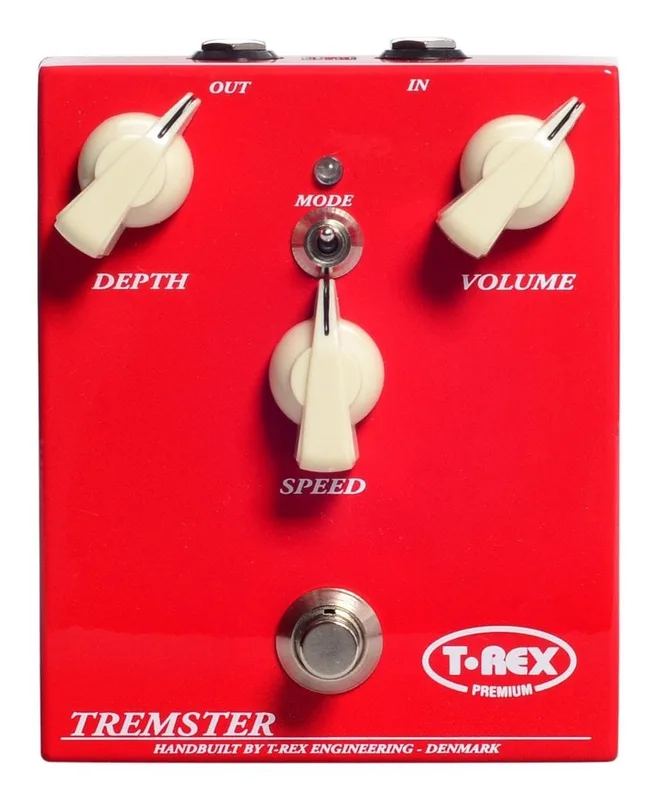
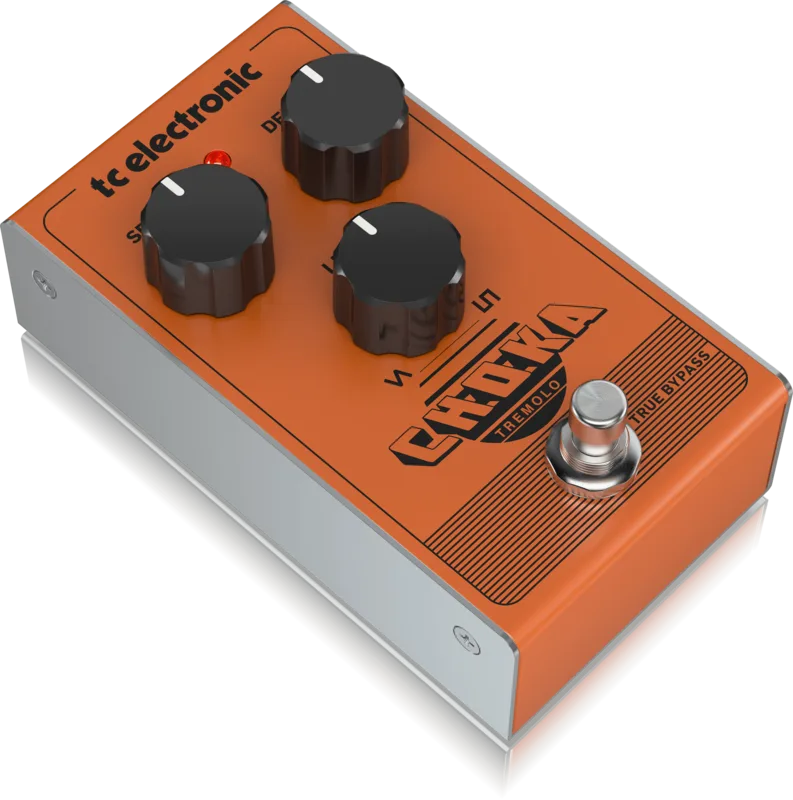
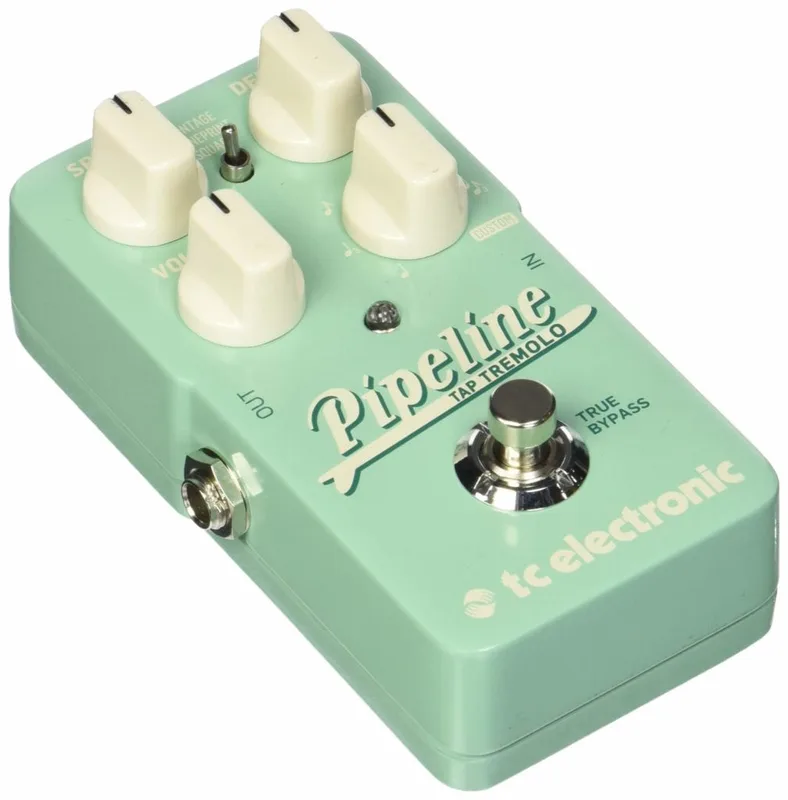
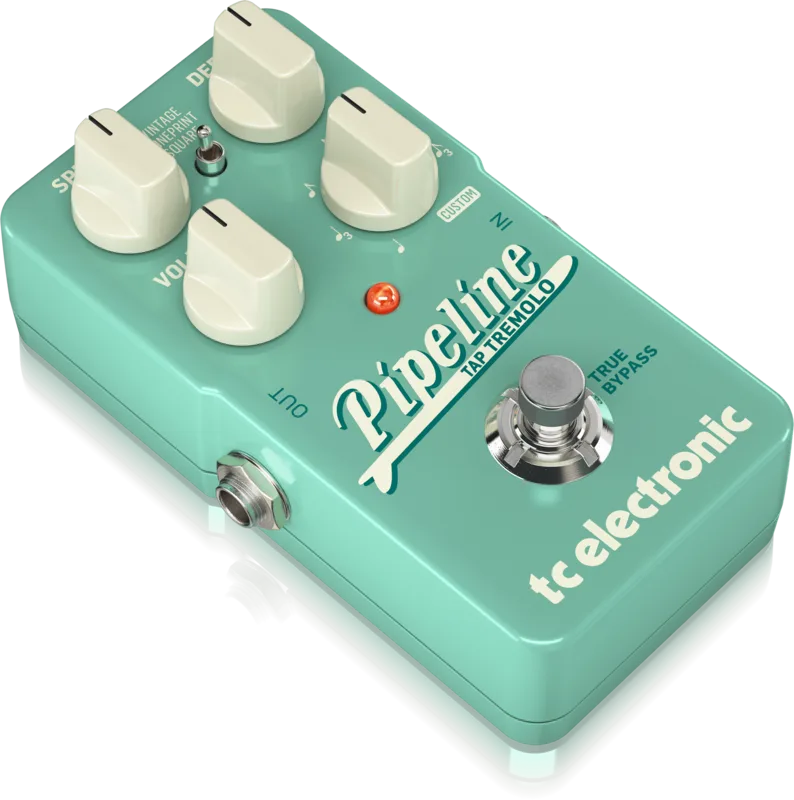

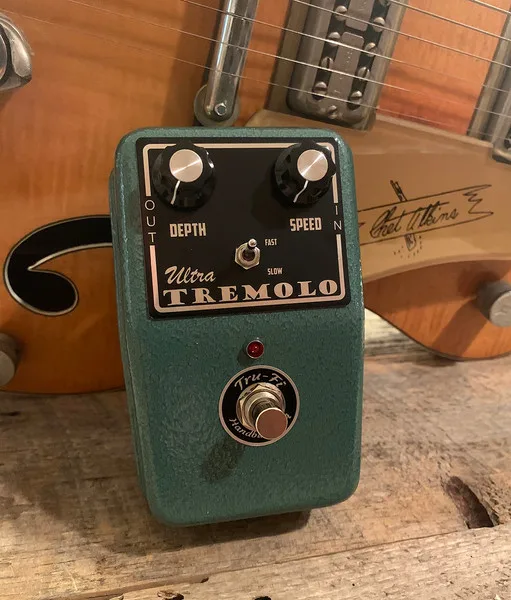
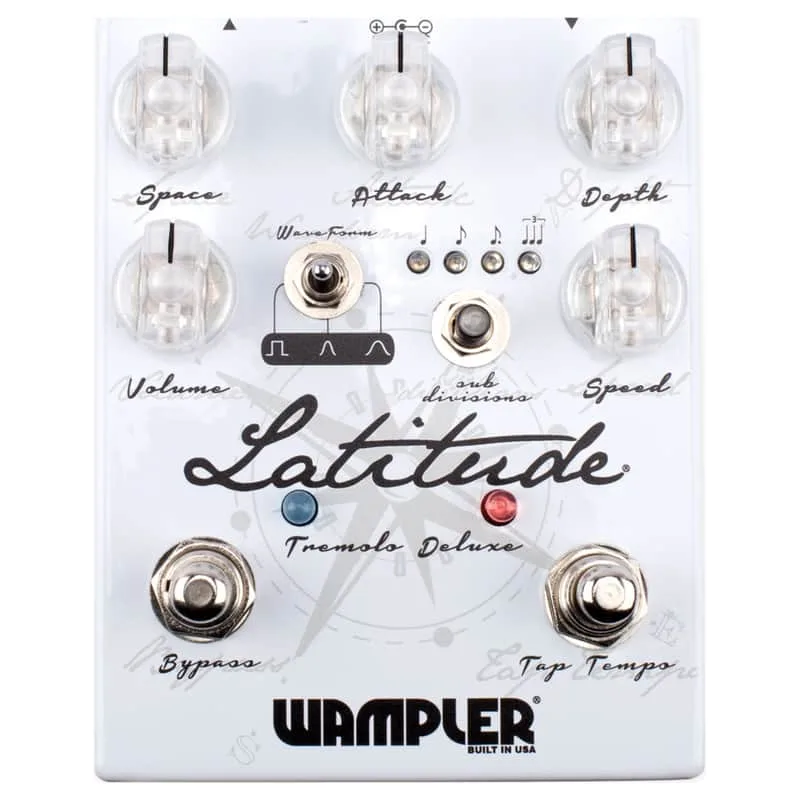
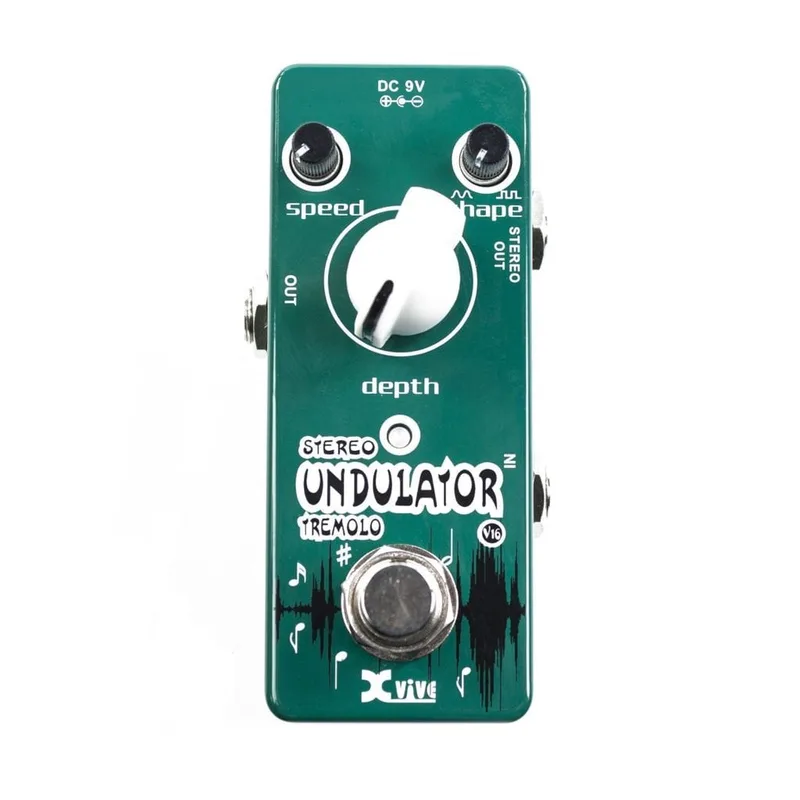
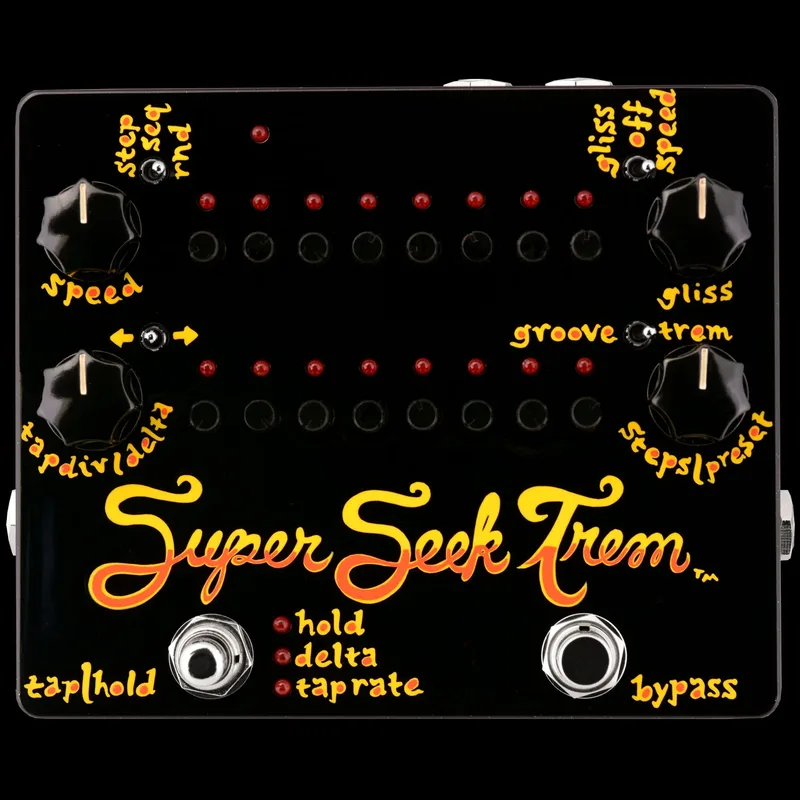
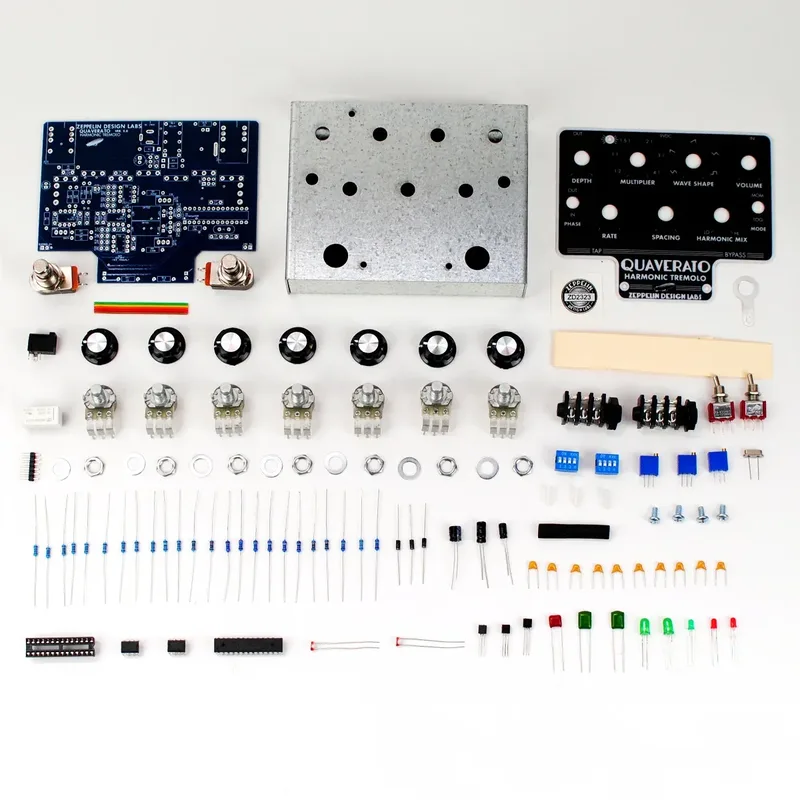
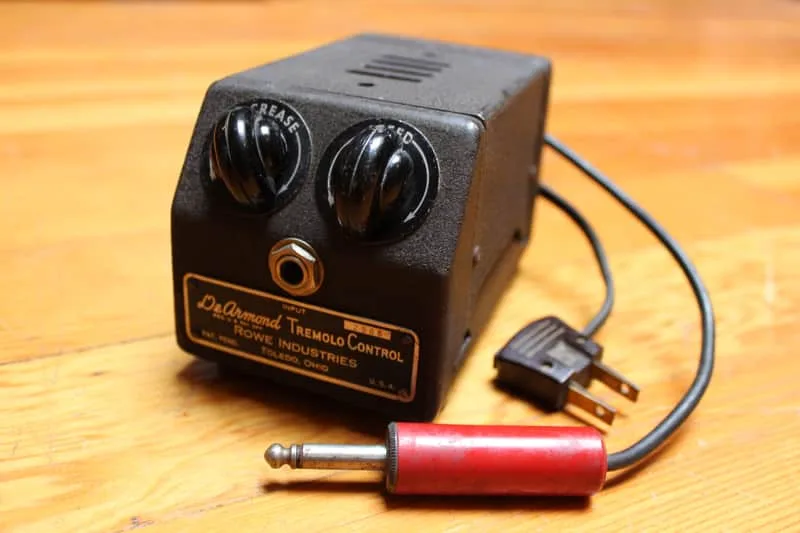
A tremolo pedal makes your guitar's volume rise and fall in a repeating rhythm. Instead of adding anything to the signal, it takes the sound you already have and pulses it: slow settings give a gentle, lapping swell, fast settings give a chop or stutter, and everything in between sits somewhere on that spectrum. It is one of the oldest electric guitar effects there is. Anasounds notes that tremolo was the first effect designed specifically for electric guitar, predating even reverb, when the DeArmond pedal was released in 19481.
Because tremolo works on volume rather than pitch, it is often confused with vibrato, and the confusion goes back decades. Strymon's technical white paper describes the effect plainly: "Still incorrectly labeled as 'vibrato' in many cases, the tremolo effect is a cyclical amplitude (volume) modulation of the input signal"2. Fender amplifiers famously labeled their tremolo circuits as vibrato, which is part of why the two terms are still swapped today. A tremolo pedal is the standalone, footswitchable version of the effect built into those old amps, and modern versions range from faithful vintage recreations to pattern sequencers that barely resemble an amplifier at all.
What a tremolo pedal does to your sound
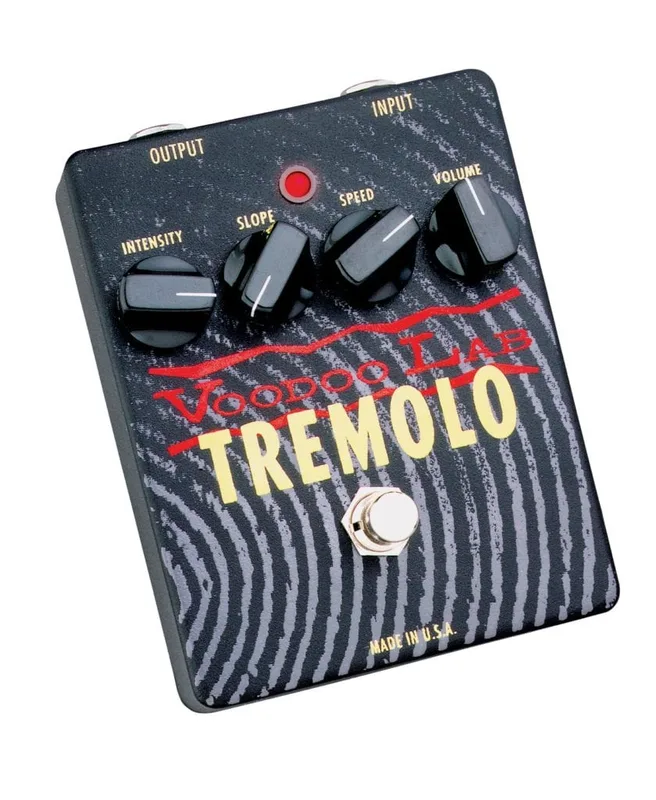
At its simplest, a tremolo pedal turns your volume up and down at a rate you choose. Coda Effects defines it as an effect that "modifies the volume of the guitar in a rythmic way," and distinguishes it from vibrato, which changes pitch instead3. Set the speed slow and the depth shallow and you get a subtle breathing motion under sustained chords. Set the speed fast and the depth deep and the signal chops in and out, a sound players describe as machine-gun stutter. The Voodoo Lab Tremolo's Slope control is built around exactly this range, letting you move "from a traditional soothing tremolo to a hard 'machine-gun' stutter"9.
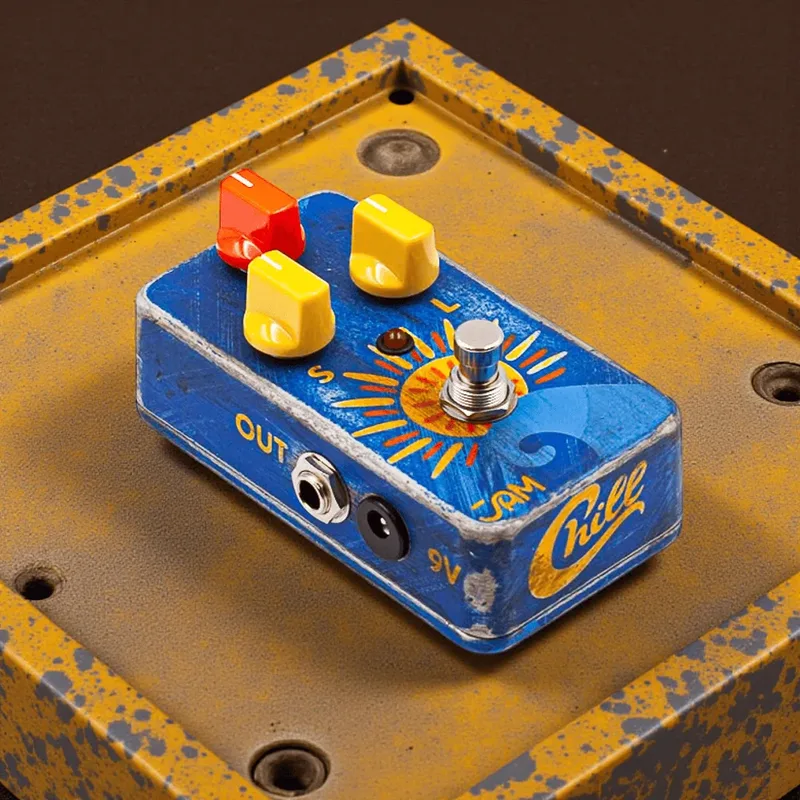
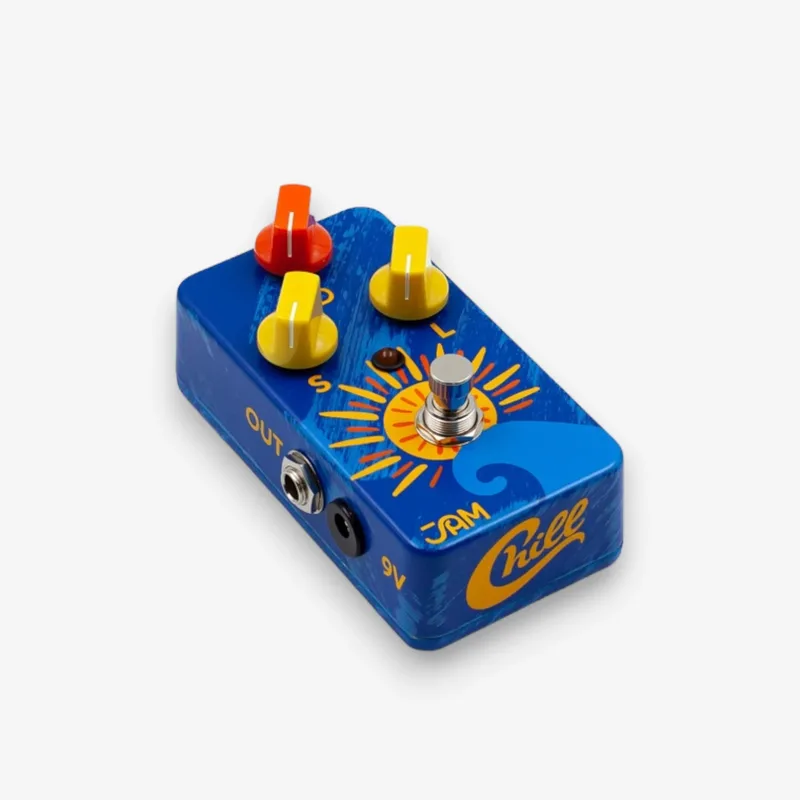
What the effect does to your playing depends on where the pulse sits relative to the music. A tremolo locked to the tempo of a song adds motion to held notes and clean arpeggios without changing your tone. Out of tempo, or at odd ratios, it becomes a texture of its own. Guitarist Lage Lund describes using his JAM Pedals Chill this way: "I use it mostly with just a hint of tremolo"10, which is one common approach: tremolo as a quiet undercurrent rather than an obvious effect.
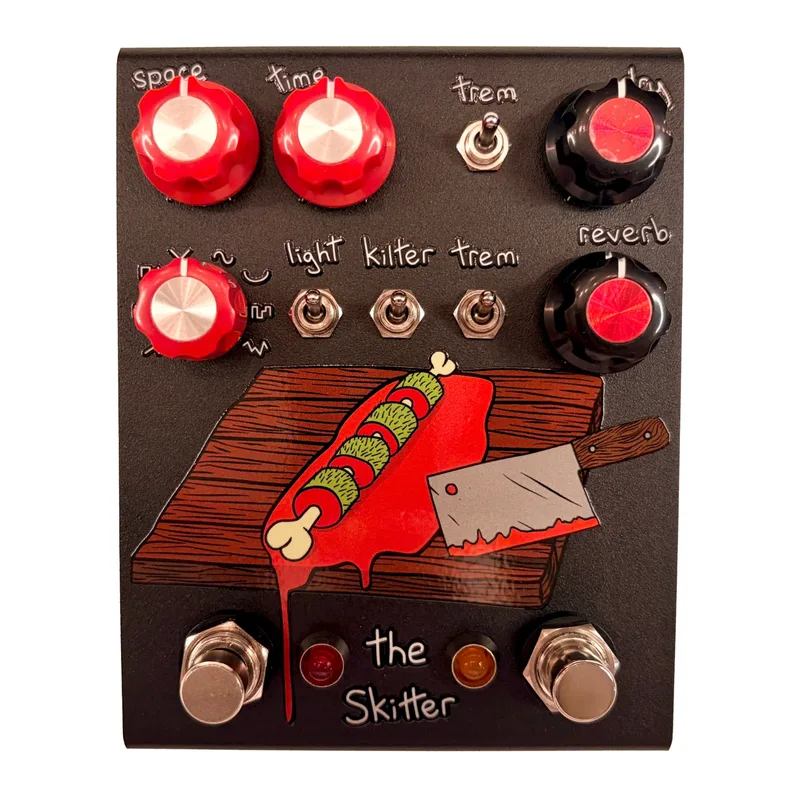
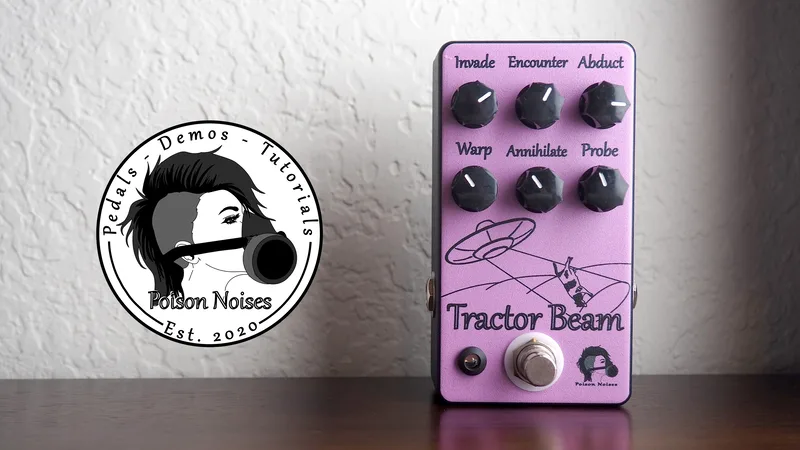
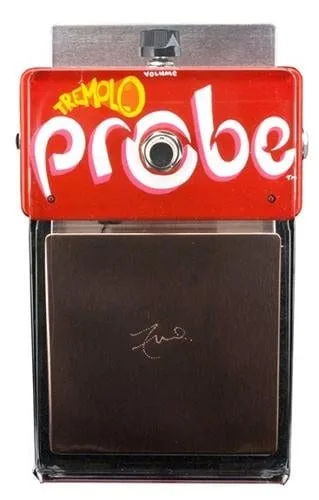
Some pedals push the effect further into territory an amplifier tremolo never reached. The ZVex Tremolo Probe replaces the rate knob with a copper plate you tap with your foot, producing "lovely tremolo sounds that are in perfect time with your foot's movement," along with reverse-sounding volume swells and pedal-steel type volume effects11. The Gamechanger Audio LIGHT Pedal, a reverb pedal built around optical sensors, includes a trem mode "produced by rhythmically switching the optical sensors on and off," which can be blended with its spring reverb signal12. These are tremolo in the broad sense, volume moved in a rhythm, but achieved by unusual means.
How tremolo works
Every tremolo circuit needs two parts: something that controls the volume of the signal, and something that tells it when. The controller is a Low Frequency Oscillator, or LFO, an oscillator running at a low frequency (typically a few times per second down to well under one per second) whose output rises and falls in a repeating wave. The LFO drives the volume control element, so the volume follows the shape of that wave: a sine wave gives a smooth, round pulse, a square wave switches abruptly between loud and quiet, and a triangle wave sits between them.
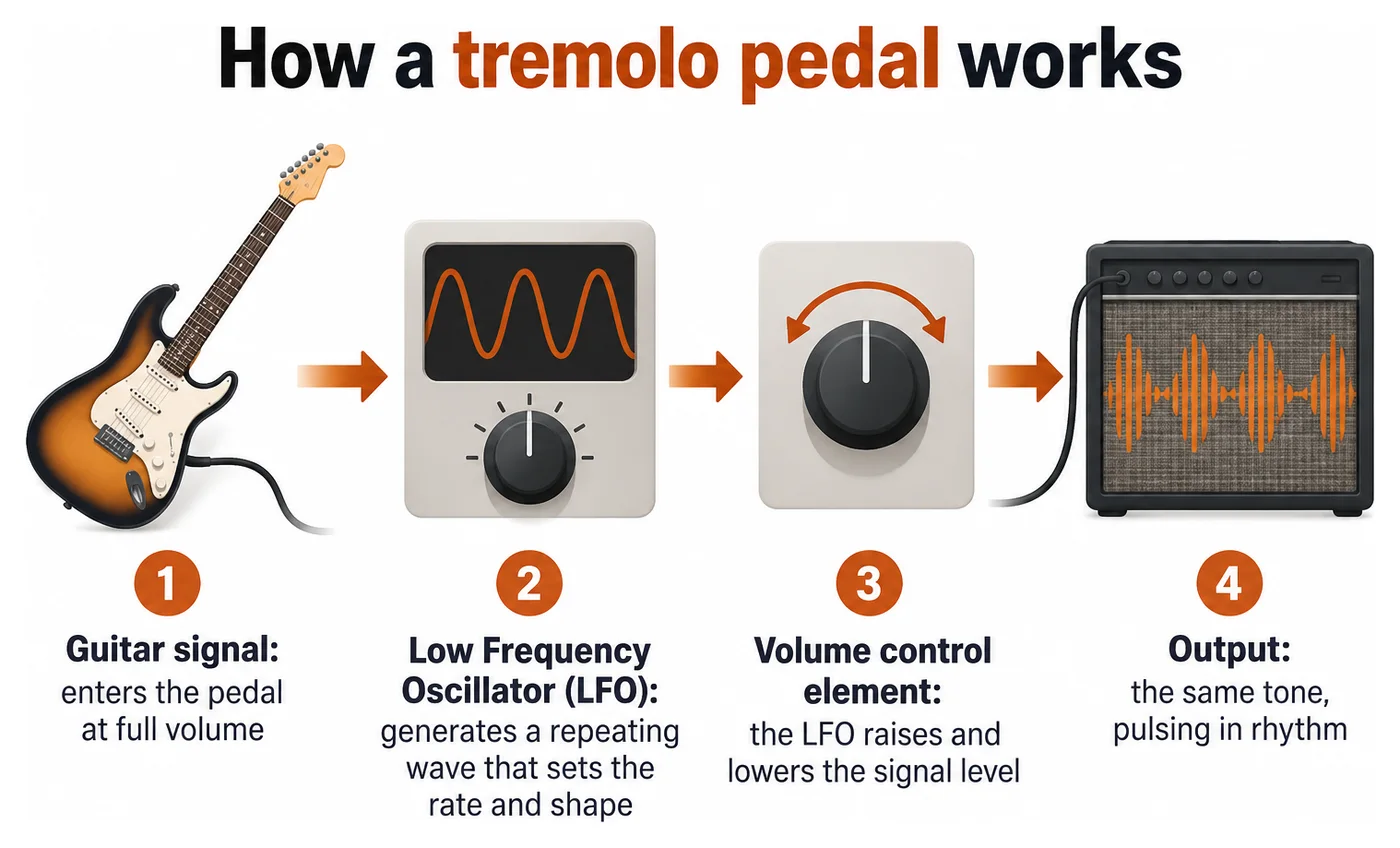
Coda Effects' technical analysis describes the classic optical approach: the LFO lights an LED coupled to a Light Dependent Resistor (LDR) on the signal path, often combined in a single component called a vactrol. The LED brightens and dims with the LFO wave, and the LDR's resistance changes with the light, which changes how much signal passes. The same analysis notes that the photocell can instead be connected to ground or used to bias a tube, an IC or a FET transistor3. Different methods give different feels, which is why optical tremolos are often described as smooth and tube-bias tremolos as softer and rounder.
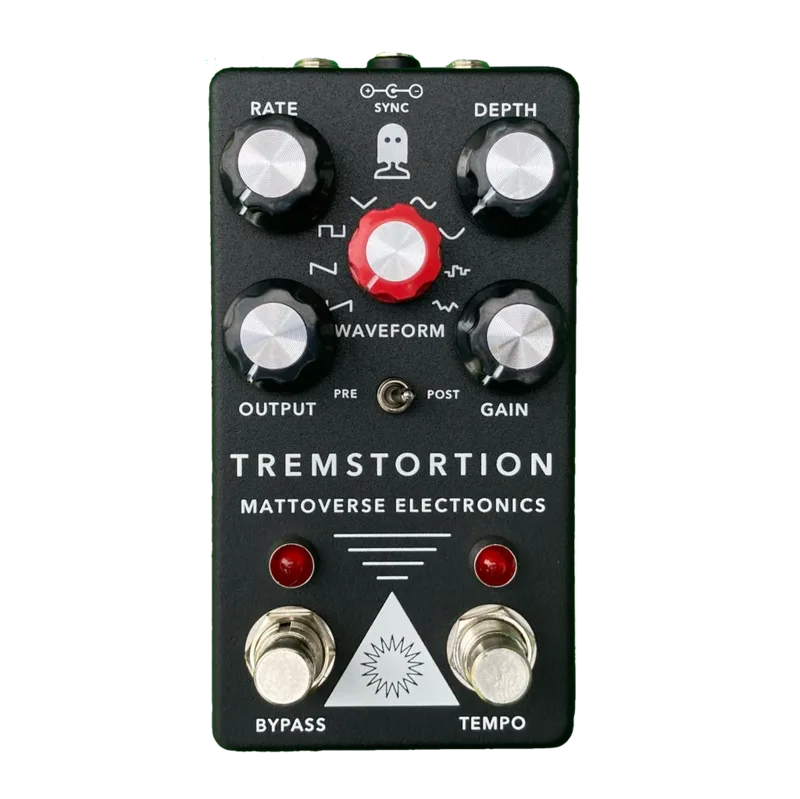
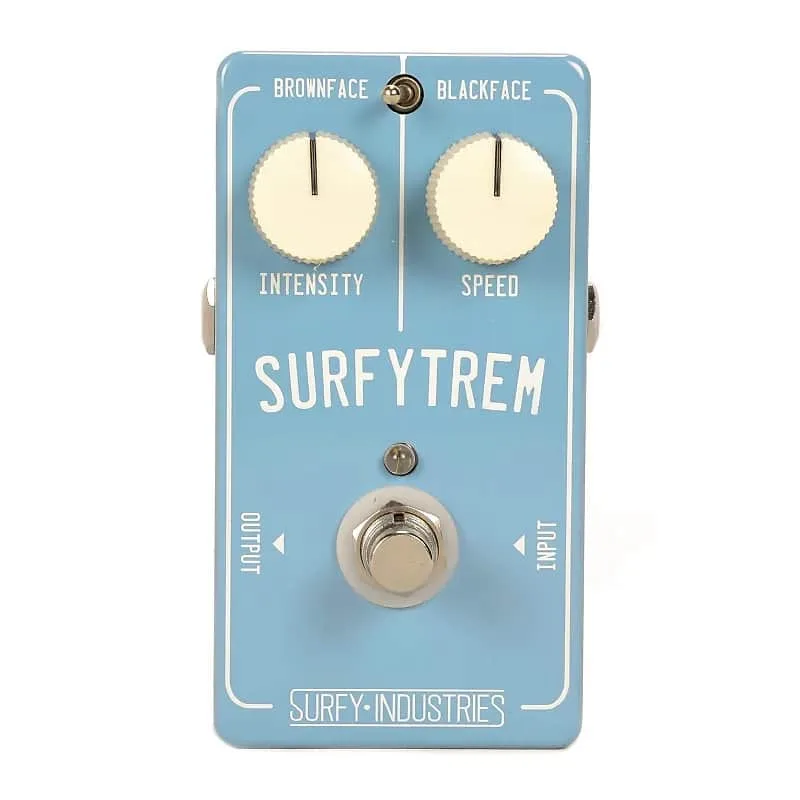
The optical approach is closely associated with vintage American amplifiers. Master Effects Pedals describes its own pedal as "a fully analog optical tremolo that replicates the tremolo sound found in old vintage blackface and brownface" tube amps13, and the Mattoverse TremStortion is likewise "a full-featured analog optical tremolo pedal"14. Strymon's white paper, written when the company developed the Flint, identifies three vintage amplifier tremolo circuits worth modeling: harmonic, power tube, and photocell2. That taxonomy, based on how the original amps did it, still shapes how pedal makers describe their products.
Tremolo versus vibrato
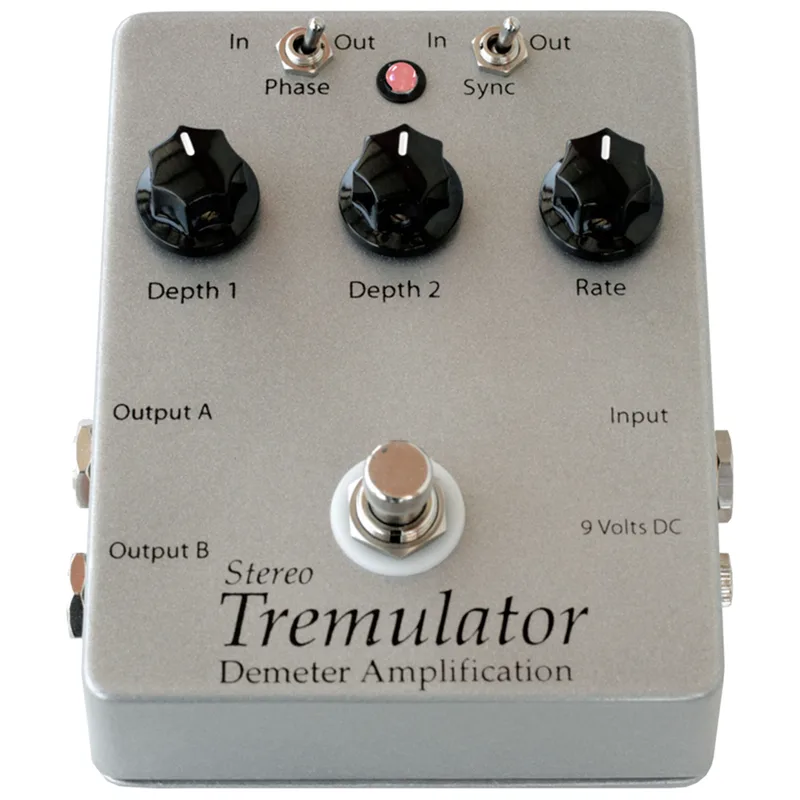
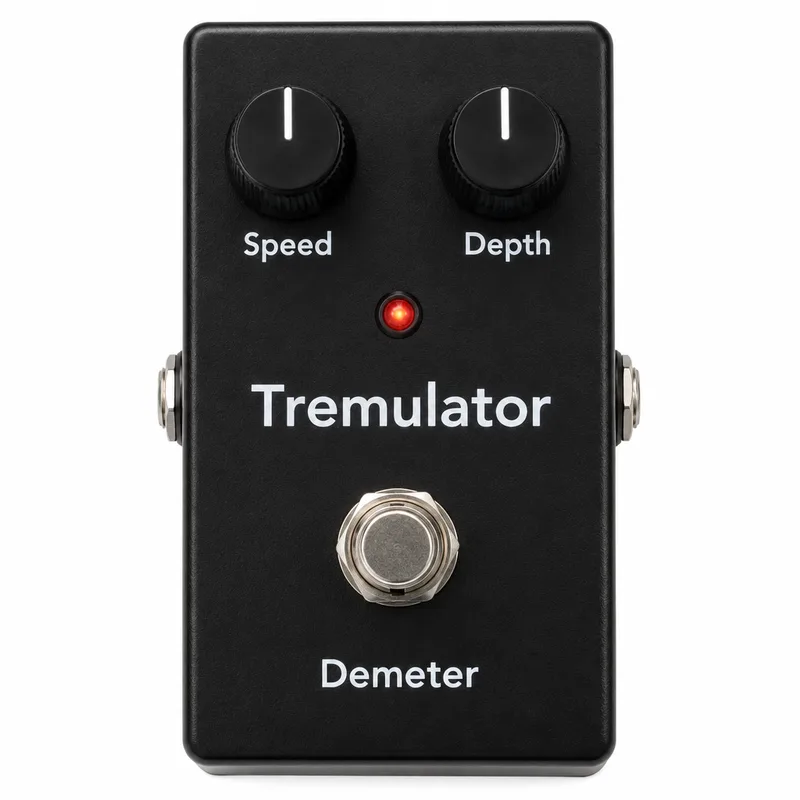
The distinction matters because the two effects are constantly mislabeled. Tremolo changes volume; vibrato changes pitch. Coda Effects puts it directly: a tremolo "modifies the volume of the guitar in a rythmic way," while "a vibrato changes the pitch of the guitar rhythmically"3. Demeter Amplification acknowledges the historical confusion in its own copy, saying its Stereo Tremulator is "designed to emulate the classic Fender tremolo effect (or vibrato as it is often referred to)"7.
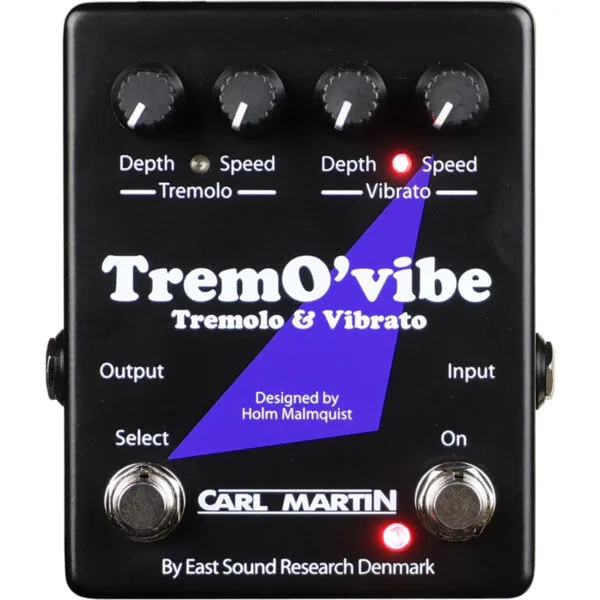
Some pedals offer both. The Carl Martin Trem O' Vibe is an "analog two-in-one tremolo and true vibrato pedal with independent controls," and Carl Martin explains the difference in its product description: "The tremolo effect works like a change in volume. The vibrato, which works as a change in tone (pitch modulation)"15. If you want the wobble of pitch rather than the pulse of volume, a vibrato pedal is the effect to look at; if you want the pulse, tremolo is it.
Styles: standard, harmonic and stutter tremolo
Standard (amplitude) tremolo
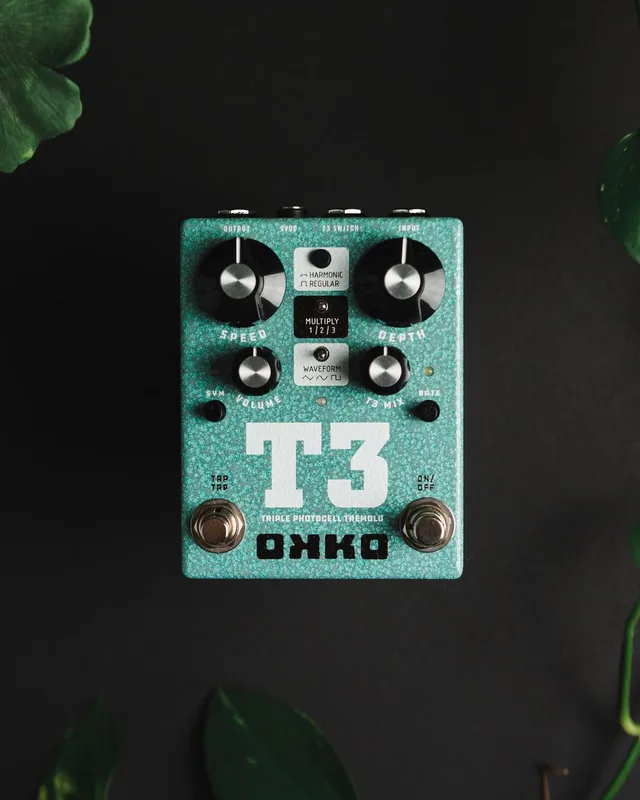
Standard tremolo is what most guitarists picture: the whole signal's volume goes up and down together. Flower Pedals describes it as "what most guitarists think of when they think of tremolo: varying the volume up and down"4. The Boss TR-2 is a well-known compact example, "designed to provide guitarists with classic tremolo effects in an easy-to-use compact pedal"16, and the OKKO FX T3 Tremolo covers the same ground and more, doing "everything from vintage amp style modulation to weird polyrhythmic" patterns17.
Harmonic tremolo
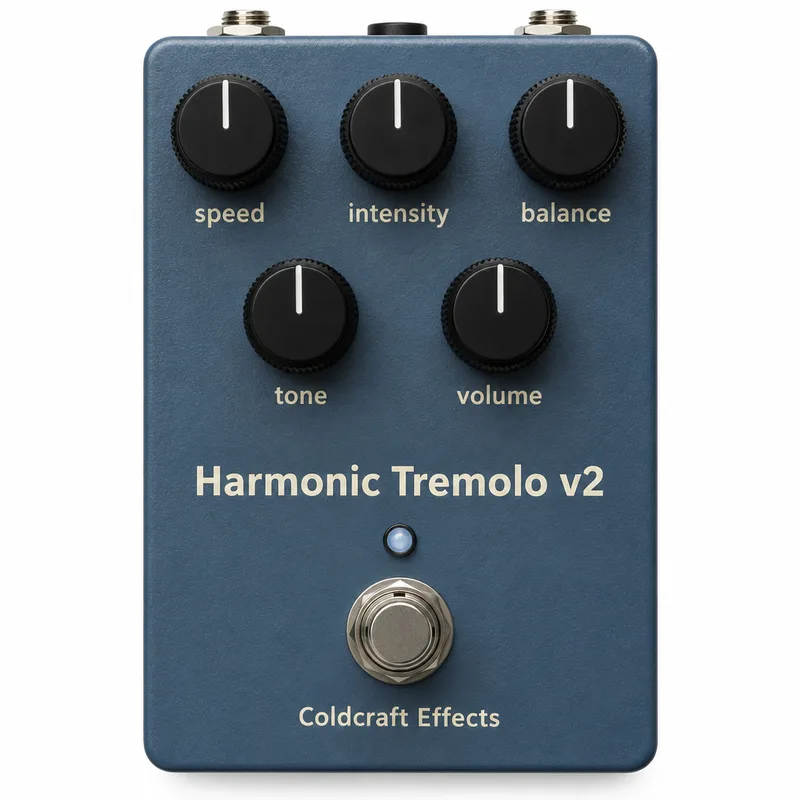
Harmonic tremolo works differently. Instead of lowering the whole signal at once, it splits the signal into bass and treble bands and alternately turns each down. Coda Effects traces it to its origin: "initially developped in Fender 'brown face' amps, it is a different kind of tremolo" that alternatively changes the volume of bass and treble frequencies3. Flower Pedals describes the result as having "a warbly, almost vibrato like feel" compared with standard tremolo4. To a listener it can sound closer to a phaser or a slow sweep than to a pulse.
Harmonic tremolo has become a category of its own among pedal makers:
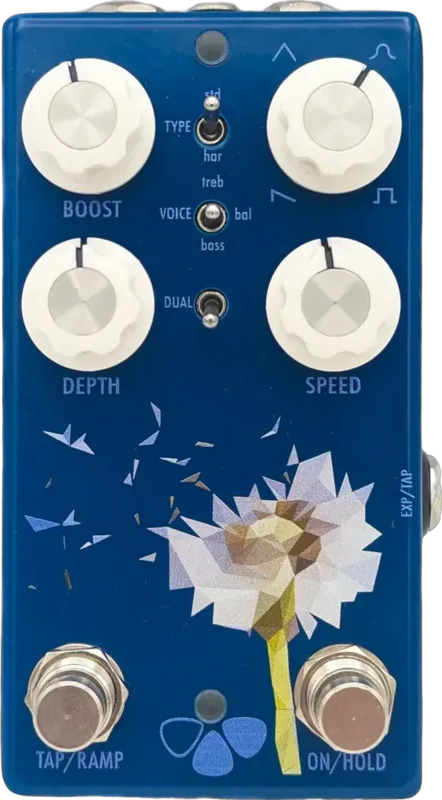
- The Flower Pedals Dandelion Tremolo V2 offers standard and harmonic tremolo, with 3 voicings for the harmonic mode4.
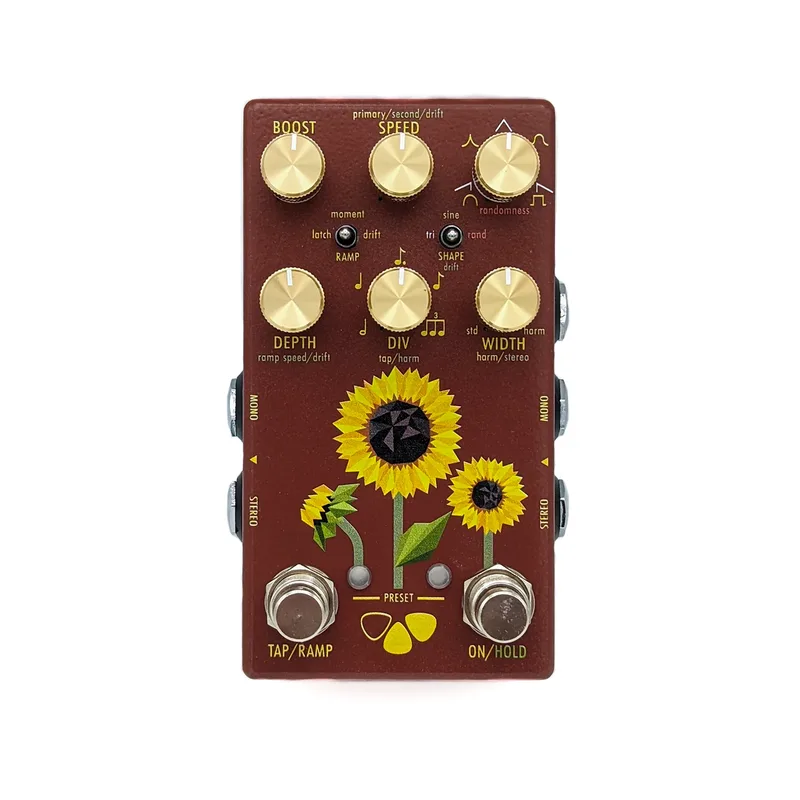
- The Flower Pedals Sunflower Deluxe Tremolo is a stereo harmonic tremolo with a fully analog signal path, offering both harmonic and standard types18.
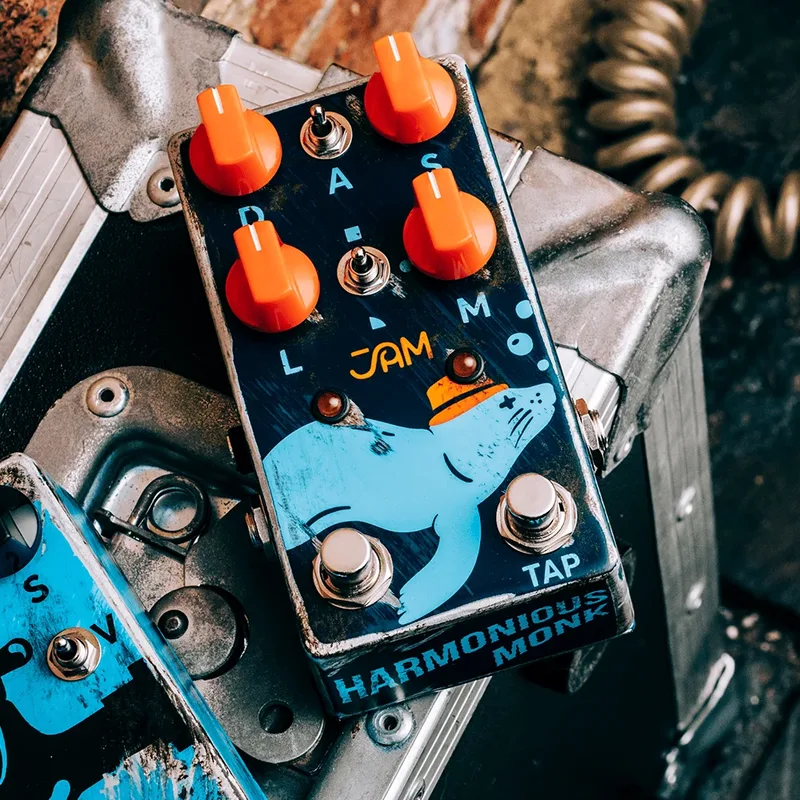
- The JAM Pedals Harmonious Monk is an all-analog harmonic and amplitude tremolo developed with the team behind That Pedal Show19.
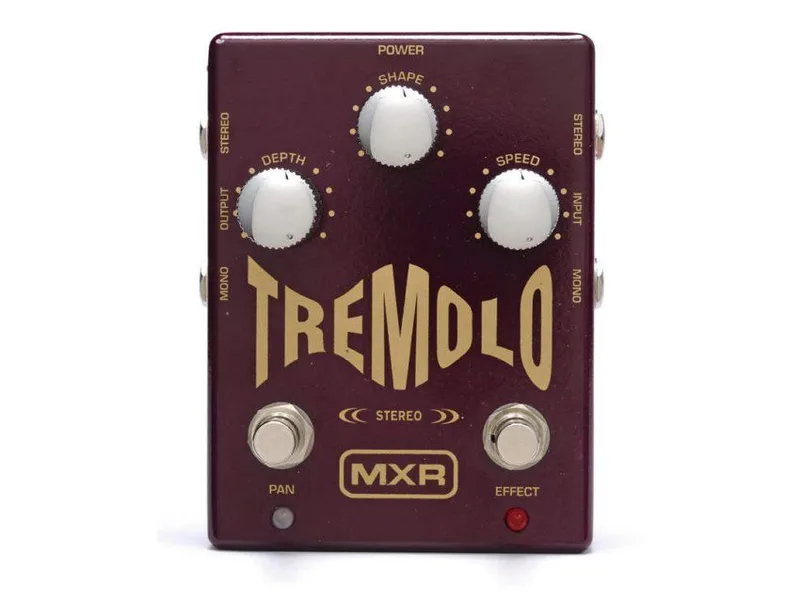
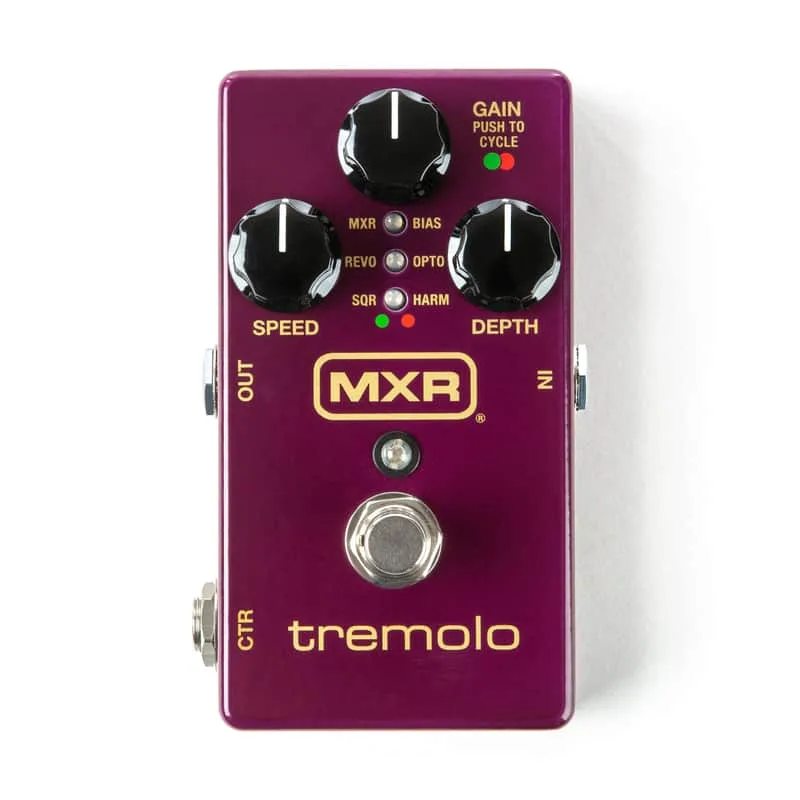
- The MXR M305 Tremolo includes a harmonic mode, described in its manual as "vintage harmonic tremolo for shimmering frequency" modulation20.
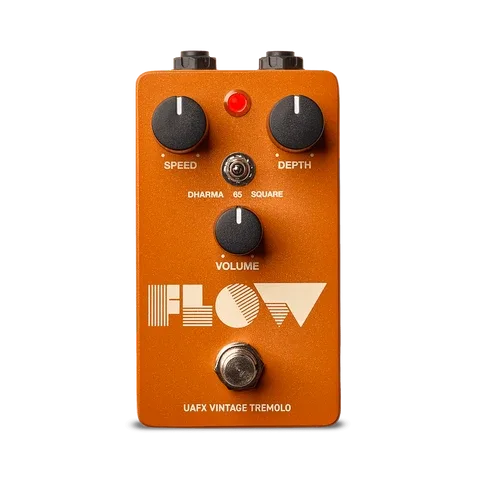
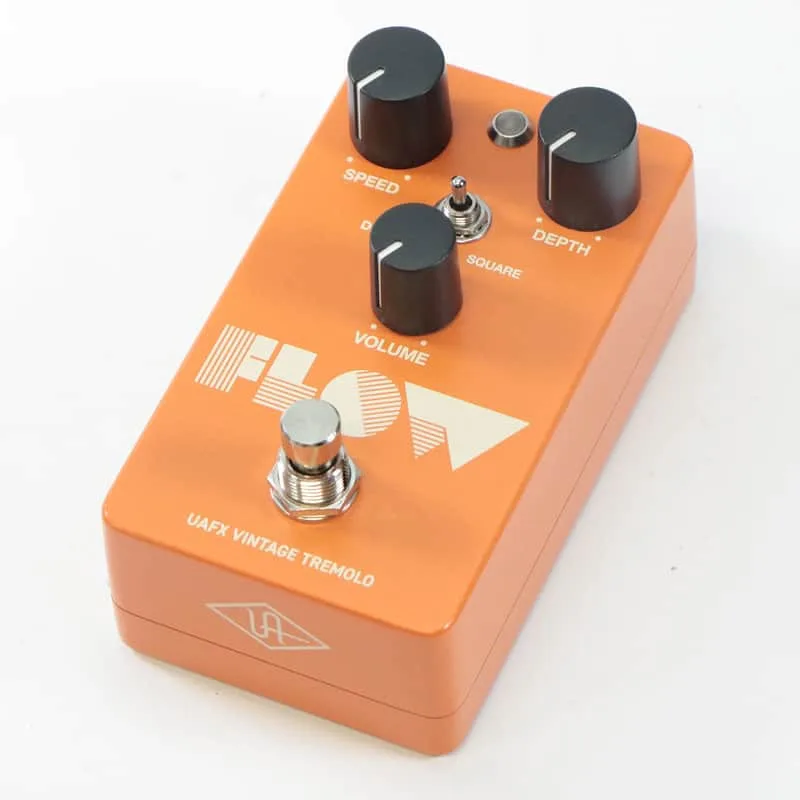
- Universal Audio's Flow Vintage Tremolo offers three modes: Dharma (harmonic tremolo), 65 (a round sine wave), and Square (a choppier square wave)6.
Stutter and pattern tremolo
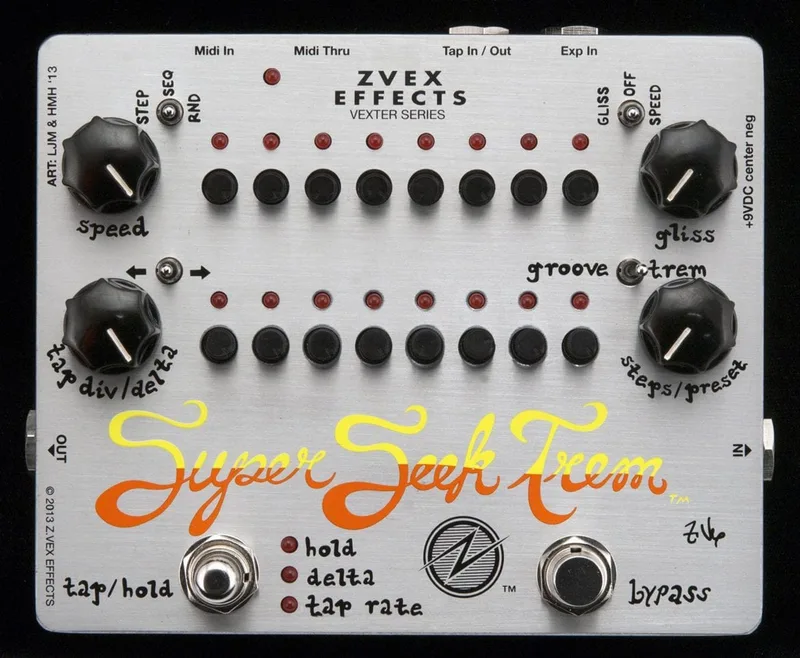
At fast speeds and deep settings, tremolo stops sounding like a swell and starts sounding like a stutter, and some pedals make that extreme their specialty9. Slope-style controls let a player shape how the volume rises and falls, from a smooth round wave to a hard on-off chop9. Beyond simple stutter, a newer group of pedals treat tremolo as a pattern sequencer, cycling through programmed volume steps rather than repeating a single wave2122.
Landmark tremolo pedals and makers
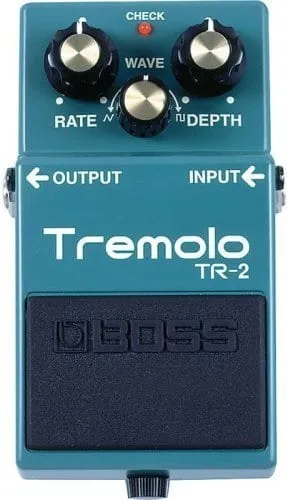
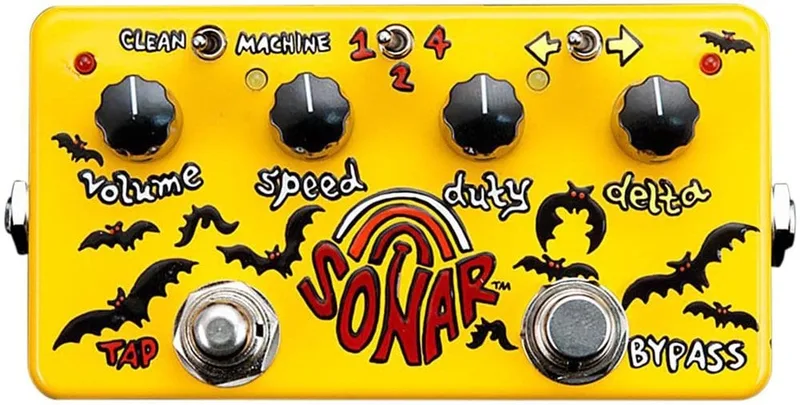
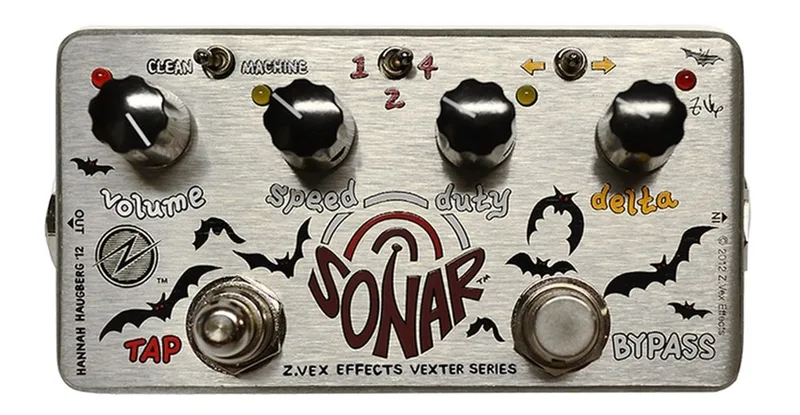
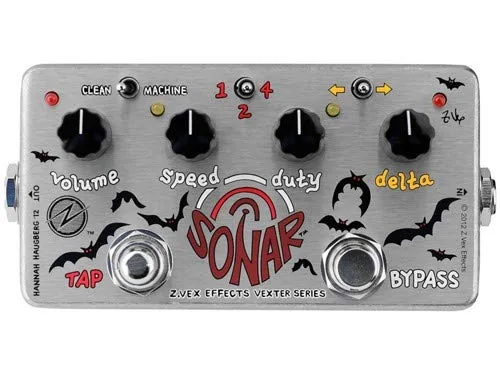
Tremolo's history in pedals is long, and several makers have become closely identified with the effect. The DeArmond pedal of 1948 came first1. The Boss TR-2 remains one of the most widely seen compact tremolos16. Voodoo Lab's Tremolo is a long-running analog example with its Slope control9. ZVex brought unconventional approaches with the Tremolo Probe, whose probe plate has no moving parts, and the Sonar112324.
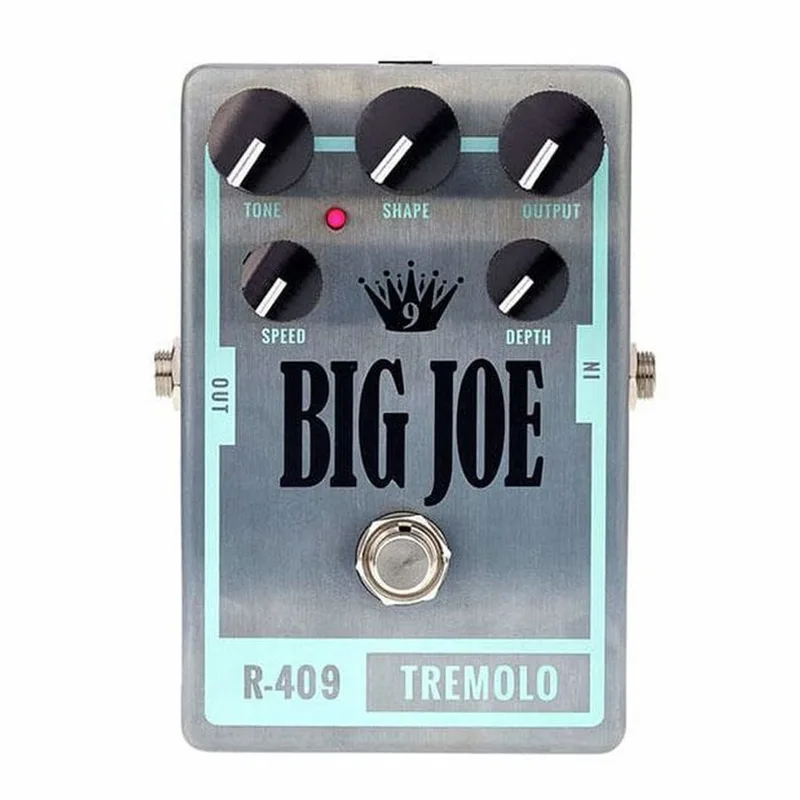
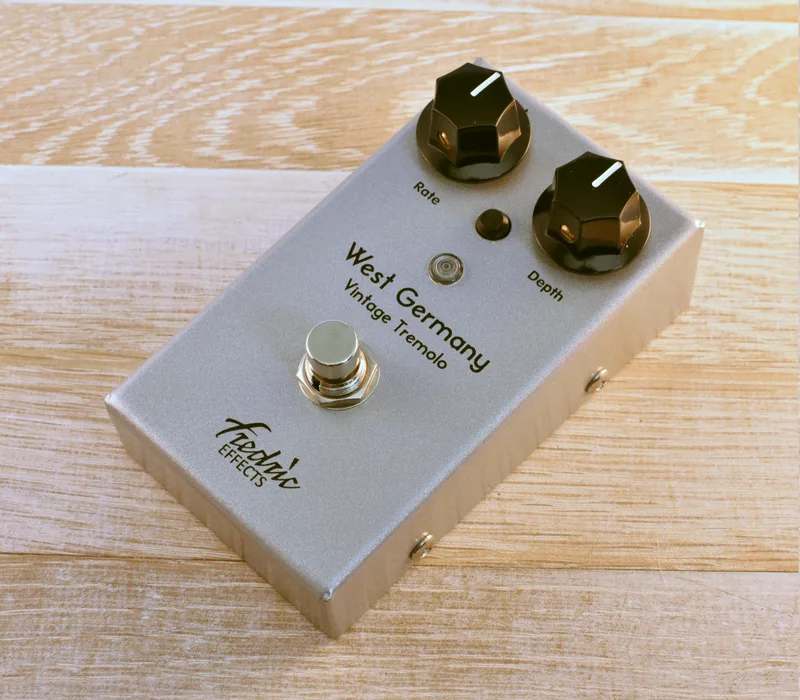
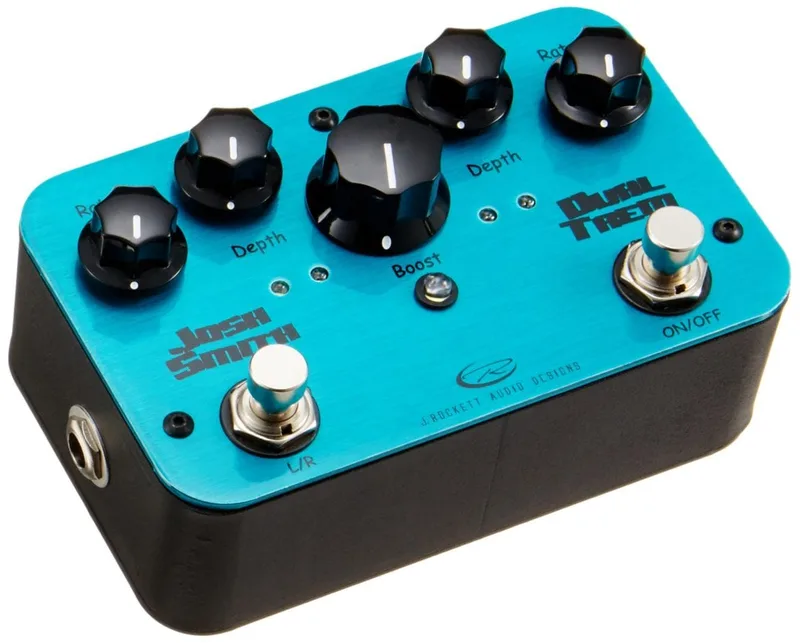
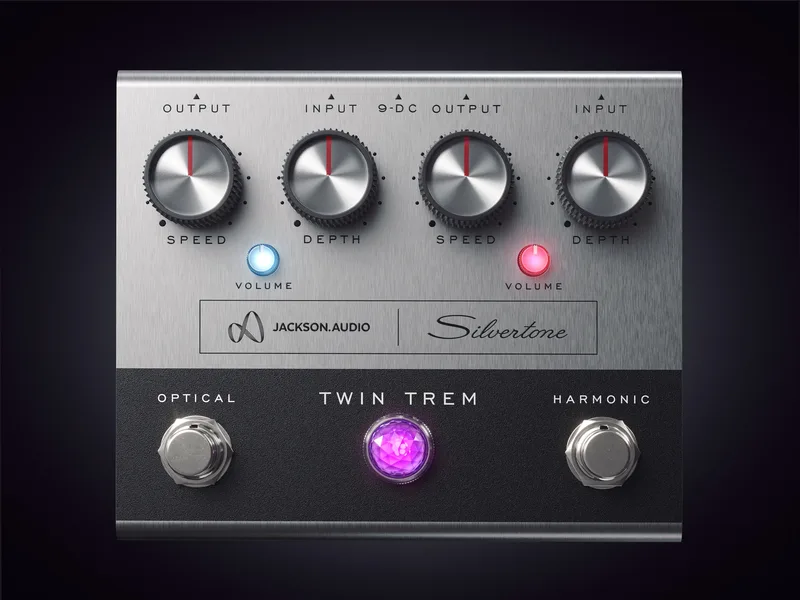
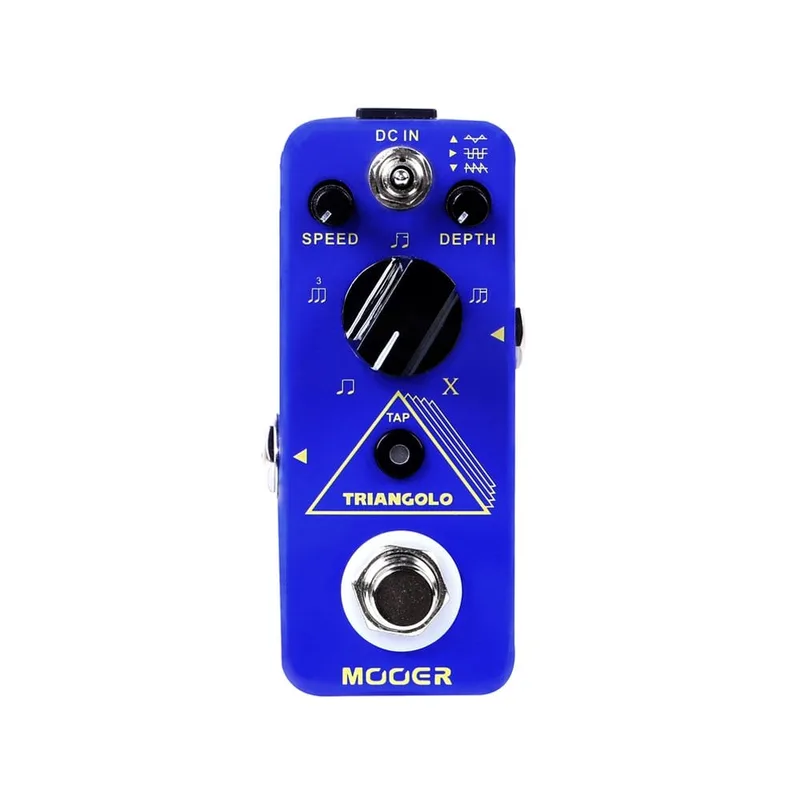
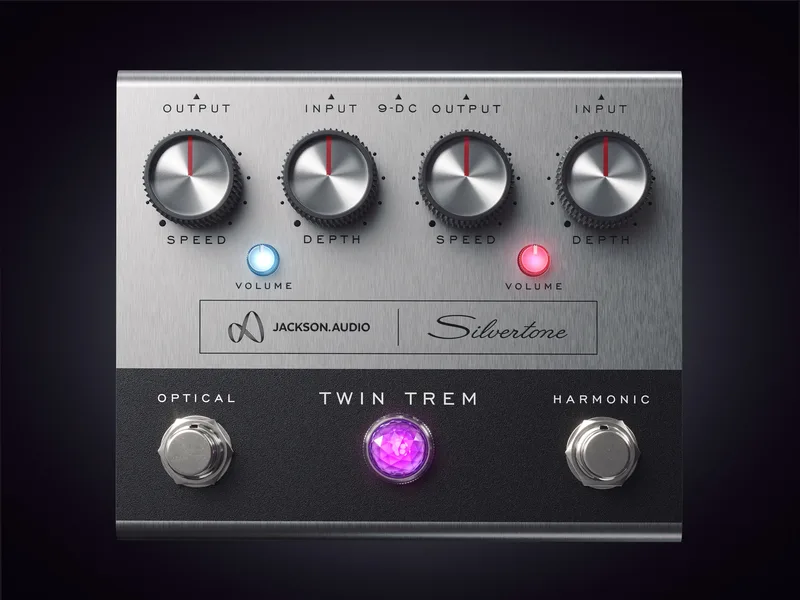
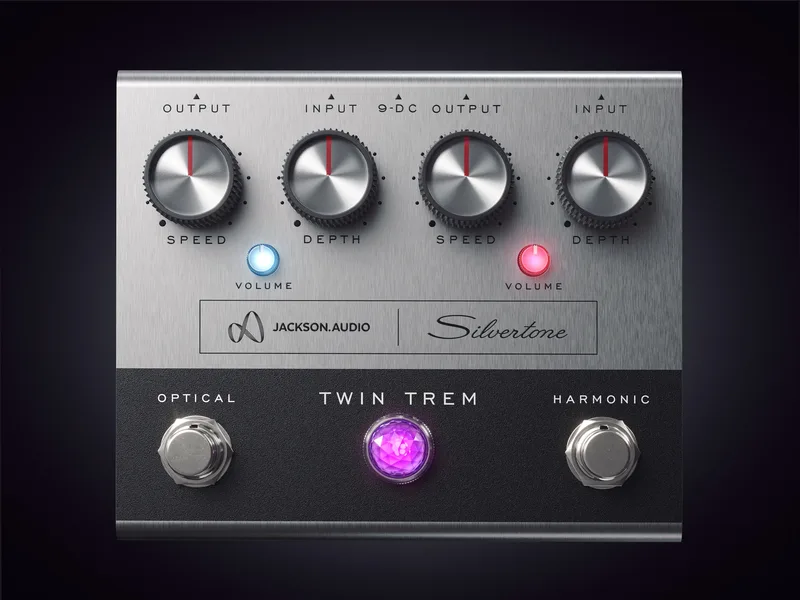
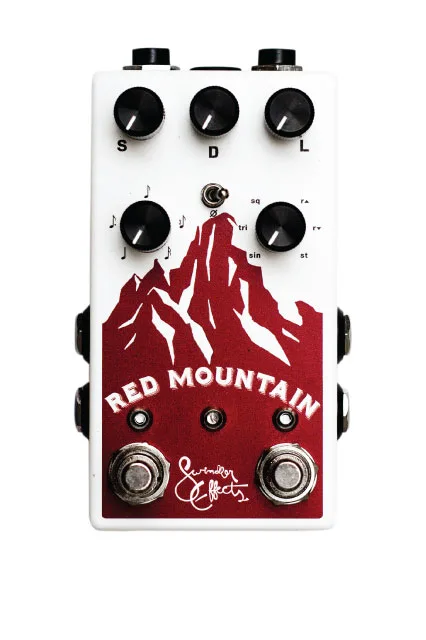
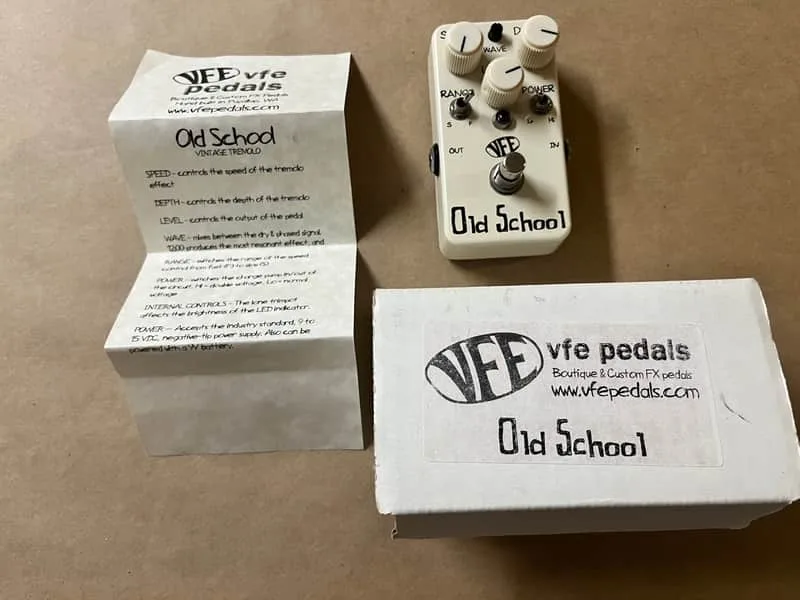
The current field is broad. Swindler Effects' Red Mountain is described as "one of the most versatile, feature-packed tremolo pedals ever produced," and is "first and foremost a stereo tremolo pedal"8. Fredric Effects' West Germany Vintage Tremolo "reworks the classic West German pedal," described by its maker as "a new version of one of the best sounding classic tremolo circuits"25. The VFE Old School, documented in its build manual, "recalls the luxurious tremolo sounds of vintage tube amps," derived from a rich-sounding but feature-limited 1960s circuit with extra range on speed and depth26. Others include the Big Joe R-409 Tremolo, described as "a very unique and organic sounding tremolo pedal"27, the Jackson Audio Twin Trem28, Cmat Mods' Tremoglo29, the MOOER Triangolo272830, and the Anasounds Tremolo, which pairs with Anasounds' Spinner expression pedal272830.
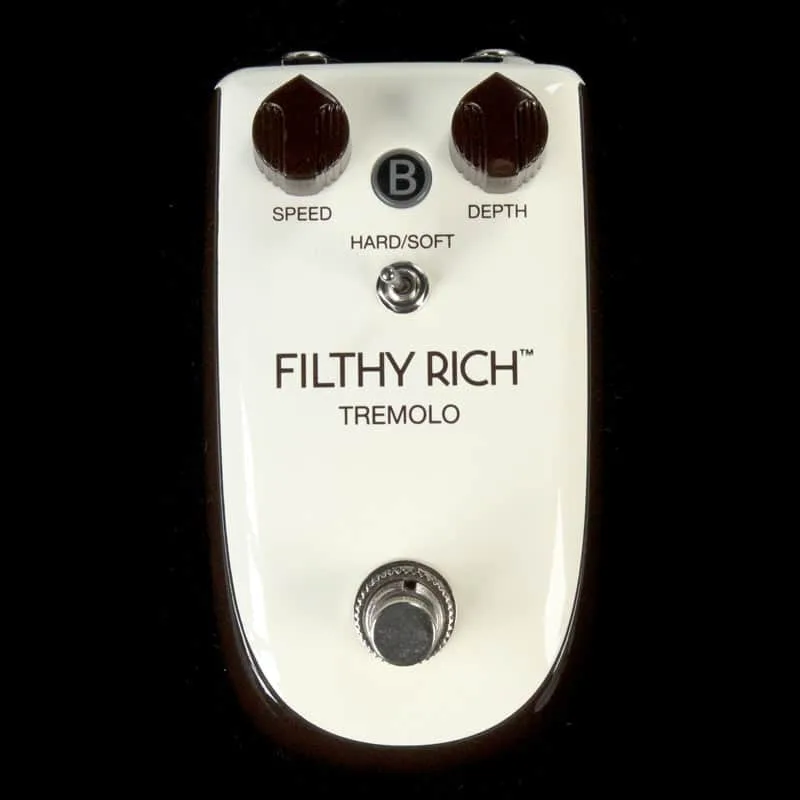
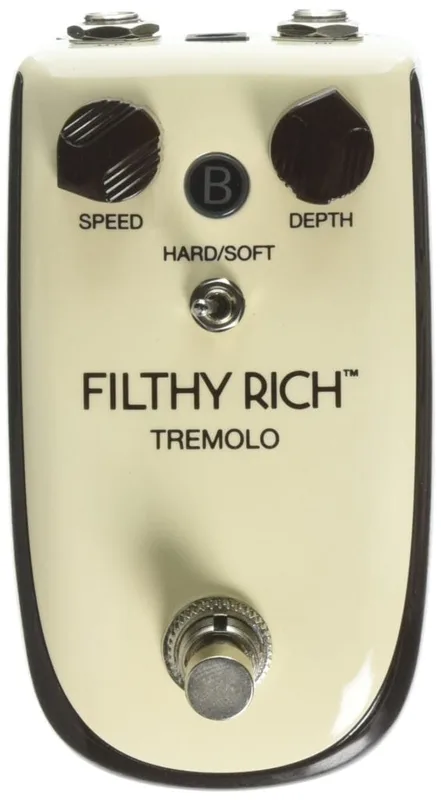
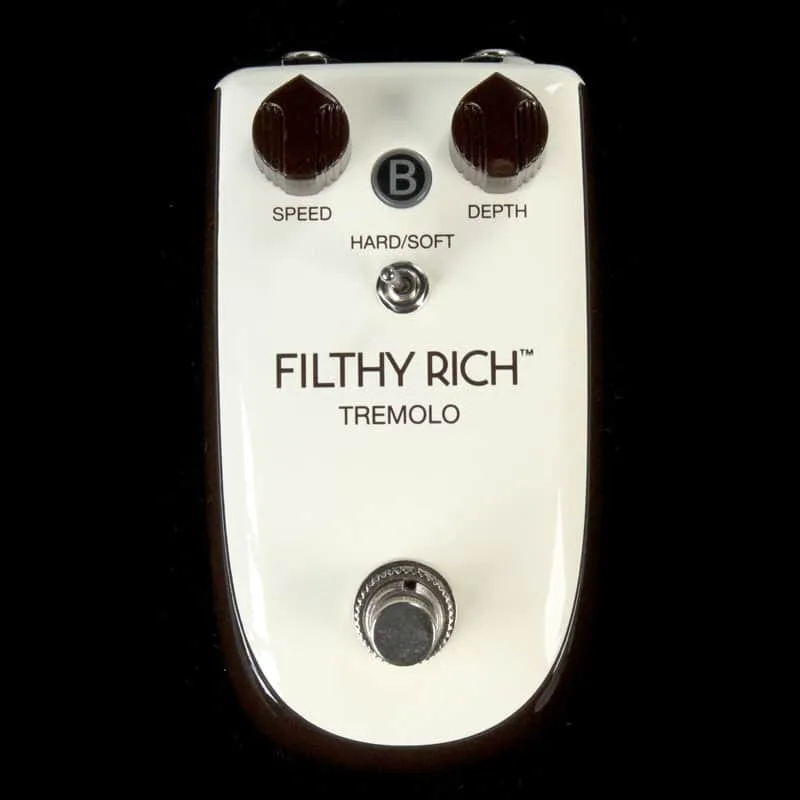
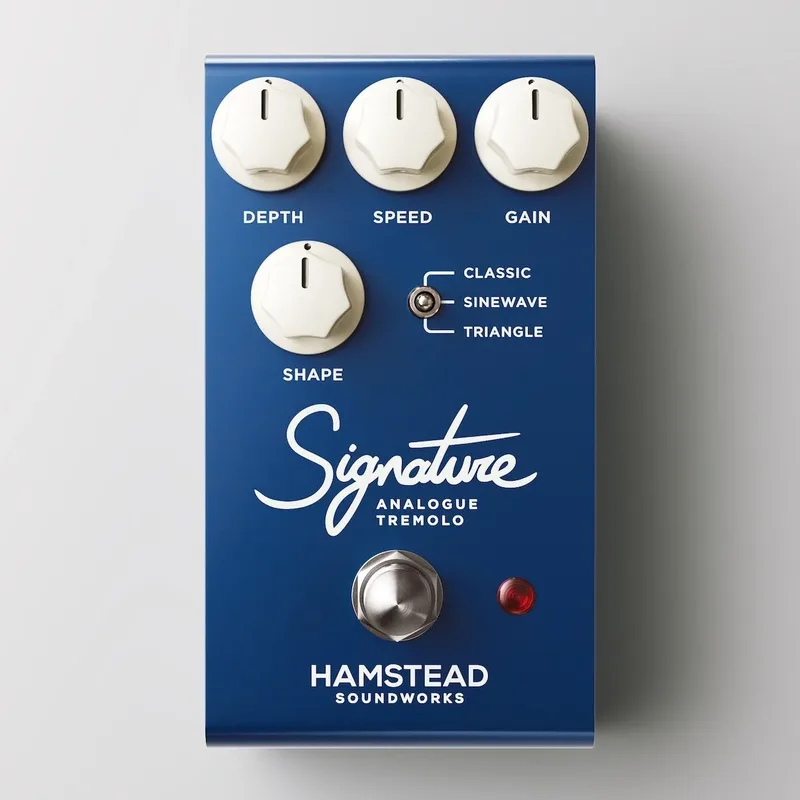
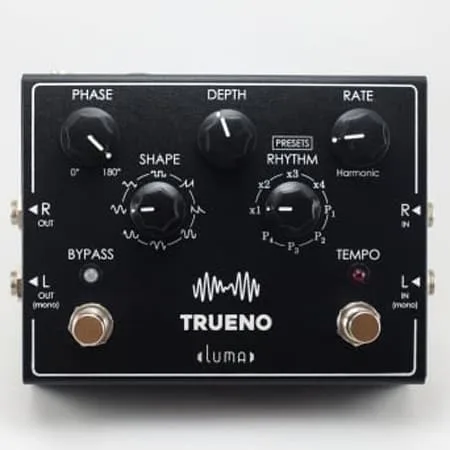
Recent releases show the effect still evolving. Hamstead Soundworks, better known for its overdrives, also put out a tremolo pedal some time ago31. The category spans a wide range of builders: Fredric Effects' West Germany Vintage Tremolo reworks a classic West German circuit, Flower Pedals offers the Dandelion Tremolo V2, and the Trueno Tremolo is the first pedal by Luma Sonido32. Danelectro, credited with inventing the amplifier tremolo of the 1940s, builds its Billionaire Filthy Rich Tremolo on that heritage32.
The usual controls
Most tremolo pedals share a small set of controls, with the differences being in how far each one goes.
| Control | What it does | Example |
|---|---|---|
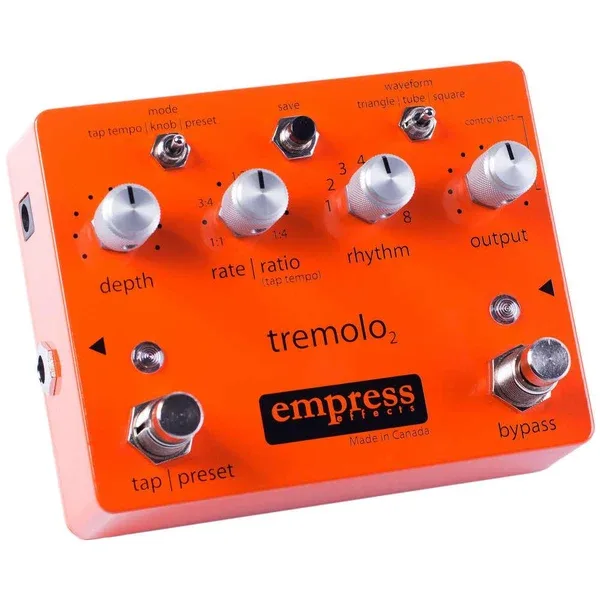
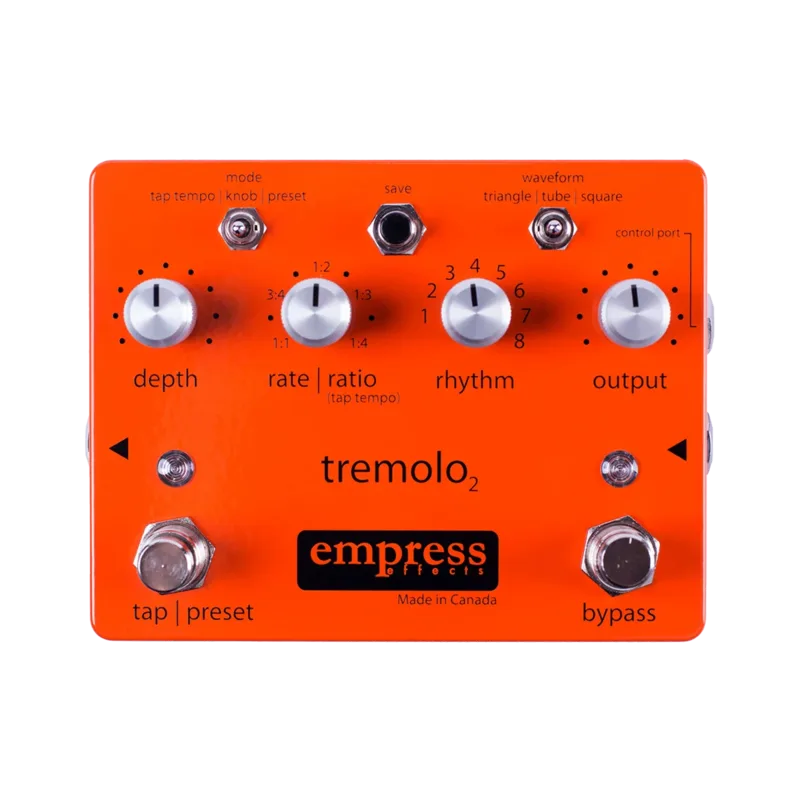
| Speed / Rate | Sets how fast the volume pulses | Voodoo Lab's SPEED control "controls the rate of the tremolo"9; de Lisle's Tube Tremolo Pedal has a speed control93334; MOOER's Triangolo includes "a classic speed control" for players who "like to set it and leave it"34 |
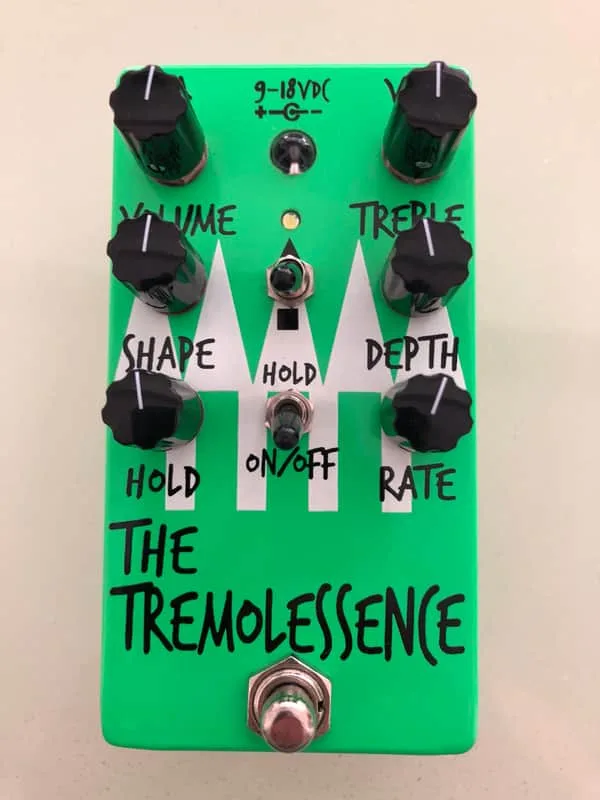
| Depth | Sets how far the volume drops, from a hint of motion to full chop | VFE Old School's DEPTH, turned fully counterclockwise, removes the tremolo and leaves "a great-sounding clean boost"26 |
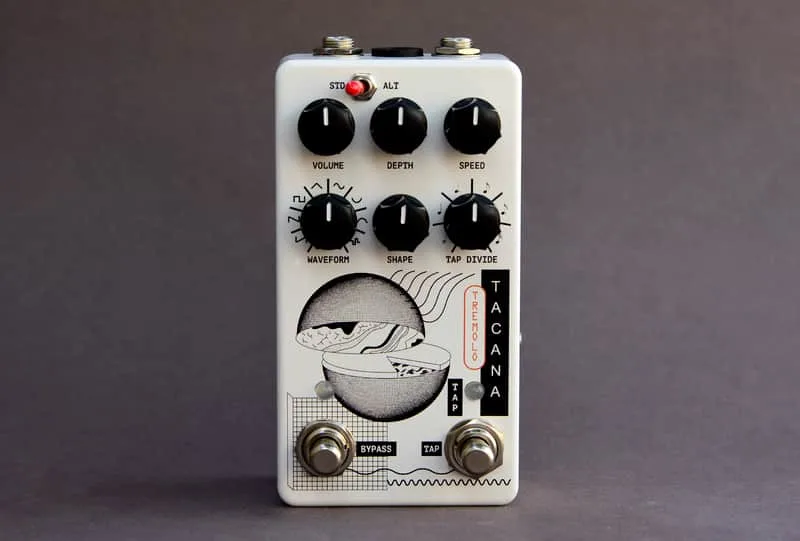
| Shape / Wave / Slope | Chooses the waveform or the character of the pulse | Voodoo Lab's Slope moves from soothing to machine-gun stutter9; UA Flow switches between sine, square and harmonic modes6 |
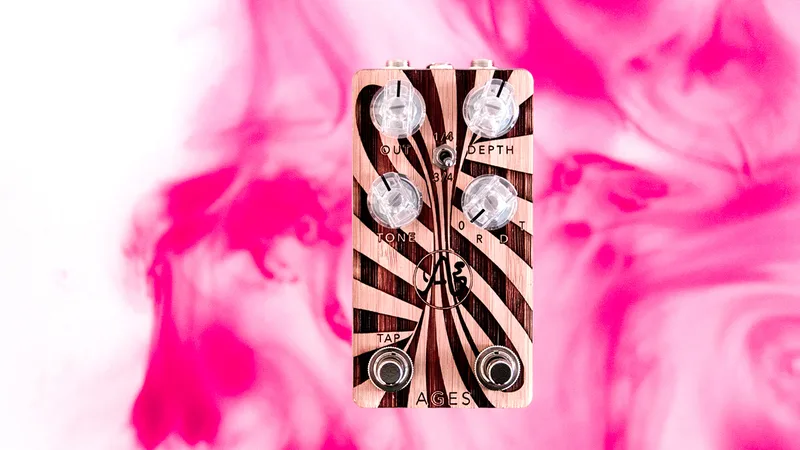
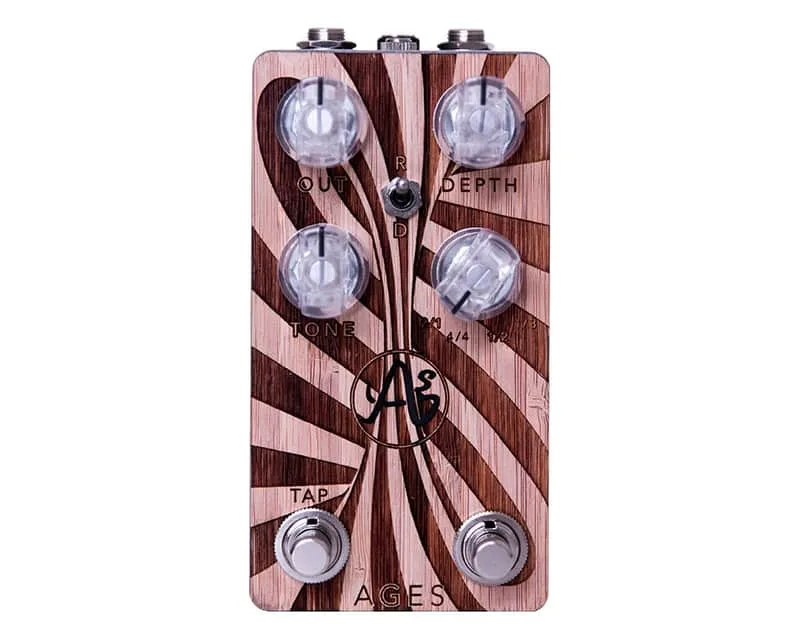
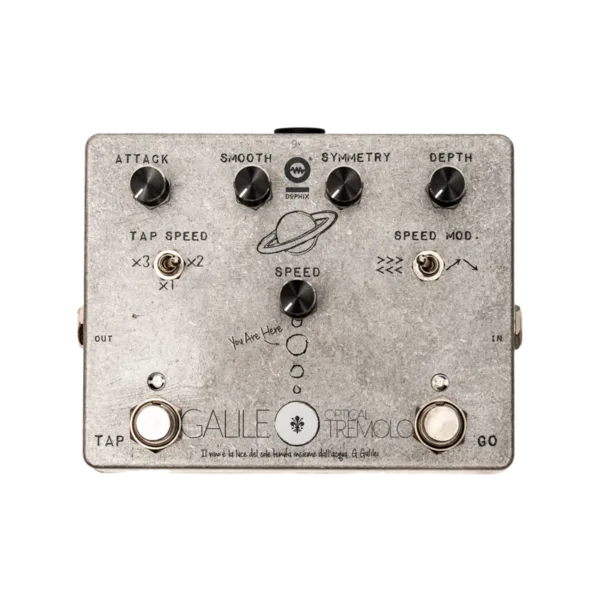
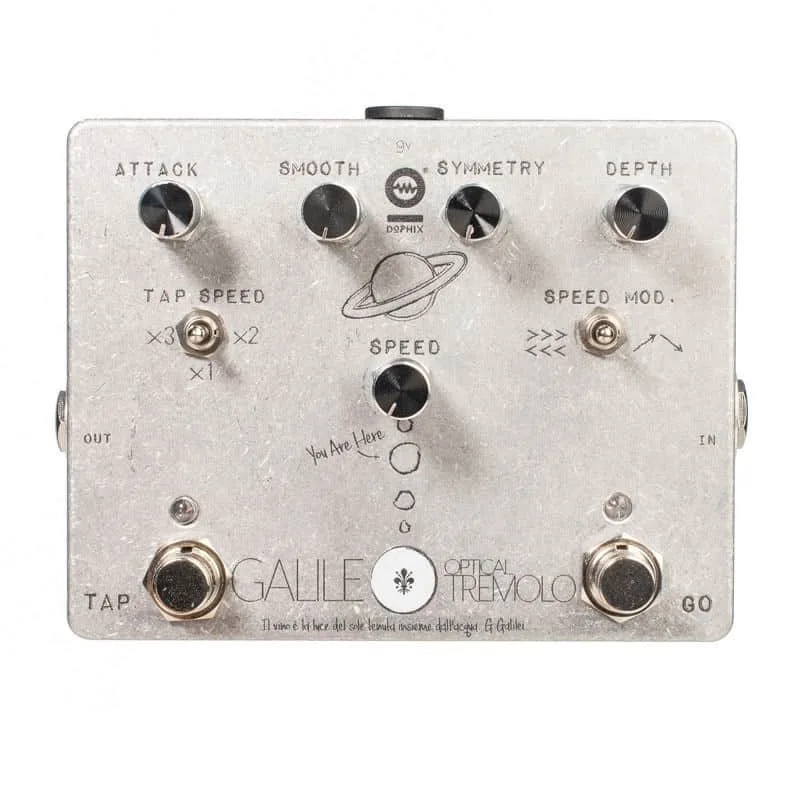
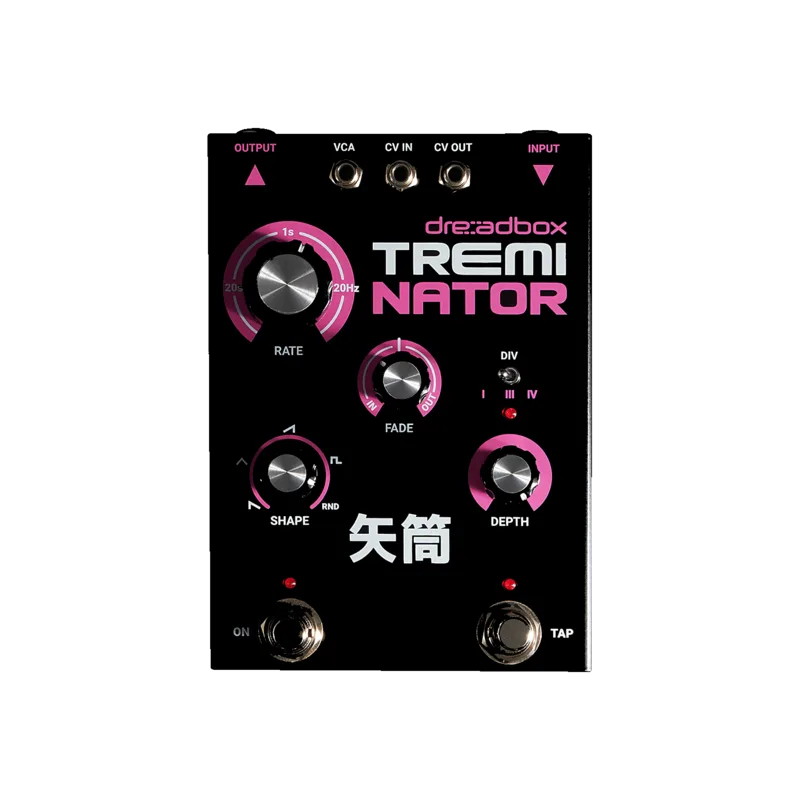
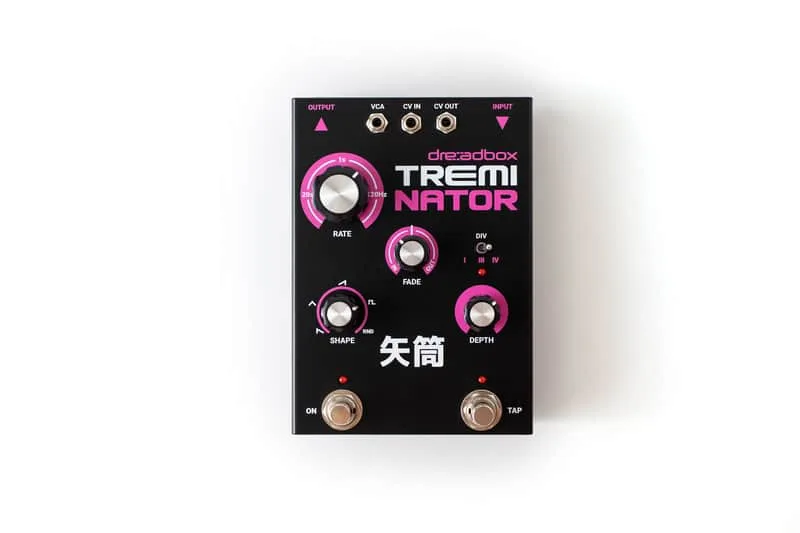
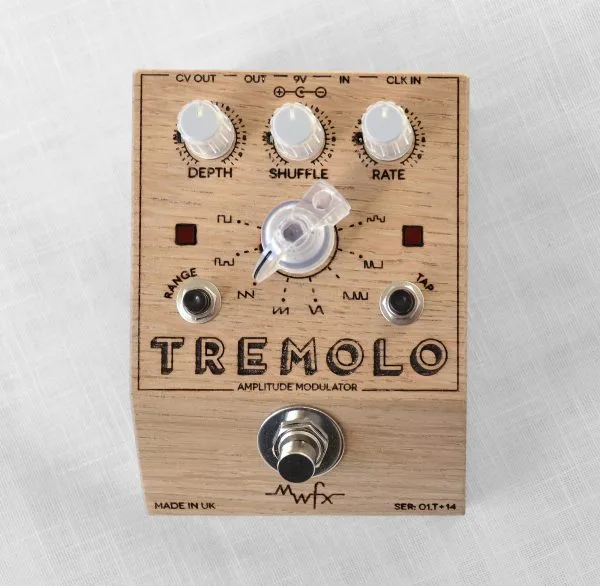
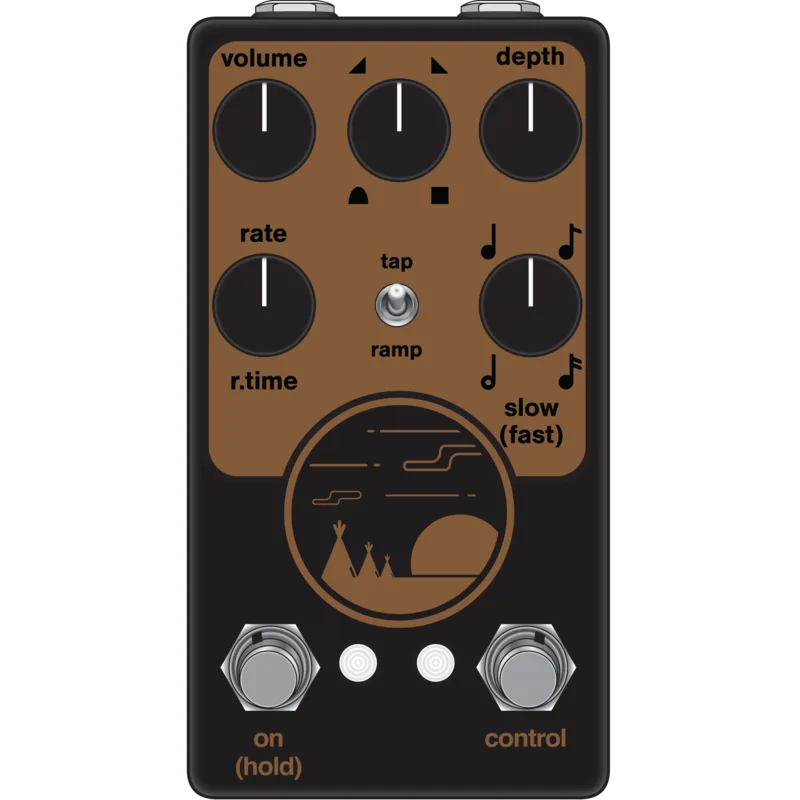
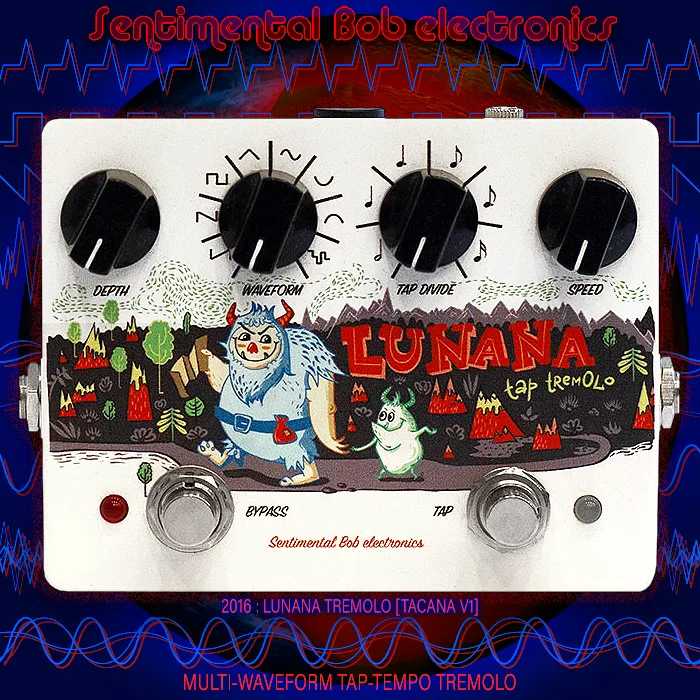
| Tap tempo | Sets the rate by tapping a footswitch in time | Anasounds Tremolo's built-in and external tap switches can work simultaneously35 |
Depth is the control that determines whether tremolo is a texture or an effect you hear from the back of the room. The VFE Old School manual's note about turning depth to zero is worth remembering: several tremolo pedals double as clean boosts when the effect is dialed out26. Expression pedal inputs, like the Anasounds Spinner pairing36, let you move speed or depth with your foot while playing, which suits the swell-style use the Tremolo Probe builds in by design11.
Placement in the signal chain and power
The conventional answer is that modulation, tremolo included, goes after your drive pedals. Boss's effects-order guide advises players to "accentuate a modulation effect by placing it after the drive section," while noting that positioning "is not set in stone"37. Mu-Tron gives the same guidance for its Tremu-Tron: "The TREMU-TRON pedal should be placed after overdrive and before reverb in the signal chain"23. That ordering, drives first, then tremolo, then time effects like delay and reverb, is the most common starting point.
The practical difference is audible. Tremolo before overdrive or distortion lets the drive pedal compress the pulses, giving a smoother, more amp-like result. Tremolo after drive makes each pulse distinct and hard-edged. Neither is wrong; Boss's own guide treats the whole question as flexible37. Volume pedals are a separate debate: Boss notes they are "popularly at the start of the chain, or with only reverb and delay after it"37, and a volume pedal placed after a tremolo will override its pulses when you turn down.
Power requirements vary by pedal and are worth checking on each product's page, since some tremolos are simple analog designs and others with tap tempo, stereo outputs and digital control draw more current.
Stereo tremolo and panning
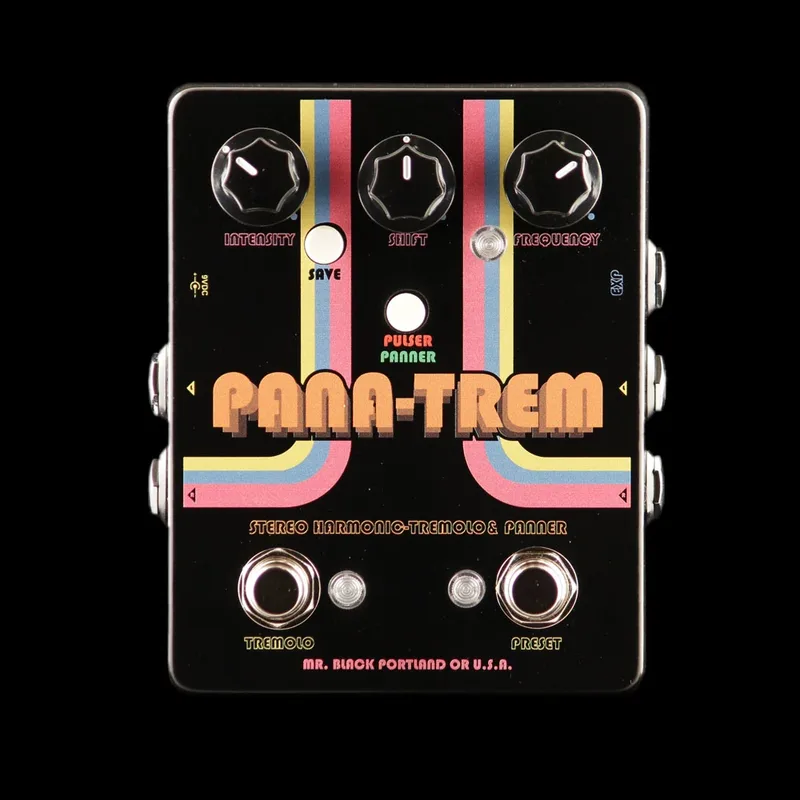
A stereo tremolo feeds two outputs. In simple stereo mode both outputs pulse together; in panning mode the volume shifts from one output to the other, so the sound moves between two amplifiers or the left and right of a stereo rig. Some pedals are built as stereo tremolos from the ground up rather than adapted from mono designs818, and others offer stereo harmonic and standard tremolo in the same box18. A TRS splitter cable is one common way a single output jack carries both channels20.
The panning format has its own modern lineage, and builders keep expanding the stereo tremolo and panner format with new features and patterns29. Tap tempo tremolos are also gaining stereo options, with some makers announcing that future versions will add the choice of full stereo tremolo or panning38.
Tap tempo and syncing
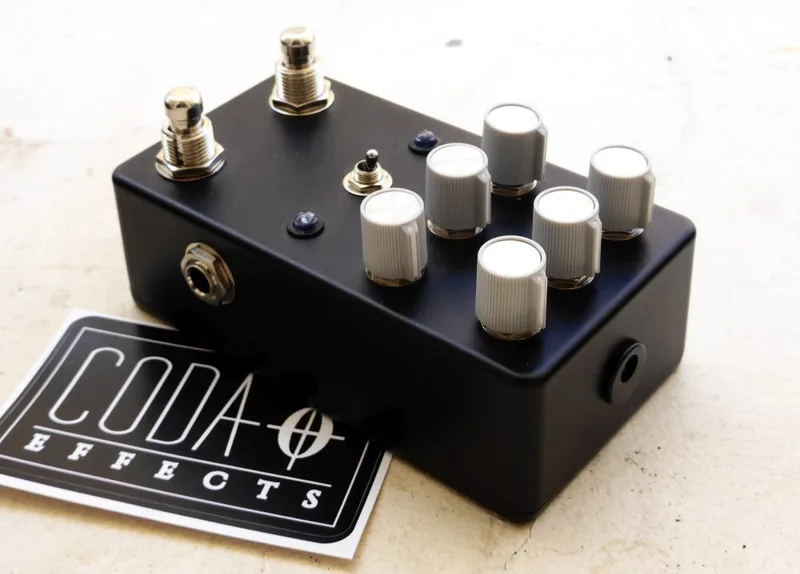
Tap tempo solves the basic problem of tremolo: a rate knob set by ear drifts out of time with the song. With a tap switch you set the pulse by tapping along with the music. Coda Effects' analysis of its Montagne tap tempo tremolo explains the mechanics: the tap is detected on a specific pin of the TAPLFO chip, which "calculates time between 2 activations and sets the rate accordingly, considering only the last two taps, no mean between several tapping"3. In practice that means your most recent two taps set the tempo, so a mid-song correction takes effect immediately.
External syncing is also common. The Anasounds Tremolo's external and built-in tap switches "can communicate and simultaneously control the pedal"35, and the same pedal hides a second trick: holding the tap footswitch for more than 500 ms with the pedal on sends the tremolo into self-oscillation feedback35. For players running multiple synchronized effects, the American Loopers Dual Tap Tempo is an external footswitch that will "tap tempo two of your favorite Strymon pedals at the same time"39. MIDI pedals and clock-input designs extend this further.
Tremolo combined with other effects
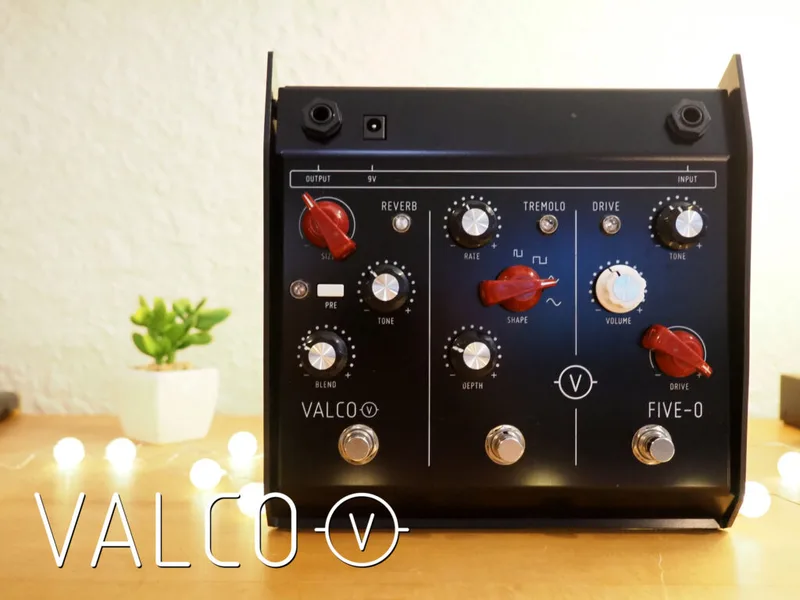
Tremolo shares a pedal with other effects often enough that combination pedals are their own category. The most common pairing is tremolo and reverb, a surf-music lineage2. Multi-effect pedals also fold tremolo in among their modes: the Wampler Terraform lists tremolo as one of its modes40. Other builders pair tremolo and reverb in a single box12, and the Gamechanger Audio LIGHT Pedal's trem mode can be applied to its spring output together with the optical signal or separately12. Reviewers have found combination pedals delivering classic sounds in both effects41.
Tremolo also appears alongside drive: the Mattoverse TremStortion is an analog optical tremolo "capable of producing anything from pristine clean to full-on" distortion14, and Carl Martin's Trem O' Vibe pairs tremolo with true vibrato15.
Questions to ask when choosing a tremolo
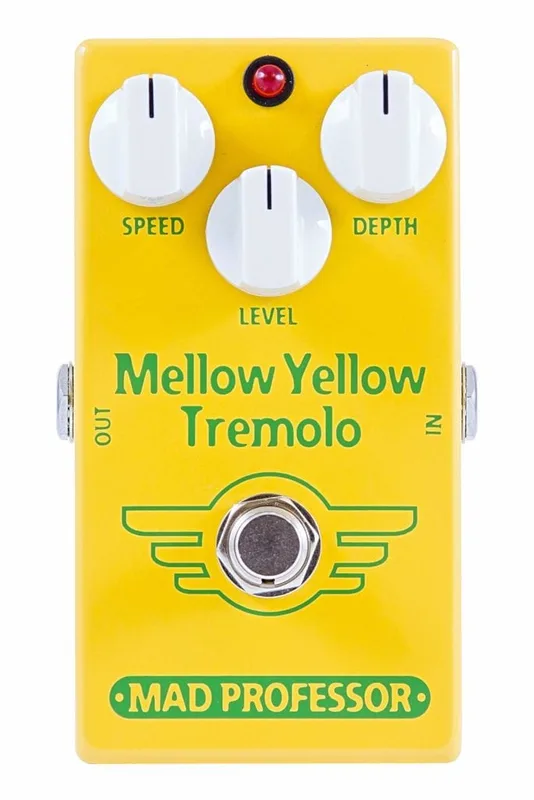
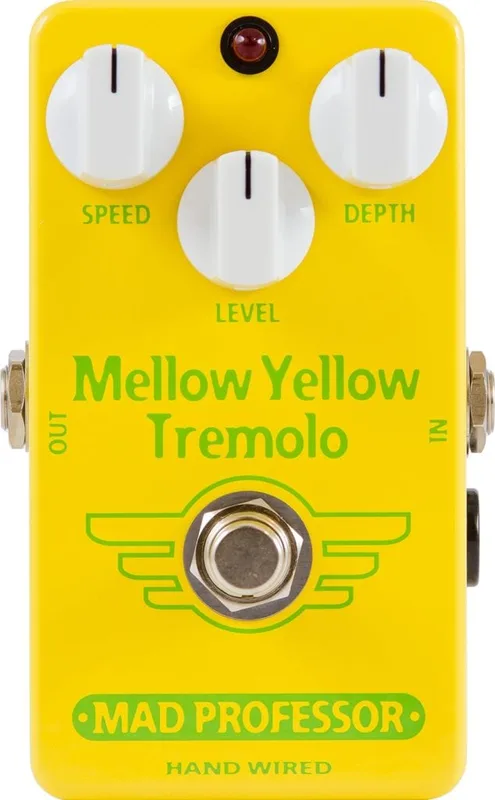
The range of tremolo pedals runs from three-knob vintage recreations to sequenced stereo machines, so the choice comes down to what you actually play.
- Do you want one sound or many? A simple analog optical pedal like the Master Effects or Big Joe units does one vintage-flavored thing2713; the Swindler Red Mountain and UA Flow pack multiple modes and features68.
- Standard or harmonic? If you want the classic pulse, standard tremolo is it; if you want the warbly brownface-amp sweep, look for a harmonic mode34.
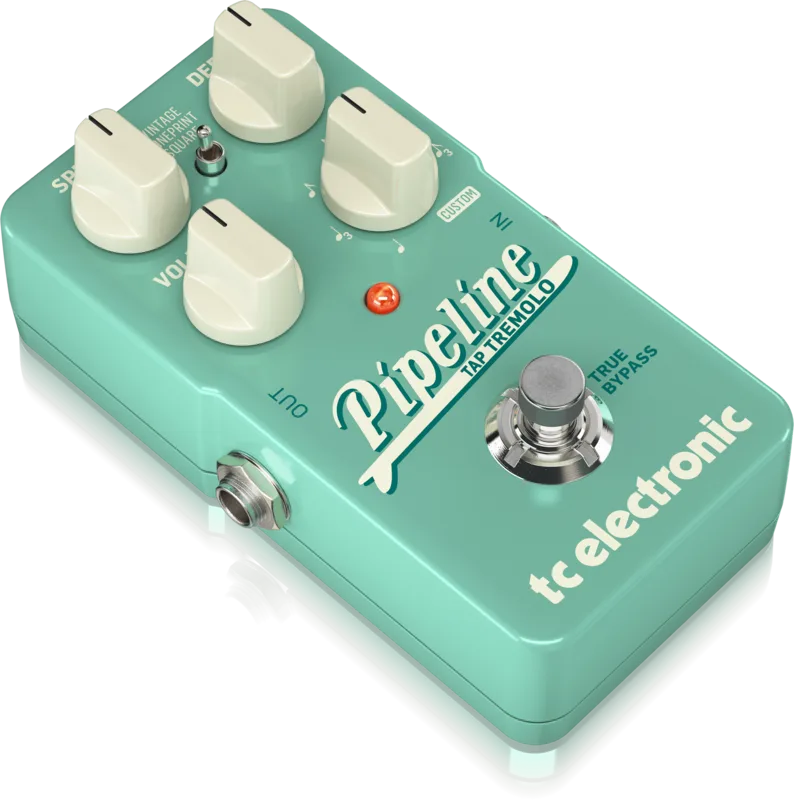
- Do you need tap tempo? If you play to a click or with a band, tap tempo keeps the pulse locked424344. If you set and forget, a speed knob is enough34.
- Mono or stereo? A single-output pedal covers most rigs; stereo and panning need two amps or a stereo playback system45.
- How much room on the board? Compact pedals like the Boss TR-2 and MOOER Triangolo trade features for space3416; feature-packed stereo units are larger.
- New or vintage circuit? Some makers reissue or rework specific vintage circuits, like Fredric Effects' take on the classic West German pedal25 and VFE's 1960s-derived Old School26.
Questions
Does a tremolo pedal go before or after other modulation pedals?
Most players put tremolo and other modulation after the drive section, so the effect stands out in the mix rather than being smeared by distortion. Boss's guidance says positioning is not set in stone, and Mu-Tron specifically recommends placing its Tremu-Tron after overdrive and before reverb. Experiment: tremolo before dirt gives a smoother, amp-like pulse, while tremolo after dirt sounds more pronounced and choppy.
What is the difference between tremolo and vibrato?
Tremolo changes volume; vibrato changes pitch. A tremolo pedal repeatedly raises and lowers the level of your signal in a rhythm, while a vibrato wobbles the pitch up and down. The two have been confused for decades because Fender labeled its amplifiers' tremolo circuits as vibrato, and the mix-up persists today. Pedals like the Carl Martin Trem O' Vibe offer both effects in one box with independent controls.
What is harmonic tremolo?
Harmonic tremolo splits your signal into bass and treble bands and alternately turns each one down, instead of lowering the whole volume at once. The result is a warbly, almost phase-like sweep rather than a straight pulse. It was first developed in Fender's brownface amplifiers, and modern pedals from Flower Pedals, JAM Pedals, Universal Audio and MXR recreate it.
Can a tremolo pedal sync to tap tempo?
Yes. Many tremolo pedals include a tap tempo footswitch so you can set the pulse rate in time with the music by tapping, and some accept an external tap switch or MIDI clock. The Anasounds Tremolo lets its built-in and external tap switches work together, and accessories like the American Loopers Dual Tap Tempo can sync two Strymon pedals from one switch.
Do any pedals combine tremolo and reverb?
Yes. The Strymon Flint pairs three amplifier-modeled tremolo types with reverb in one pedal, and Crazy Tube Circuits' White Whale Jr combines an amp-type tremolo with a three-spring reverb. Combining the two saves pedalboard space and suits surf and ambient styles, where a pulsing signal feeding a wash of reverb is a classic sound.
What does a stereo tremolo or panner do?
A stereo tremolo outputs the effect through two amplifiers or channels. In panning mode the volume shifts from one output to the other, so the sound appears to move left and right between your speakers. The MXR M305 does this with a TRS splitter cable, and pedals like the Demeter Stereo Tremulator and Swindler Effects Red Mountain are built as stereo tremolos from the ground up.
Sources (45)
- optical tremolo, Anasounds, 2026-03-26
- Flint Tremolo Pedal, Strymon (www.strymon.net), 2012-04-12
- Coda Effects, Coda Effects (www.coda-effects.com), 2016-05
- Dandelion Tremolo V2 by Flower Pedals, RockBoard PedalPedia, 2026
- Pedal Projects Undertow Tremolo, Pedal of the Day, 2015-05-23
- Flow Vintage Tremolo Pedal, Universal Audio (www.uaudio.com)
- STRM-1 Stereo Tremulator, Demeter Amplification
- Red Mountain by Swindler Effects, RockBoard PedalPedia, 2026
- Tremolo - Voodoo Lab, Voodoo Lab, 2026-10-14
- Lage Lund, JAM Pedals (www.jampedals.com)
- Tremolo Probe by ZVEX, RockBoard PedalPedia, 2026
- LIGHT PEDAL, Gamechanger Audio, 2026-09-23
- Master Effects Pedals, Master Effects Pedals
- Mattoverse AirTremTrashStortion, Mattoverse Electronics
- Trem O' Vibe, Carl Martin (carlmartin.com), 2026
- TR-2 Tremolo by BOSS, RockBoard PedalPedia, 2026
- T3 TREMOLO, OKKO FX
- Sunflower Deluxe Tremolo, Flower Pedals
- Harmonious Monk, JAM Pedals (jampedals.com)
- M305.pdf, Jim Dunlop, 2020
- Guitar Pedal X, Guitar Pedal X
- New Pedal: Over Under Pedals Ah, Tremendous Tremolo, Delicious Audio, 2026-10-02
- Tremu-Tron, Musitronics Mu-Tron
- Daniel Buettner Sonar, ZVEX Effects
- West Germany Vintage Tremolo, fredric.co.uk
- Microsoft Word, madbeanpedals.com, 2019
- R-409 TREMOLO (9V-18V), Big Joe Stomp Box Company
- Twin Trem by Jackson Audio, RockBoard PedalPedia, 2026
- Guitar Pedal X, Guitar Pedal X
- Tremoglo by Cmat Mods, RockBoard PedalPedia, 2026
- Hamstead Soundworks Signature Analogue Tremolo MKII review, guitarworld.com, 2021-02-10
- Best tremolo pedals 2026: vintage vibes to chopped tones, guitarworld.com, 2022-05-05
- de Lisle Tube Tremolo Pedal, de Lisle Guitar Co. (delisleguitar.com)
- Triangolo_MOOER Audio, MOOER Audio
- trémolo | Anasounds, Anasounds, 2021-03-24
- Spinner | Expression pedal | Kit version | Anasounds, Anasounds, 2026-04-04
- The Ultimate Guide to Guitar Effects Pedal Order and Signal Chain, BOSS (articles.boss.info), 2023-03-01
- Dark Waves Tap Tempo Tremolo Pedal, Vein-Tap.com, 2026-09-01
- American Loopers Dual Tap Tempo for Strymon Timeline, Mobius, American Loopers
- Wampler Pedals Terraform Multi Modulation, pedal-of-the-day.com, 2019-12-21
- Source Audio Pathways review: “between the worlds of modernity and tradition”, guitar.com
- Tap, external tap tempo, Anasounds, 2024-04-18
- TC Electronics Pipeline Tap Tremolo pedal, gearnews.com, 2017-06-09
- Thorn Soundlabs Flex Series pedals review, Guitar World, 2026-08-29
- TONEHOME, TONEHOME